Construction Cost Index Q1 2026: Reading the PPI, RSMeans, and Mortenson Signals Together
Quick Answer: What Does the Q1 2026 Construction Cost Index Show?
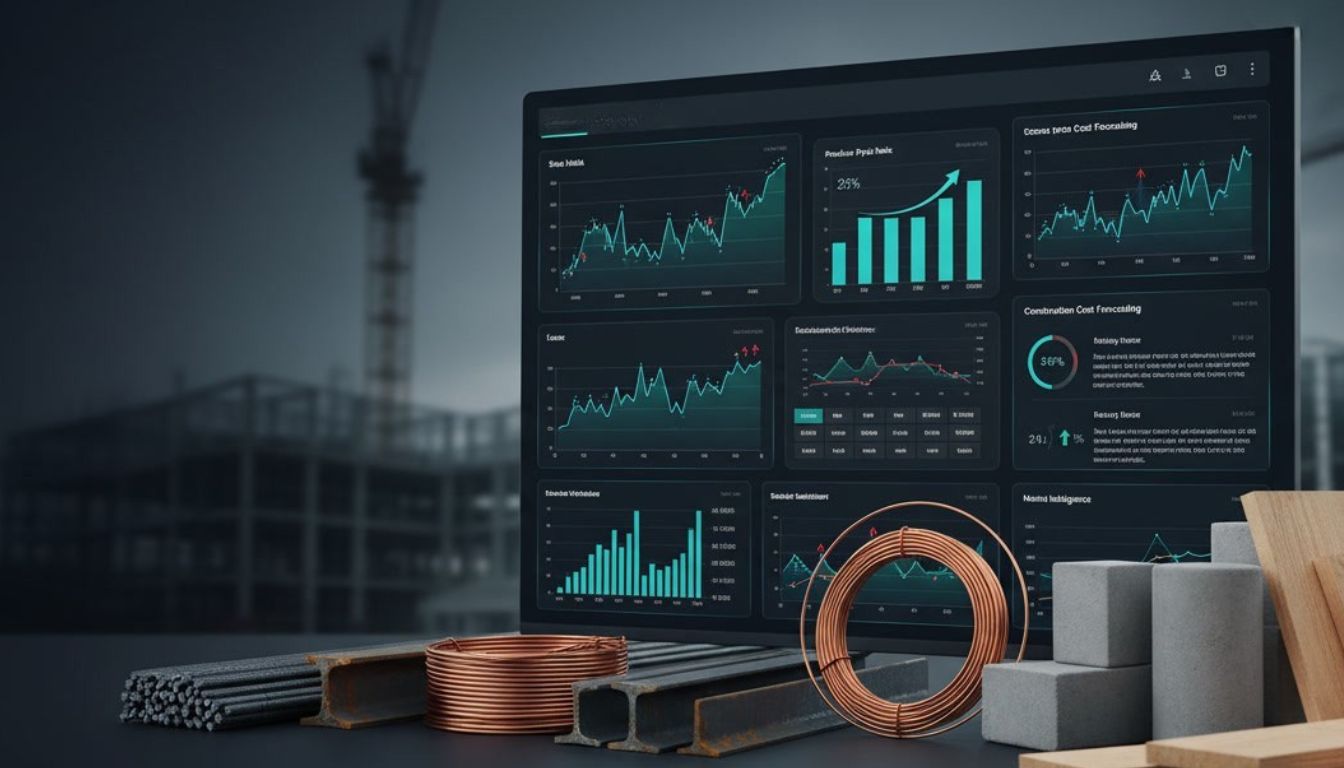
The Q1 2026 construction cost picture is not a single number. It is a combination of three signals:
- PPI shows input-price pressure. Construction materials PPI moved higher through Q1 2026, suggesting that upstream material costs were rising again.
- RSMeans/Gordian shows mixed material behavior. Some materials softened from late 2025 into Q1 2026, while other categories, especially certain non-metal materials and labor-related costs, remained under pressure.
- Mortenson shows real project-cost escalation. Mortenson’s construction cost index showed continued nonresidential cost increases entering 2026, with regional variation and persistent pressure in metals, labor, and MEP systems.
For estimators, the takeaway is simple:
Do not use one index to update a bid. Use PPI for material direction, RSMeans for line-item cost benchmarking, and Mortenson for whole-project escalation context.
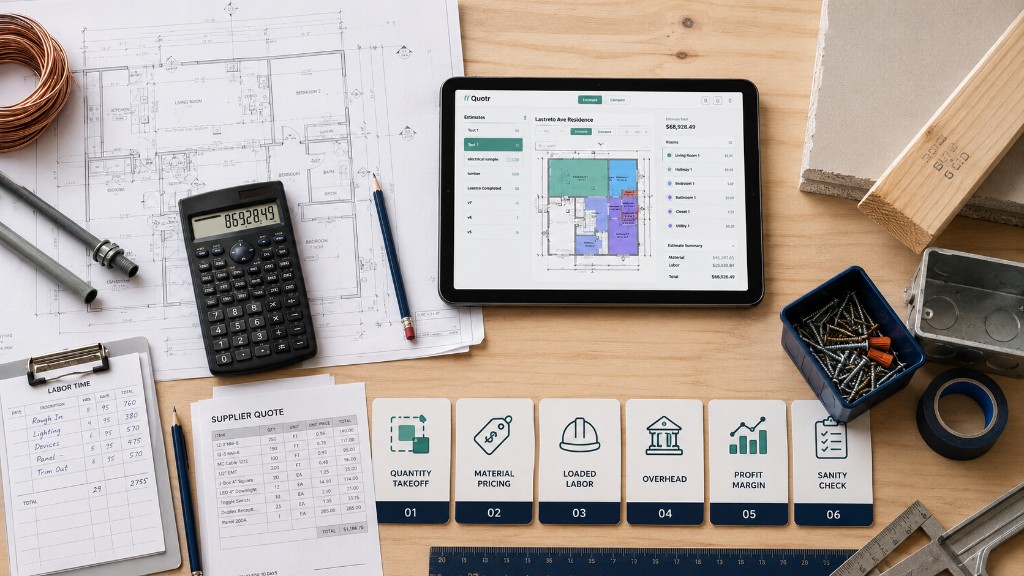
That is especially important when turning drawings into priced estimates. For a broader workflow, see Quotr.ai’s guide on AI construction estimating software and the blueprint to priced estimate workflow.
Why Construction Cost Indexes Matter in 2026
Construction costs are still difficult to forecast because the market is being shaped by several overlapping forces:
- Material volatility
- Labor availability
- Wage pressure
- Tariffs
- Energy prices
- Long-lead electrical equipment
- Regional demand differences
- Data center and advanced manufacturing activity
- Interest rates
- Owner budget sensitivity
- Procurement timing
A single index rarely captures all of that.
A contractor estimating a commercial project in Q1 2026 needs to answer several questions:
- Are material prices rising or falling?
- Which trades are moving fastest?
- Is labor becoming a bigger share of total cost?
- Are suppliers holding quotes for less time?
- Should procurement happen earlier?
- Should escalation be carried in the bid?
- Are national indexes matching local market reality?
- Are line-item prices changing faster than the overall project index?
That is why PPI, RSMeans, and Mortenson should be read together.
What Is the Construction Cost Index?
A construction cost index is a benchmark that tracks how construction costs change over time. But not all indexes measure the same thing.
Some indexes track:
- Material input prices
- Labor costs
- Installed construction costs
- Whole-building costs
- Regional project costs
- Trade-specific costs
- Commodity movements
- Equipment costs
This is where estimators often get confused.
The phrase “construction cost index” can refer to different datasets with different purposes. A PPI input index is not the same thing as a contractor’s installed cost. A national cost book is not the same thing as a local subcontractor quote. A regional project index is not the same thing as a material-only commodity trend.
A good estimate uses each index for the right purpose.
PPI vs RSMeans vs Mortenson: What Each One Tells You
| Source | What It Is Best For | What It Does Not Fully Capture |
|---|---|---|
| PPI | Direction of producer/input prices | Final installed cost, labor productivity, contractor margin, local bid climate |
| RSMeans/Gordian | Line-item estimating benchmarks and material/labor/equipment cost trends | Every local quote, every project-specific condition, every subcontractor strategy |
| Mortenson | Regional nonresidential project-cost escalation | Every individual trade detail or national commodity movement |
Each source answers a different question.
1. PPI: What Producer Prices Say About Construction Inputs
The Producer Price Index, or PPI, measures average changes in selling prices received by domestic producers. For construction, estimators often look at PPI series related to construction materials, goods, and inputs.
In Q1 2026, construction materials PPI moved upward. The FRED series for the BLS construction materials PPI showed:
| Month | Construction Materials PPI |
|---|---|
| December 2025 | 344.679 |
| January 2026 | 347.906 |
| February 2026 | 352.484 |
| March 2026 | 355.106 |
| April 2026 | 359.743 |
From December 2025 to March 2026, the construction materials PPI increased by roughly 3.0%.
That matters because PPI can signal upstream cost pressure before it fully shows up in subcontractor quotes or project budgets.
But PPI has limitations. PPI does not automatically equal the final cost paid by an owner or contractor. It may not include:
- Subcontractor margin
- Labor productivity
- Installation complexity
- Local availability
- Freight and storage
- General conditions
- Procurement risk
- Schedule compression
- Bid competition
- Regional market premiums
In other words, PPI is useful for direction, not final bid pricing.
For a practical estimating workflow, see Quotr.ai’s article on how AI construction estimating works.
2. RSMeans/Gordian: What Line-Item Cost Data Says About Q1 2026
RSMeans data, published by Gordian, is widely used for estimating material, labor, and equipment costs. For Q1 2026, Gordian’s construction cost insights pointed to a mixed market.
The key signal was not “everything is up” or “everything is down.” It was more nuanced:
- Some core materials, including lumber and steel, softened from Q4 2025 to Q1 2026.
- Certain non-metal materials, including insulation, showed strong year-over-year increases.
- Labor costs became a larger share of total construction cost than at any time in the previous four years.
- Supply, demand, and global disruptions continued to affect material volatility.
- Procurement strategy remained important because lead times and quote validity could change quickly.
For estimators, RSMeans is valuable because it is closer to line-item estimating than a broad inflation index.
It helps answer questions like:
- What should this assembly cost?
- How are material, labor, and equipment components changing?
- Which trades need updated unit pricing?
- Are historical unit costs still usable?
- Should a cost database be refreshed before bidding?
This matters for contractors who are still relying on old spreadsheets. For more on that issue, see Quotr.ai vs Excel and Quotr.ai vs traditional estimating.
3. Mortenson: What Whole-Project Escalation Says Entering 2026
Mortenson’s Construction Cost Index tracks the cost of a representative nonresidential construction project across multiple U.S. markets.
The most important Mortenson signal entering 2026 was continued escalation, but with moderation in some areas.
Mortenson reported that Q4 2025 national nonresidential construction costs increased 1.05% quarter-over-quarter and 7.35% year-over-year. Regional increases varied, with some markets showing more modest quarterly gains and others experiencing stronger cost pressure.
Mortenson also highlighted continued pressure from:
- Metals
- Tariffs
- Electrical and power-distribution lead times
- Mechanical and electrical systems
- Structural steel
- Labor
- Regional demand differences
This matters because Mortenson is closer to a real project-cost view than a raw material index.
Where PPI may show input pressure and RSMeans may show line-item movement, Mortenson helps owners and contractors understand what is happening to the total cost of a nonresidential project in a real market.
For developers and owners, this connects directly to Quotr.ai’s article on the pro forma that never stops changing and real estate pro forma software comparison.
How to Read the Three Signals Together
The right way to read Q1 2026 construction cost data is to separate the signals.
PPI answers: Are input prices moving?
PPI is useful when you want to understand whether upstream material prices are rising, falling, or stabilizing.
Use PPI for:
- Material trend direction
- Inflation risk
- Escalation assumptions
- Commodity-sensitive trades
- Early warning signals
Do not use PPI alone to price a project.
RSMeans answers: Are line-item costs changing?
RSMeans is useful when you want to update assemblies, labor units, and estimate templates.
Use RSMeans for:
- Unit-cost benchmarking
- Material/labor/equipment breakdowns
- Historical comparison
- Conceptual estimates
- Early budgets
- Estimate validation
Do not assume RSMeans replaces local subcontractor quotes.
Mortenson answers: Are project costs escalating in real markets?
Mortenson is useful when you want to understand overall nonresidential cost escalation and regional pressure.
Use Mortenson for:
- Owner budget updates
- Regional escalation assumptions
- Project-level cost trend context
- Market comparison
- Early-stage feasibility
- Risk conversations with owners
Do not use Mortenson alone to price specific assemblies.
Q1 2026 Construction Cost Signal Matrix
| Question | Best Signal | Why |
|---|---|---|
| Are material inputs rising? | PPI | Tracks producer/input-price movement |
| Are specific assemblies changing? | RSMeans | Provides line-item cost data |
| Are whole-project costs escalating? | Mortenson | Tracks representative nonresidential project costs |
| Should I update my bid template? | RSMeans + PPI | Combines unit pricing with market direction |
| Should I carry escalation? | PPI + Mortenson | Shows both input movement and project-cost escalation |
| Should I procure early? | RSMeans + Mortenson | Highlights material volatility and project-level risk |
| Are local costs different from national costs? | Mortenson + local quotes | Captures regional variation |
| Can I use last year’s estimate? | No | Q1 2026 signals show continued movement |
What Q1 2026 Means for Contractors
For contractors, Q1 2026 cost signals point to one main conclusion:
Old estimates are risky.
Even if some materials softened, the market is not stable enough to reuse old pricing without review. Contractors should update estimates for:
- Material escalation
- Labor rates
- Supplier quote validity
- Subcontractor availability
- MEP equipment lead times
- Steel and metal exposure
- Insulation and envelope materials
- Freight and delivery
- Tariff-sensitive products
- Regional bid competition
A contractor bidding from outdated unit costs may look competitive on bid day but lose margin during procurement.
That is exactly why AI-assisted estimating matters. Quotr.ai helps teams move from drawings to updated quantities faster, so estimators have more time to validate pricing and scope instead of manually rebuilding takeoffs.
For related workflows, see:
- How to bid commercial construction projects as a subcontractor
- Construction estimating mistakes to avoid
- How to price a construction job
What Q1 2026 Means for Developers and Owners
For developers and owners, the Q1 2026 cost index picture creates a different challenge.
The issue is not only whether construction costs are rising. The issue is whether budgets, pro formas, and procurement assumptions are being updated quickly enough.
Developers should review:
- Hard cost assumptions
- Escalation allowances
- Contingency
- Procurement schedules
- Bid package timing
- Long-lead equipment exposure
- Tenant improvement allowances
- Value engineering options
- Regional labor conditions
- Financing sensitivity
If the budget was created using older pricing, it may not reflect current market risk.
This is especially important for commercial real estate, multifamily, industrial, healthcare, data centers, and advanced manufacturing projects where equipment, electrical, steel, and labor can move quickly.
For owner-side estimating workflows, see Quotr.ai’s article on underwriting-grade estimates in 72 hours.
What Q1 2026 Means for Estimators
Estimators should treat Q1 2026 as a “refresh your assumptions” quarter.
That means:
- Update cost databases.
- Recheck supplier quotes.
- Separate material escalation by trade.
- Review labor productivity.
- Confirm quote validity periods.
- Track regional market conditions.
- Flag long-lead items.
- Compare the current plan set to prior versions.
- Document exclusions and escalation assumptions.
- Avoid using old bid tabs without adjustment.
The best estimating teams will not simply ask, “What is the construction cost index?”
They will ask:
- Which index applies to this trade?
- Which costs are material-driven?
- Which costs are labor-driven?
- Which scopes are exposed to long-lead risk?
- Which numbers are national averages?
- Which numbers need local validation?
- Which assumptions changed since the last estimate?
That is where Quotr.ai helps. By reading construction drawings, extracting scope, and helping teams ask questions against the plan set, Quotr.ai gives estimators more time to focus on pricing strategy.
See also:
- AI that reads construction drawings
- How to do construction takeoff from a PDF blueprint
- Construction takeoff guide
Why One Construction Cost Index Is Not Enough
Using one index can create bad decisions.
For example:
- PPI may show material pressure, but a local trade may be hungry and bid aggressively.
- RSMeans may show a unit cost, but a specific project may have access, phasing, or schedule issues.
- Mortenson may show regional escalation, but one trade package may be moving much faster than the overall index.
- A national index may hide local labor shortages.
- A material index may ignore installation complexity.
- A whole-project index may hide commodity volatility.
This is why construction cost intelligence should be layered.
A better approach:
- Use PPI to understand material direction.
- Use RSMeans to refresh unit-cost assumptions.
- Use Mortenson to understand regional project escalation.
- Use local subcontractor quotes to validate bid reality.
- Use Quotr.ai to keep drawings, quantities, and estimate assumptions connected.
How Quotr.ai Helps Teams React Faster to Cost Movement
Cost indexes are useful, but they do not build estimates by themselves.
The hard part is connecting cost signals to the actual scope in the drawings.
Quotr.ai helps preconstruction teams:
- Read construction drawings
- Extract quantities from plan sets
- Ask questions about blueprints in plain English
- Compare drawing revisions
- Identify scope changes
- Move from takeoff to pricing faster
- Support contractor and developer estimating workflows
- Reduce manual plan review time
- Help teams respond faster when cost assumptions change
For example, if material costs move after a drawing revision, the estimator needs to know:
- Which scopes changed?
- Which quantities changed?
- Which alternates are affected?
- Which materials are most exposed?
- Which bid packages need repricing?
- Which owner budget assumptions are now stale?
That is the gap between cost-index awareness and real estimating execution.
Quotr.ai helps close that gap.
Practical Q1 2026 Estimating Checklist
Use this checklist when updating estimates with Q1 2026 cost-index signals.
Cost Index Review
- PPI construction materials reviewed
- RSMeans/Gordian cost trends reviewed
- Mortenson regional cost index reviewed
- Local subcontractor quote trends reviewed
- Material volatility flagged
- Labor assumptions updated
- Escalation assumptions documented
Drawing and Scope Review
- Latest plan set confirmed
- Addenda reviewed
- Drawing revisions compared
- Quantities updated
- Long-lead scopes identified
- Alternates reviewed
- Exclusions updated
- Owner assumptions checked
Pricing Review
- Material quotes refreshed
- Labor rates updated
- Supplier validity periods checked
- Freight and delivery included
- Tariff-sensitive items reviewed
- MEP equipment lead times checked
- Steel and metals reviewed
- Insulation and envelope pricing reviewed
- Contingency reviewed
- Escalation allowance reviewed
Bid Strategy Review
- Quote expiration dates documented
- Procurement risks listed
- Subcontractor coverage checked
- Regional market conditions considered
- VE options prepared
- Owner budget impact summarized
- Final estimate reviewed against latest cost signals
Common Mistakes When Reading Construction Cost Indexes
Mistake 1: Treating PPI as a Final Installed Cost
PPI is a producer-price signal. It does not fully capture labor, installation, margin, access, productivity, or local bid conditions.
Mistake 2: Using RSMeans Without Local Validation
RSMeans is useful for benchmarking and cost planning, but contractors should still validate against current local supplier and subcontractor quotes.
Mistake 3: Applying a National Index to Every Trade
Different trades move at different speeds. Steel, electrical, HVAC, drywall, concrete, and finishes may not follow the same cost pattern.
Mistake 4: Ignoring Regional Differences
A national average may not match local market conditions. Labor availability, project volume, and subcontractor competition vary by region.
Mistake 5: Reusing Old Estimates
In a volatile market, a prior estimate can become stale quickly. Drawings, quantities, materials, labor, and escalation assumptions all need review.
Mistake 6: Forgetting Procurement Timing
The cost risk is not only today’s price. It is whether the project can buy materials before the quote expires or before prices move again.
Mistake 7: Separating Cost Data From Drawings
Cost indexes only become useful when tied back to actual project scope. That means quantities, assemblies, bid packages, and drawings need to stay connected.
FAQ: Construction Cost Index Q1 2026
What is the construction cost index for Q1 2026?
There is no single universal construction cost index for Q1 2026. Different sources track different parts of the market. PPI tracks producer/input prices, RSMeans tracks line-item cost data, and Mortenson tracks representative nonresidential project costs across regions.
What did PPI show for construction costs in Q1 2026?
Construction materials PPI increased through Q1 2026, indicating renewed input-price pressure. PPI is useful for understanding material direction, but it should not be treated as a final installed construction cost.
What did RSMeans show in Q1 2026?
RSMeans/Gordian showed a mixed cost environment in Q1 2026. Some materials softened from Q4 2025 to Q1 2026, while other categories remained volatile. Labor also became a larger share of total construction cost.
What did Mortenson show entering 2026?
Mortenson showed continued nonresidential construction cost escalation entering 2026, with regional variation and ongoing pressure from metals, tariffs, labor, electrical systems, and power-distribution lead times.
Should contractors use PPI, RSMeans, or Mortenson for estimating?
Contractors should use all three for different purposes. PPI helps track input-price direction, RSMeans helps benchmark line-item costs, and Mortenson helps understand regional whole-project escalation. Final estimates should still be validated with current local quotes.
Why do construction cost indexes disagree?
Construction cost indexes disagree because they measure different things. Some track material inputs, some track line-item costs, and some track total project escalation. They also differ by geography, timing, methodology, and cost category.
How should estimators use construction cost indexes in 2026?
Estimators should use cost indexes to refresh assumptions, identify escalation risk, validate unit costs, and explain market movement to owners. Indexes should support the estimate, not replace project-specific takeoff, supplier quotes, and subcontractor pricing.
Final Thoughts
The Q1 2026 construction cost index story is not about one number.
It is about reading the signals together.
PPI shows that construction material input pressure moved higher through Q1. RSMeans/Gordian shows a mixed market where some materials softened but labor and certain categories remained under pressure. Mortenson shows continued nonresidential project-cost escalation entering 2026, with regional differences and persistent pressure in metals, MEP systems, tariffs, and labor.
For contractors, developers, and estimators, the lesson is clear:
Cost indexes should not be read in isolation. They should be connected to drawings, quantities, procurement, and bid strategy.
That is where Quotr.ai fits.
Quotr.ai helps teams move from construction drawings to quantities and estimate workflows faster, so they can spend less time manually reading plans and more time making pricing decisions in a changing cost environment.