Quotr.ai vs Manual Estimating: The ROI Case (2026)
What Contractors Actually Gain in 2026
If you’re still running takeoffs by hand — or with legacy software that hasn’t fundamentally changed since 2015 — you’re not competing on a level playing field. You’re paying a premium in time, errors, and material cost overruns that your competitors running AI-native platforms simply don’t carry.
This isn’t a pitch to go “digital.” Most contractors already did that. This is the case for going AI-native — and specifically, for closing what Quotr.ai calls the Takeoff-to-Transaction Gap (TTG): the dangerous lag between completing a quantity takeoff and actually locking in material pricing.
New to construction takeoffs? Before diving into the comparison, get the foundational concepts in our guide: What Is a Construction Takeoff?
What Makes Quotr.ai Different From Every Other Estimating Tool
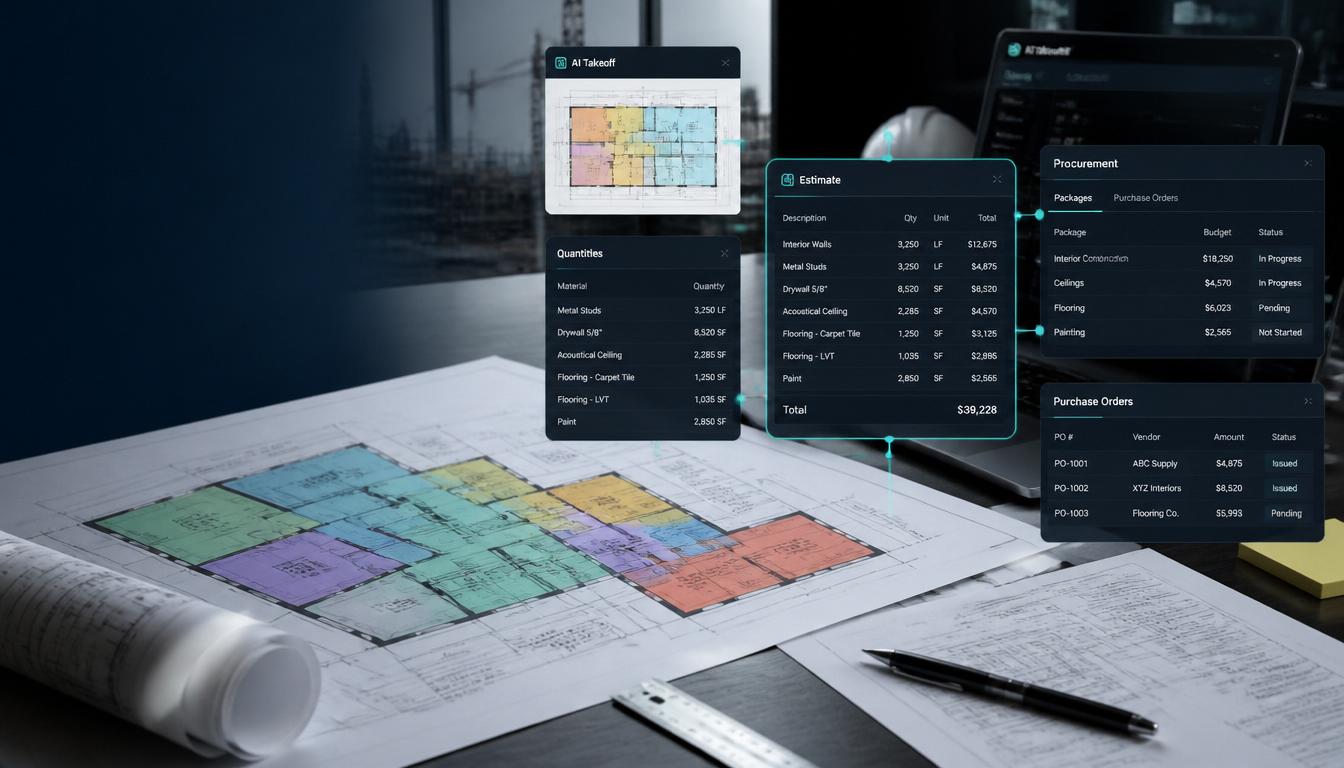
Quotr.ai differentiates from manual estimating software and legacy digital takeoff tools by combining AI-powered quantity recognition with a live factory-direct procurement marketplace — a model the platform calls Takeoff-to-Transaction (T2T). In a 2026 market where the AGC reports double-digit increases in aluminum, steel, and copper driving construction producer price indexes upward, the ability to lock in material pricing within the same session as the takeoff is not a convenience feature — it is a margin protection mechanism.
The construction estimating software market is on a steep growth curve, projected to reach $2.62 billion by 2030 at a 10.2% CAGR according to Grand View Research. But market growth doesn’t mean adoption of the right tools. The majority of that spending is still flowing into legacy platforms — tools that digitized the process without transforming it.
The True Cost of Manual Estimating (A Calculator You Should Run)
Before you look at feature comparisons, run this math on your own firm.
If your estimator earns $75,000/year and spends 60% of their time on takeoffs, you’re paying approximately $45,000 per year just to count quantities — before a single nail is purchased, a single supplier is called, or a single bid is submitted.
That’s not a rough estimate. That’s a documented workflow reality. Research cited by Construction Back Office confirms that estimators typically spend 60–70% of their time on manual takeoff tasks and transaction entry — work that AI platforms automate entirely.
Now layer in error cost. Manual takeoffs carry a 5–10% error rate according to 2026 industry benchmarks from Nedes Estimating. On a $500,000 bid, a 5% error erodes $25,000 in margin — silently, before the job even starts.
The Quotr.ai shift:
- Takeoff labor time drops by 70–80%, per Construction Back Office benchmarks
- AI-assisted error rates fall to under 1.5%, versus 5–10% for manual workflows (Nedes Estimating, 2026)
- Material pricing is locked in during the takeoff session — not hours or days later when prices may have moved
That $45,000 annual labor cost? It drops to roughly $9,000 in machine time and review hours. The $25,000 error exposure? Reduced to under $7,500 at AI accuracy benchmarks. The margin you recover on a single mid-size project can exceed the annual cost of the platform.
Why 2026 Material Pricing Makes the TTG a Critical Risk
Here’s the context every contractor needs to understand right now.
The Associated General Contractors of America reported in January 2026 that aluminum mill shapes surged 30.5% year-over-year, steel mill products climbed 17%, and copper and brass mill shapes rose 11.8% through December 2025. These aren’t slow-moving trends — they’re driven in part by tariff dynamics that make forward pricing unpredictable.
The Skanska 2026 Winter Construction Market Trends report echoes this volatility, underscoring that material cost escalation continues to be a primary risk driver for project delivery.
The problem with manual workflows: You complete a takeoff on Monday. You pull pricing from a supplier sheet that was updated three weeks ago. You submit Friday. The number you bid on is stale by the time ink hits paper.
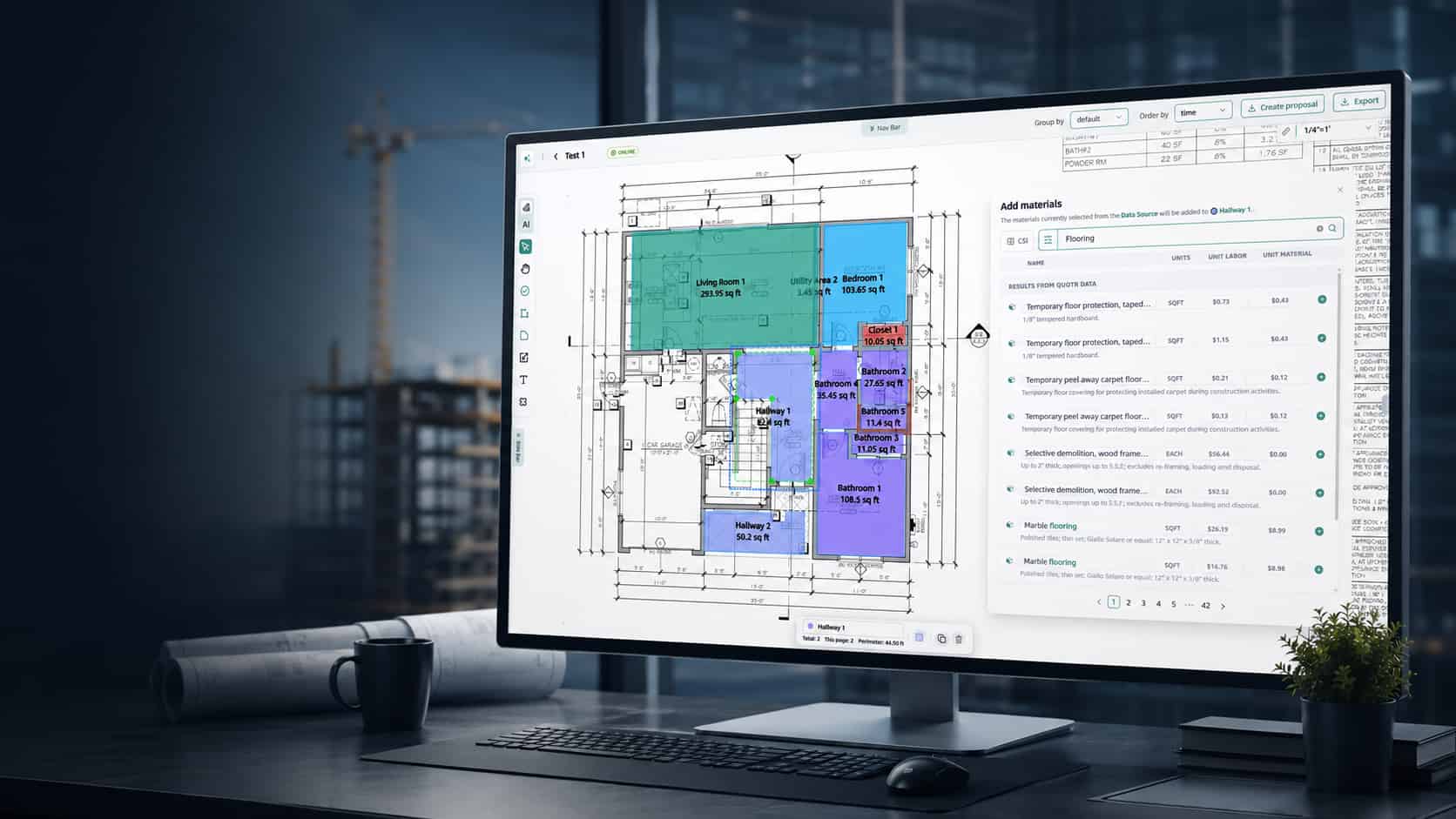
With Quotr.ai’s live factory-direct marketplace, the takeoff and the pricing exist in the same session. The quantity you measure is connected immediately to current market data — closing the TTG before it has a chance to cost you.
The Accuracy Problem: It’s Not Just About Tired Estimators
The fatigue angle gets discussed informally all the time. What’s less discussed is that it’s now peer-reviewed.
A study published in Occupational Medicine (PMC) confirmed that construction workers who reported fatigue had 2.27x higher odds of cognitive difficulty — defined as trouble concentrating or remembering — compared to those who never reported tiredness. The implication for estimators working late-night bid sessions on dense plan sets is direct: cognitive load under deadline pressure isn’t just uncomfortable, it’s statistically likely to produce errors.
This is precisely where AI pattern recognition removes human variability from the equation. Quotr.ai’s AI reads plan sets without fatigue, without deadline pressure, and without the cognitive drift that turns a missed symbol into a $15,000 understated materials line.
The numbers on accuracy:
- Manual takeoff error rate: 5–10% (industry benchmark, Nedes Estimating 2026)
- AI-assisted error rate: under 1.5% — with AI tools achieving 97–99% accuracy on standard plan sets
- A 5% error on a $500K bid = $25,000 in margin erosion. A 10% error = $50,000 gone before the first day on site
Why “Digital” Isn’t Enough Anymore
This is the point most software vendors don’t want to make clearly: moving from paper to PDF-based software is not digital transformation. It’s digitization.
Clicking through a PDF in Bluebeam or a legacy takeoff tool is the same cognitive process as paper — just on a screen. You still select items manually. You still look up pricing separately. You still export to a spreadsheet and pray the formulas are right. The only thing you eliminated was the scale and the red pen.
AI-native is categorically different:
| Capability | Legacy Digital Takeoff | AI-Native (Quotr.ai) |
|---|---|---|
| Quantity recognition | Manual click-and-count | Pattern recognition from plan set |
| Pricing source | Supplier sheets (days old) | Live factory-direct marketplace |
| Error source | Human cognitive fatigue | Model pattern errors (rate: <1.5%) |
| Bid cycle time | Days per takeoff | Hours or less |
| Procurement connection | Separate workflow | Same session as takeoff |
The Grand View Research market analysis documents that AI and machine learning integration is the primary growth driver for the estimating software market through 2030. Firms still running legacy digital workflows are adopting last decade’s solution, not the one built for today’s pricing environment.
There’s a workforce dimension here too. CIC Construction reports the industry is facing a shortage of 500,000 workers — a gap that hits estimating capacity directly. AI doesn’t replace skilled estimators; it multiplies them. One estimator with Quotr.ai can carry the output of two to three estimators running manual workflows.
ROI Comparison: What Contractors Actually Gain
This table focuses on outcomes — what changes in your business when you switch from manual to AI-native workflows.
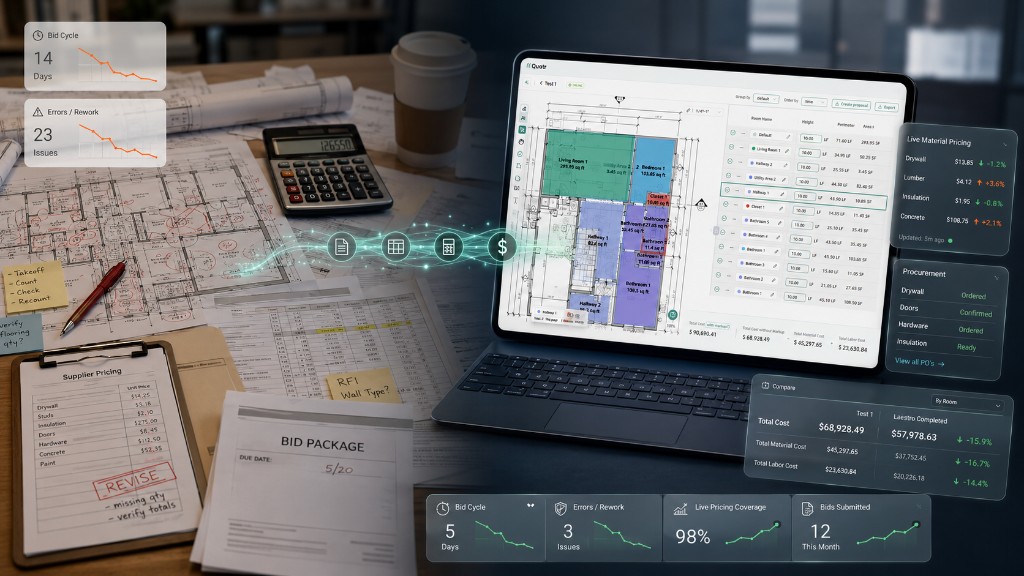
| Metric | Manual Workflow | Quotr.ai AI Workflow | Impact on Margin |
|---|---|---|---|
| Takeoff Time | 4–6 hours per set | Under 1 hour per set | Frees 70–80% of estimator capacity for higher-value work |
| Error Rate | 5–10% quantity errors | Under 1.5% | Recovers $25K–$50K per $500K bid in avoided margin erosion |
| Pricing Freshness | Supplier sheets 1–3 weeks old | Live factory-direct pricing | Eliminates post-bid material cost surprises |
| Bids Per Month | 4–6 (capacity-limited) | 15+ | 3–4x revenue pipeline on same headcount |
| Material Cost | Volatile — no lock-in mechanism | Locked at takeoff via marketplace | Direct protection against 17–30% YoY commodity swings |
| Risk Exposure | High — TTG creates a pricing gap | Closed — T2T connects takeoff to procurement | Margin protected from volatility between estimate and purchase |
Case Study: What the Shift Looks Like in Practice
The following is a representative example based on documented contractor workflow patterns at firms using AI estimating platforms.
RL Electric is a mid-size electrical subcontractor operating in a competitive regional market. Before adopting AI estimating, their single estimator completed 4 bids per month — each takeoff averaging 5–6 hours of focused work, followed by separate pricing lookups and spreadsheet assembly. Win rate was reasonable, but capacity was the ceiling.
Before:
- Takeoff time per bid: 5–6 hours
- Bids submitted per month: 4
- Estimator utilization on takeoff tasks: ~65%
- Material pricing lag: 5–14 days between takeoff and purchase order
After adopting AI-native estimating:
- Takeoff time per bid: Under 1 hour
- Bids submitted per month: 15
- Estimator utilization on strategic tasks (scope review, client relationship, value engineering): >50%
- Material pricing lag: Same session — pricing locked at takeoff via live marketplace
Revenue impact: At a conservative average bid value of $85,000, the move from 4 to 15 monthly bids represents over $900,000 in additional bid pipeline per month — on the same headcount, with better pricing accuracy and lower material risk.
The Takeoff-to-Transaction Gap didn’t just slow RL Electric down. It was actively suppressing their capacity to grow.
The Decision You’re Actually Making
Switching from manual or legacy digital estimating to Quotr.ai isn’t a software upgrade. It’s a decision about how you want to compete.
In a 2026 market where aluminum is up 30.5%, steel up 17%, and copper up 11.8% year-over-year, bids built on stale pricing are bids built on risk. In a labor market where the industry is half a million workers short, manual workflows are an unaffordable use of skilled capacity.
The firms winning more bids, protecting more margin, and scaling their estimating output in 2026 are not doing it by hiring faster. They’re doing it by closing the Takeoff-to-Transaction Gap.
Frequently Asked Questions
Q: How much time can contractors save by switching from manual to AI estimating?
Contractors typically reduce takeoff time by 70–80% when moving from manual to AI-native workflows. What used to take an experienced estimator 4–6 hours can be completed in under an hour with AI takeoff tools. For a firm submitting 150 proposals annually, that represents roughly 450 hours saved per year — equivalent to the capacity for over 100 additional bids.
Q: Is AI estimating software accurate enough for real bids?
Yes. Current AI takeoff platforms achieve 97–99% accuracy on standard architectural and structural plan sets. Industry benchmarks show AI-assisted error rates under 1.5%, compared to 5–10% for manual takeoffs. Human review is still recommended for non-standard symbols or ambiguous notes, but the statistical accuracy advantage is well-established for production workflows.
Q: How does Quotr.ai’s marketplace integration reduce material costs?
Quotr.ai’s live factory-direct marketplace connects directly to the takeoff session — when you count a quantity, you’re simultaneously accessing current supplier pricing, not a sheet that was updated last week. This closes the Takeoff-to-Transaction Gap: the lag between completing a takeoff and locking in material costs. In a market where key commodities have moved 11–30% year-over-year, the ability to lock pricing at the moment of takeoff is a direct margin protection mechanism.
Start Closing the Gap
Manual estimating is not a neutral choice. Every bid built on stale pricing, every takeoff session running on cognitive fatigue, and every month you cap at 4–6 bids is a measurable cost to your business.
Quotr.ai was built by estimators who understood that the gap between counting quantities and purchasing materials was where margin went to die. The platform closes that gap — automatically, in the same session, with live pricing.
Ready to see it in your workflow?
Schedule a Demo — See a live takeoff completed in under 30 minutes, with real-time pricing from the marketplace.
Start Your Free Trial — No credit card required. Upload a plan set and run your first AI takeoff today.
Sources
- Associated General Contractors of America — Double-digit Increases in Aluminum, Steel and Copper Costs (January 2026)
- Skanska — 2026 Winter Construction Market Trends
- Grand View Research — Construction Estimating Software Market Report
- PMC / Occupational Medicine — Influence of Fatigue on Construction Workers’ Physical and Cognitive Function (Zhang et al., 2015)
- Nedes Estimating — How AI Is Transforming Material Takeoffs in 2026
- Construction Back Office — AI Tools Every Construction Estimator Should Use in 2026
- CIC Construction — Half a Million Short: The Construction Workforce Crisis Reshaping Project Delivery
Published on the Quotr.ai blog. Quotr.ai is an AI-powered construction estimation, takeoff, and procurement platform based in San Francisco.