12 Construction Estimating Mistakes to Avoid in 2026 | Quotr.ai
In 2026, most construction bids aren’t lost because of high labor rates or expensive materials. They are lost in the “translation” between the blueprints and the final proposal.
At Quotr.ai, we spend our time looking at the “Pre-Construction Gap”—the space where quantities get miscounted, spreadsheets get broken, and margins disappear before the ground is even broken. After auditing thousands of digital bid sheets, we’ve identified a recurring pattern of 12 mistakes that cost contractors work.
Here is the 2026 checklist to ensure your workflow isn’t sabotaging your bids.
1. The “Copy-Paste” Transcription Risk
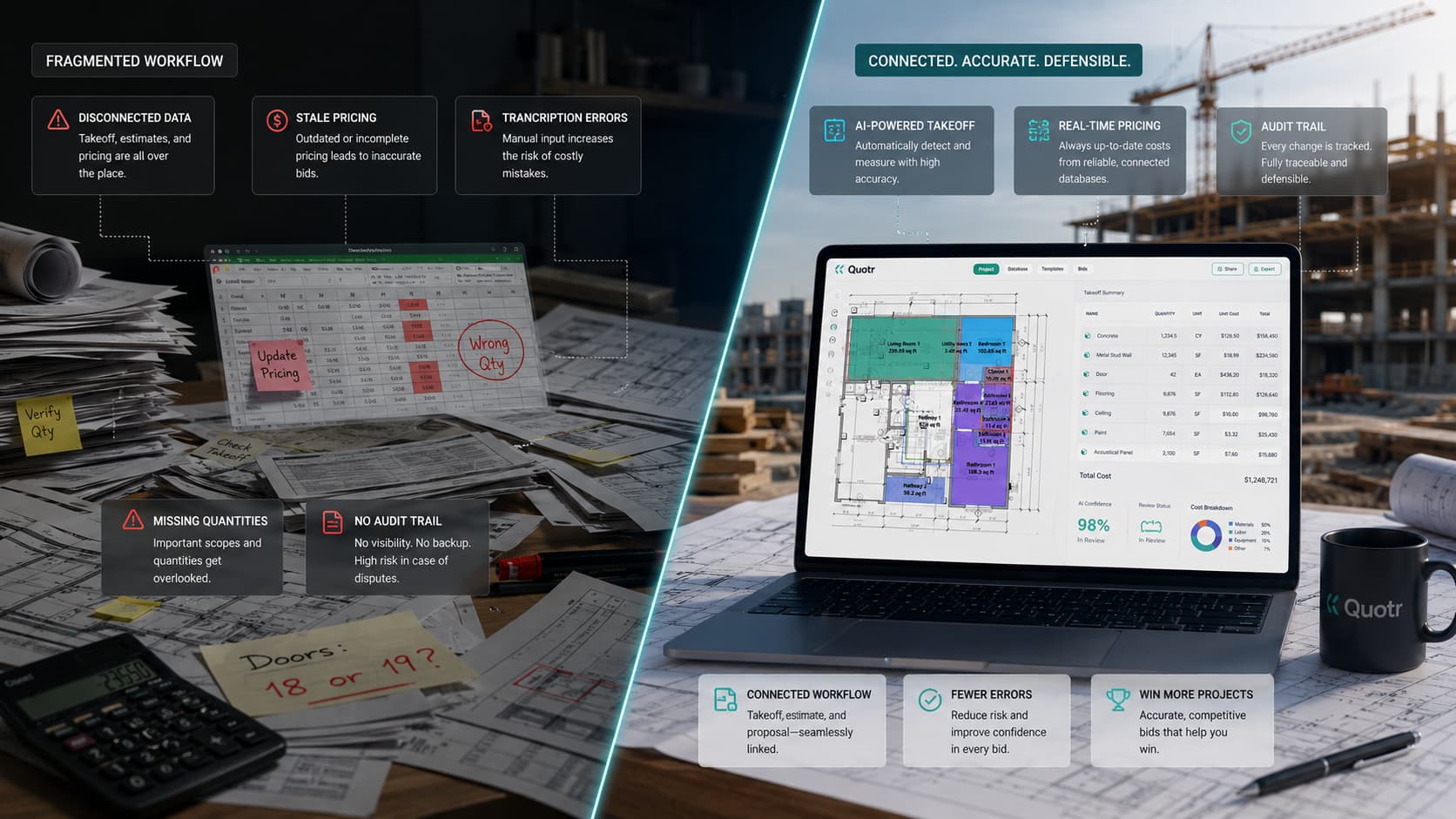
Many estimators still run a takeoff in one software and then manually type those totals into a separate Excel estimate. Every time a number is re-keyed, there is a 5–10% chance of a transcription error.
- The Fix: Use a Unified Workflow. Your takeoff and your estimate should be dynamically linked. If a quantity changes on the plan, it should update in the bid automatically.
2. Using Static “Library” Pricing in a Volatile Market
A “Master Price List” created six months ago is a liability in 2026. Relying on static internal libraries rather than live market data leads to bids that are either too high to win or too low to be profitable.
- The Fix: Connect your estimate to live procurement feeds. At Quotr.ai, we emphasize pulling factory-direct pricing into the bid in real-time to close the Takeoff-to-Transaction Gap.
3. The “Broad Brush” Waste Factor
Applying a flat 10% waste factor across the entire project ignores the reality of the trade. Flooring, drywall, and MEP all have different scrap rates based on the floor plate complexity.
- The Fix: Apply Trade-Specific Waste. Modern AI tools can analyze the “perimeter-to-area” ratio of a room to suggest a more accurate waste percentage than a blanket guess.
4. Lack of “Visual Proof” for Counts
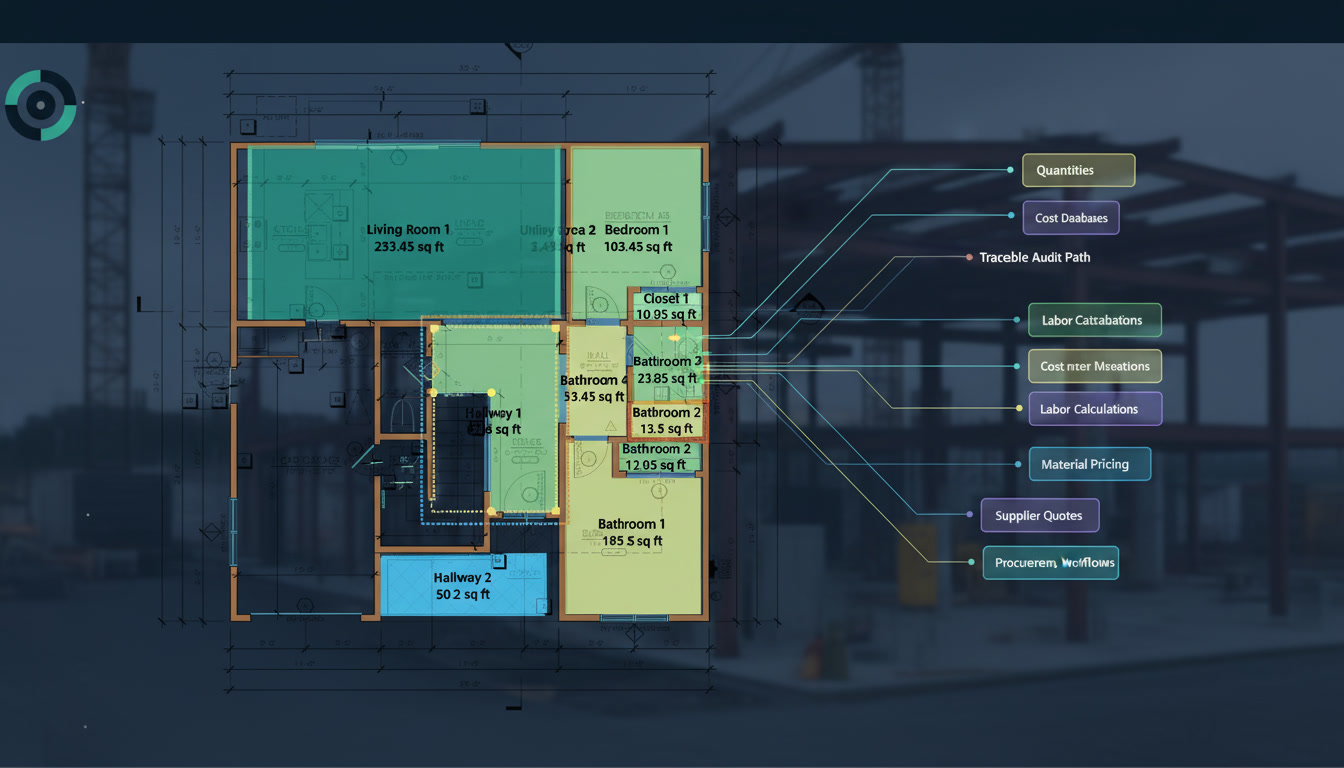
When a GC asks for a breakdown of your quantities, saying “it’s in the spreadsheet” isn’t enough. If you can’t show exactly where those 200 valves are located on the plan, you lose the “Trust Moat.”
- The Fix: Always maintain an Auditable Takeoff. Every line item in your bid should be a “clickable” link that takes you directly to the highlighted symbol on the plan set.
5. Estimating for “Perfect” Productivity
Estimators often price labor based on how a crew performs on a clear site. They forget to account for “congestion taxes”—the slowdown that happens when three other trades are working in the same hallway.
- The Fix: Include a Congestion Variable. If the schedule looks crowded, adjust your labor productivity down by 15% immediately to protect your margin.
6. The “Thursday Night” Accuracy Drop
The most dangerous time for an estimate is 48 hours before the deadline. This is when human fatigue leads to missed exclusions and rounded numbers that eat profit.
- The Fix: Automate the “Heavy Lifting.” Use AI construction takeoff software to handle the repetitive counting early in the week, so your brain is fresh for the high-stakes risk review at the end of the week.
7. Ignoring the Spec Book “Gotchas”
A takeoff counts what is drawn; the estimate must account for what is written. Relying only on the drawings while ignoring the 300-page spec book is how you end up owning a premium finish you didn’t price.
- The Fix: Use a Unified Document Viewer. Your software should allow you to search the specs and the drawings simultaneously to find contradictions before you submit.
8. Miscalculating “General Conditions” on Small Jobs
Contractors often think small jobs don’t require mobilization or site management fees. They do. Over time, these “small” unpriced costs add up to a significant annual loss.
- The Fix: Standardize your Overhead Recovery. Even if a job is only $5,000, your template should force a line item for general conditions.
9. Pricing for the “Average” Crew
Not every crew moves at the same speed. Pricing a job for your “A-Team” when they are already booked on another project means you’re bidding a loss-leader with your “C-Team.”
- The Fix: Bid based on Current Capacity. Check your resource schedule before setting your labor rates for a specific bid window.
10. Failing to Account for Scale Discrepancies
Bidding off a PDF that has “mixed scales” (e.g., 1/4” and 1/8” on the same page) is a common cause of massive linear-foot errors in manual takeoffs.
- The Fix: Utilize Auto-Scaling AI. Use tools like Quotr.ai that detect scale callouts automatically to prevent measurement disasters.
11. Bidding Without “Exclusions” Clarity
Winning a bid is great—until you realize the GC expected you to handle the dumpster fees you didn’t exclude. Vague proposals lead to “Scope Creep.”
- The Fix: Generate Automated Proposals. Use a system where your estimate automatically builds your “Exclusions and Clarifications” list based on the items you didn’t price.
12. Using Software as a “Digital Ruler”
If you are only using your software to measure lines, you are missing 90% of the value. Disconnected tools create “Data Silos” that lead to errors.
- The Fix: Move to a Preconstruction Engine. The goal is a single stream from PDF plans to a finished purchase order.
Final Thoughts: The Cost of the “Status Quo”
In 2026, the competitive advantage isn’t just about having the lowest price—it’s about having the most defensible workflow. When you eliminate these 12 mistakes, you don’t just bid faster; you bid with more confidence.
Ready to stop the profit leaks? Explore the Quotr.ai Platform and see how we’ve built the fix for these mistakes directly into the software.
FAQs: Construction Estimating Mistakes & Workflow Fixes
- What is the most expensive mistake a contractor can make in 2026? The most expensive mistake is Data Fragmentation—keeping your takeoff, estimate, and proposal in separate, disconnected files. This leads to transcription errors and “stale” data. In 2026, the most successful firms use a unified AI engine where a change on the plans automatically updates the final bid price.
- How do I know if my labor productivity assumptions are accurate? The best way is to compare your “bid productivity” against “actual productivity” from your last three jobs. Most contractors price for a “perfect site,” but in 2026, site congestion and trade overlap are at an all-time high. Adding a Congestion Variable to your labor rates is the best way to protect your profit margins.
- Can AI help me find mistakes in the Spec Book? Yes. Modern AI-native platforms like Quotr.ai use Natural Language Processing (NLP) to scan spec PDFs for “hidden” requirements—like specific material grades or warranty terms—that contradict the drawings. This prevents you from owning unpriced scope.
- Why is an “Audit Trail” considered a sales tool? Because transparency builds trust. When a GC or Developer asks you to justify a $50,000 line item, being able to show them exactly where those quantities are on the plan (visually) proves your accuracy. It moves the conversation from “your price is too high” to “the scope is accurate.”
- Does using AI takeoff software remove the need for a senior estimator? No. AI is designed to remove the “clerical” work (counting and measuring). A senior estimator is still required to handle “strategic” work, such as assessing project risk, negotiating with suppliers, and making final margin calls.
- What is the “Thursday Night” accuracy drop? It’s a documented pattern where the quality of an estimate declines as the deadline approaches due to fatigue. By automating the takeoff process earlier in the week, you ensure that the final review happens when your brain is fresh, not during an 11 PM rush on bid night.
Don’t wait until the next bid deadline to find a broken formula or a stale price. Bring your last “lost” bid to a 15-minute audit with the Quotr.ai team, and we’ll show you exactly where the workflow gaps are hiding. Start a 7-Day Free Trial