Scope Gaps Cost More Than Pricing Errors. Here's the Math.
The short version: A pricing error and a scope gap are not the same size of mistake. A pricing error is bounded — you carried the work and got the number a little wrong, so you’re off by a percentage of one line item. A scope gap means you carried zero for work that still has to get built, so the entire cost lands later — as a marked-up change order if you’re lucky, or as eaten cost and rework if you’re not. Industry data puts change orders at 8–14% of contract value, and about 80% of them trace to missing or poor information — exactly what a scope gap is. Here’s the math on why the gap, not the price, is what actually kills the job.
Estimators obsess over pricing precision — the right unit cost, the current copper number, the labor rate dialed to the crew. That’s the right instinct on the work you carried. But the mistake that actually blows up a job usually isn’t a number that was a little off. It’s a number that was never there at all.
What a scope gap is
A scope gap is work that falls between trades and gets priced by nobody, because each sub assumes someone else has it. Classic examples: housekeeping pads, cutting and patching, temporary protection, firestopping, and the interface work between mechanical, electrical, and architectural scopes. Every sub’s proposal looks complete on its own. Stack them together and there’s a seam nobody covered.
It’s different from a plug number, which is work you know is unpriced and flagged to fill in (more on plug numbers here). A scope gap is worse because nobody flagged it — everyone believes it’s covered.
Pricing error vs. scope gap: why one is bounded and one isn’t
Here’s the distinction that matters:
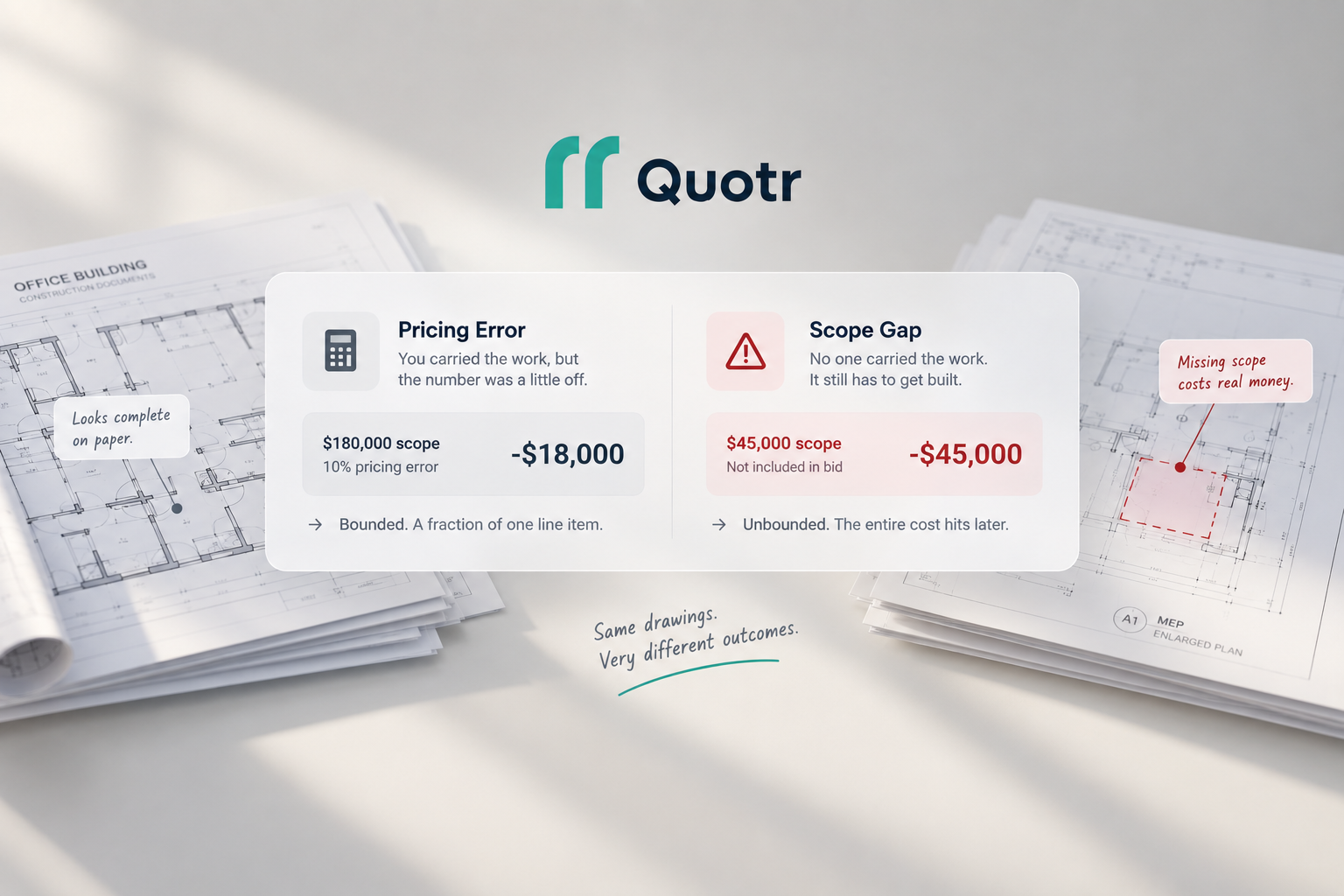
- A pricing error is bounded. You carried the scope; you just got the rate wrong. The damage is capped at your error percentage × that one line item. Get a $40,000 line 10% wrong and you’re off by $4,000. Painful, survivable, and often it washes out across a bid where some lines run high and others low.
- A scope gap is unbounded relative to your bid. You carried $0. So the exposure isn’t a percentage of the line — it’s the entire line, plus whatever premium comes from discovering it after award, when your leverage is gone. There’s no offsetting error on the other side, because the work simply isn’t in your number. One is an error within the estimate. The other is a hole in the estimate. They don’t cost the same.
The math
Take a $2,000,000 commercial interiors bid at a 6% margin — $120,000 of profit on the job.
Scenario A — a pricing error. Your drywall labor is priced 10% low on a $180,000 scope. That’s an $18,000 miss. It hurts — it’s 15% of your margin — but it’s one line, it’s bounded, and a high estimator on another line may partly offset it. Worst case, you make $102,000 instead of $120,000.
Scenario B — a scope gap. The firestopping and fire-caulking at the MEP-to-drywall interface — $45,000 of work — sat between the drywall sub (“that’s the mechanical sub’s penetrations”) and the mechanical sub (“that’s the drywall sub’s wall”). Nobody carried it. It’s not in your $2,000,000.
Now it plays out one of two ways:
- You catch it after award. It becomes a change order. Change orders run 8–14% of contract value industry-wide and carry markup, administrative cost, and schedule friction — but at least the owner may absorb it. If they don’t, it’s yours.
- You eat it. The $45,000 comes straight out of the $120,000 margin — you just lost 37% of the profit on the entire job to one missed scope. And if it triggers a delay or rework, the true cost multiplies: rework alone averages around 5% of construction value and reaches into double digits on bad projects. A $45,000 scope gap did more damage than an $18,000 pricing error that was more than twice as “wrong” on paper. That’s the whole point: the size of the mistake isn’t the size of the number you got wrong — it’s the size of the number that wasn’t there.
Why scope gaps are systematically worse
- Bounded vs. unbounded. A price error is a fraction of a line; a gap is the whole line, uncapped.
- Discovered late. Pricing errors often surface during review or bid leveling. Scope gaps surface in the field — after award, after the leverage to negotiate is gone.
- They compound. A missed scope isn’t just its cost; it’s the delay, the rework, and the strained GC relationship that follows.
- They’re the number-one cause. Roughly 80% of change orders trace to poor or missing information — not bad pricing. The industry loses an estimated $177 billion a year to rework and delays, much of it downstream of exactly this.
How scope gaps happen — and how to catch them
Gaps live in the seams: work that isn’t clearly any single trade’s, scope that’s implied in the general notes but not drawn, and exclusions every sub writes assuming another sub picked it up. The fixes are unglamorous and they work:
- Reconcile a scope checklist every bid. Map each proposal back to one master scope list and flag anything no trade claimed. This is the single highest-leverage habit in estimating.
- Level the bids properly. Bid leveling normalizes exclusions and assumptions so you can see the seam where two subs both excluded the same work.
- Carry honest allowances and contingency for the scope you can’t fully resolve at bid time — deliberately, not by accident.
- Get a second set of eyes — human or machine. A reviewer whose only job is “what’s missing,” or an AI agent that checks the takeoff against the drawings and flags scope the bid didn’t carry, catches the seam before it ships. That scope-review layer is exactly what Quotr Service adds on top of the takeoff — the estimate gets checked for what isn’t there, not just priced for what is.
Bottom line
Pricing precision protects the margin on the work you carried. Scope completeness protects the job. Chase the second one first — a perfectly priced estimate with a hole in it is still a losing bid. The estimators who stay profitable aren’t the ones with the sharpest unit costs; they’re the ones who never let a scope leave the building unowned.
Frequently Asked Questions
What is a scope gap in construction? A scope gap is work that falls between trades and gets priced by nobody, because each subcontractor assumes another one has it. Common examples are firestopping, cutting and patching, housekeeping pads, temporary protection, and MEP-to-architectural interface work. Each sub’s bid looks complete alone, but stacked together they leave a seam no one carried — which surfaces as a change order or eaten cost after award.
How is a scope gap different from a pricing error? A pricing error means you carried the work but got the rate wrong, so the damage is bounded — a percentage of one line item. A scope gap means you carried nothing for work that still has to be built, so the exposure is the entire cost, plus a premium for discovering it late. A gap is a hole in the estimate; a pricing error is a mistake within it.
How much do scope gaps cost? It varies, but the exposure is the full value of the missed scope, not a fraction of it. When missed scope becomes a change order, change orders run 8–14% of contract value industry-wide; when it’s eaten, it comes straight out of margin. Because a typical commercial margin is only 5–8%, a single mid-size scope gap can erase a third or more of a job’s profit.
What causes most scope gaps? Poor or missing information. Roughly 80% of construction change orders trace to information problems rather than pricing — scope that isn’t clearly any one trade’s, work implied in notes but not drawn, and exclusions each sub writes assuming someone else covered it. Incomplete drawings and rushed bid-day reviews make gaps far more likely.
How do you prevent scope gaps? Reconcile every sub proposal against one master scope checklist and flag anything no trade claimed, level bids to normalize exclusions and assumptions, carry deliberate allowances and contingency for unresolved scope, and get a dedicated “what’s missing” review — a second estimator or an AI agent that checks the takeoff against the drawings before the bid goes out.
Related Reading
- Scope Gap — Quotr Dictionary
- The Plug Number Problem: What Estimators Do When the Sub Hasn’t Quoted Yet
- Construction Estimating Mistakes to Avoid
- Bid Leveling · Allowance · Contingency
About Quotr.ai
Quotr is an AI construction platform with three parts: Quotr Software (AI takeoff, estimating, and bidding — including the AI agent that reads your plans and flags missing scope), Quotr Service (done-for-you cost estimates, takeoffs, and pro formas — with a human scope review), and Quotr Procurement (factory-direct materials delivered door-to-door). Multi-trade by design and built for subcontractors, general contractors, and developers. Based in San Francisco.
Published on the Quotr.ai blog. Quotr.ai is an AI-powered construction estimation, takeoff, and procurement platform based in San Francisco.