AI Bidding Software for Construction: 2026 Guide
Every contractor wants the same two things from bidding: submit more bids, and win a bigger share of them — without hiring a bigger back office. That’s the promise behind AI bidding software, and in 2026 it’s finally real. But “AI bidding software” gets used for two very different jobs, and buying the wrong one wastes a quarter.
This guide defines what AI bidding software actually is, separates the two categories it spans, profiles the top tools in 2026, and shows how to choose — with Quotr.ai as the pick for contractors who want AI to turn drawings into a winning, priced bid.
What is AI bidding software?
AI bidding software uses artificial intelligence to speed up and sharpen the work of putting a construction bid together and getting it out the door. In practice, the term covers two distinct categories that solve different problems:
- Bid production (estimate-to-bid): AI reads your drawings, extracts quantities, prices the work, and builds a proposal — turning a plan set into a submittable, priced bid. This is where the estimator’s hours actually go, and where AI takeoff has the biggest impact. (This is Quotr’s lane.)
- Bid management / distribution: software that handles invitations-to-bid (ITBs), subcontractor outreach, prequalification, plan rooms, and side-by-side comparison of incoming bids. This is mostly a GC-side workflow for managing other people’s bids. The confusion is costly: a subcontractor who needs to produce priced bids faster doesn’t need a bid-distribution marketplace, and a GC drowning in sub bids doesn’t need an AI takeoff engine. Know which problem you’re solving first.
Key takeaways
- “AI bidding software” splits into bid production (estimate-to-proposal) and bid management (ITBs, prequal, comparison).
- Subcontractors usually need bid production — AI takeoff → estimate → proposal. Quotr.ai is built for this.
- GCs managing inbound sub bids usually need bid management — BuildingConnected, PlanHub, SmartBid, ConstructConnect.
- The biggest time win is compressing manual takeoff (a full day) into a short AI-assisted review.
What AI actually does in bidding
“AI bidding software” should mean more than a faster takeoff. In a real bidding workflow, AI shows up in four places:
- Scope coverage — so you don’t miss a sheet series. The costliest bid mistake isn’t a wrong count; it’s a scope you never saw because a sheet series stayed closed. AI reads the full bid package, classifies the sheet index by system, and flags every sheet that carries scope for your trade — coverage tracking that runs roughly 10× faster than manually paging a 180-sheet set.
- Confidence-scored quantities feeding the bid. AI takeoff counts every item and attaches a per-item confidence score, so the numbers in your bid are defensible and you know exactly which ones to review.
- AI bid comparison (leveling). When supplier or sub quotes come back, Quotr’s AI bid-comparison parser scans them and generates a side-by-side pros/cons and gap breakdown — so you can level competing bids in minutes instead of building a spreadsheet by hand.
- Proposal generation. AI maps your estimate into a reusable proposal template and exports a client-ready bid, so the quote reflects the takeoff without re-keying. The throughline: AI removes the repetitive parts of assembling and defending a bid — not the judgment. By compressing takeoff and pricing, the same team can pursue up to ~3× more bids without adding headcount, which is where AI bidding software actually moves win rate.
The top AI bidding software in 2026
1. Quotr.ai — Best for producing winning bids (AI takeoff → estimate → proposal)
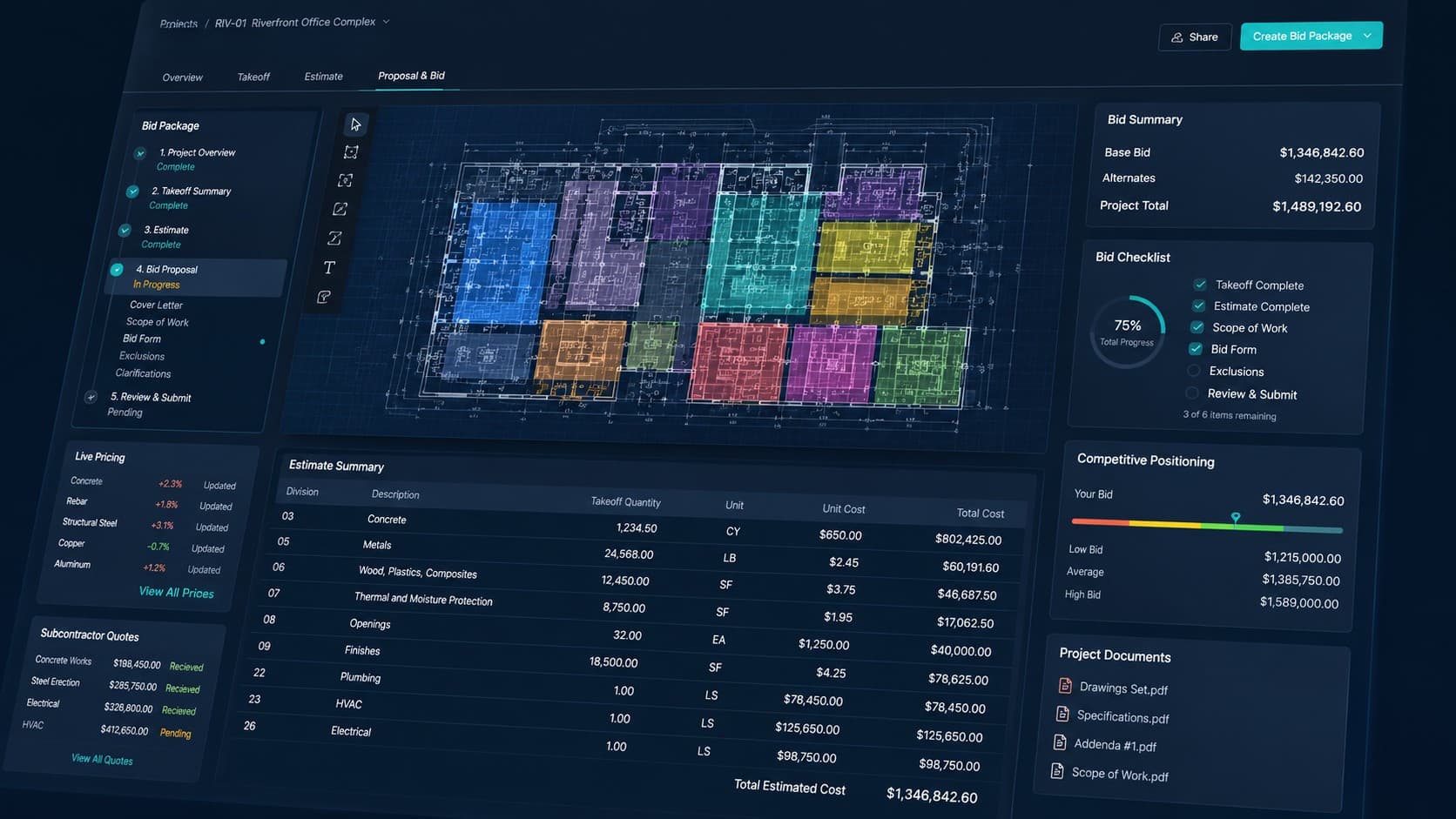
Quotr.ai is built for the side of bidding that actually eats your hours: turning a plan set into a priced, submittable bid. Upload a PDF, and Quotr’s AI takeoff detects rooms, fixtures, and symbols — automatically counting every item with per-item confidence scoring and a full audit trail back to the drawing. Quantities flow into a structured estimate with your labor rates and markup, then into a client-ready proposal export, so the path from blueprint to bid is one workflow instead of five tools.
On the bid side specifically, Quotr’s AI bid-comparison parser scans multiple supplier quotes and generates a side-by-side pros/cons and gap breakdown, so you can level competing bids in minutes. And Quotr Procurement can act as a dedicated sourcing partner for factory-direct materials delivered to the jobsite, so the material pricing in your bid reflects real numbers. On clean vector PDFs, Quotr’s AI takeoff runs at 95–99% accuracy on counts in internal benchmarking.
- Best for: subcontractors and specialty trades who want to bid more jobs, faster, with consistent and defensible numbers.
- Pricing: published — Solo from $299.90/month, Team (2–6 seats) $499.90/month, and custom Enterprise pricing for 7+ users (SSO, custom contracts, dedicated support); 7-day free trial.
- Good to know: Quotr is purpose-built to produce winning bids — takeoff → estimate → proposal. For inbound ITB distribution and subcontractor prequalification (a GC-side workflow), it works alongside a dedicated bid-management tool.
Quotr.ai Pricing • Try Quotr.ai 7 Days Free Trial
2. Autodesk BuildingConnected — Best enterprise bid management
BuildingConnected is the enterprise standard for bid management — bid distribution, subcontractor prequalification, and bid comparison, integrated into Autodesk’s construction cloud. Built for large GCs running high volumes of invitations to bid.
- Best for: large general contractors managing inbound subcontractor bids at scale.
- Pricing: free tier with limited functionality; paid plans reported from ~$199–$399/month, enterprise custom.
- Watch-out: it manages the bid process; it doesn’t do AI takeoff or build your estimate.
3. PlanHub — Best bid marketplace and plan room
PlanHub is a large bidding marketplace and plan room connecting GCs and subcontractors. GCs publish projects and invite bids; subs get access to thousands of opportunities — strong for pipeline visibility and sub outreach.
- Best for: subs expanding their opportunity pipeline and GCs broadening sub coverage.
- Pricing: free tier; paid plans reported from ~$199–$399/month.
- Watch-out: a marketplace and ITB tool, not an estimating/takeoff engine.
4. SmartBid — Best for subcontractor management and compliance
SmartBid focuses on subcontractor management and compliance — prequalification data, insurance, and certification tracking — while streamlining bid invitations and responses.
- Best for: GCs that need rigorous sub prequalification and compliance tracking.
- Pricing: quote-based.
- Watch-out: compliance and invitation management, not bid production.
5. ConstructConnect — Best for project data and directories
ConstructConnect pairs a large project directory with integrated bid management data — a fit if you already live in its ecosystem for project leads and takeoff add-ons.
- Best for: contractors who rely on its project lead and directory data.
- Pricing: custom, reported ~$400–$500/month per seat.
- Watch-out: broad platform; AI takeoff is an add-on, not the core.
AI bidding software comparison (2026)
| Tool | Category | Uses AI? | Best for | Pricing |
|---|---|---|---|---|
| Quotr.ai | Bid production | Yes — takeoff + confidence scoring + AI bid comparison | Producing priced bids from drawings | Published from $299.90/mo |
| BuildingConnected | Bid management | Limited | Enterprise GC bid distribution | Free tier; ~$199–399/mo+ |
| PlanHub | Marketplace / plan room | No | Pipeline + sub outreach | Free tier; ~$199–399/mo |
| SmartBid | Bid management | No | Sub prequal & compliance | Quote-based |
| ConstructConnect | Data / directory | Partial (add-on) | Project leads + bid data | Custom (~$400–500/seat) |
Competitor pricing is third-party-reported; confirm with each vendor. Quotr.ai pricing is published on the pricing page.
How to choose AI bidding software
Start with the bottleneck, not the brand:
- If your problem is producing bids — takeoff and pricing eat your week, and you can’t bid enough jobs — you need bid production: AI takeoff → estimate → proposal. Prioritize accuracy, confidence scoring, and a connected estimate-to-proposal workflow. (See what AI construction estimating software is.)
- If your problem is managing bids — you’re a GC fielding dozens of sub bids and chasing prequal docs — you need bid management: distribution, prequalification, and comparison.
- Test on your own work. For bid production, run a real plan set through a free trial and check accuracy and speed; see Is AI Takeoff Actually Accurate Yet?.
- Mind the gap after the count. A fast takeoff that still takes days to price hasn’t solved bidding — that’s the takeoff-to-transaction gap. Look for tools that connect quantities to real pricing. Many contractors end up using one of each: a bid-production tool like Quotr.ai to build the bid, and a bid-management or marketplace tool to find and submit to opportunities.
Frequently asked questions
What is AI bidding software?
AI bidding software uses artificial intelligence to speed up construction bidding. It spans two categories: bid production (AI reads drawings, extracts quantities, prices the work, and builds a proposal) and bid management (handling invitations to bid, subcontractor prequalification, and bid comparison). Subcontractors usually need the former; GCs often need the latter.
What is the best AI bidding software for contractors?
It depends on the job. For producing priced bids from drawings, Quotr.ai leads with AI takeoff, confidence scoring, and a connected estimate-to-proposal workflow. For managing inbound subcontractor bids, BuildingConnected, PlanHub, and SmartBid are the established bid-management platforms.
Can AI write a construction bid?
AI can do most of the heavy lifting — extracting quantities, structuring the estimate, applying your labor and material pricing, and drafting the proposal. The estimator still owns scope, exclusions, labor productivity, and final pricing judgment. The goal is to remove repetitive takeoff work, not replace estimator expertise.
How much does AI bidding software cost?
Bid-production tools like Quotr.ai publish rates from $299.90/month. Bid-management platforms like PlanHub and BuildingConnected offer free tiers and paid plans reported from roughly $199–$399/month, while enterprise platforms run $400–$500/month per seat. Confirm current pricing with each vendor.
Does AI bidding software help me win more bids?
Indirectly, yes. By compressing takeoff and pricing, it lets the same team submit more high-quality bids and respond faster — and the fastest accurate bidder often has an edge. It won’t win a bid that’s mispriced, which is why accuracy and real material pricing matter more than raw speed.
The bottom line
AI bidding software is two markets wearing one name. Decide whether your bottleneck is producing bids or managing them, then buy for that. For subcontractors and specialty trades whose week disappears into takeoff and pricing, the highest-leverage tool is one that turns a plan set into a priced, defensible bid in one workflow.
Want to see AI takeoff, estimating, and a client-ready proposal on your own plans? Start a free Quotr.ai trial or talk to our team — and bring the hardest plan set you’ve got.
Related reading
- What Is AI Construction Estimating Software?
- The Best AI Construction Estimating Software in 2026
- How to Bid Commercial Construction Projects (Step-by-Step)
- The Takeoff-to-Transaction Gap
- Is AI Takeoff Actually Accurate Yet?
Published on the Quotr.ai blog. Quotr.ai is an AI-powered construction estimation, takeoff, and procurement platform based in San Francisco.