The Best AI Construction Estimating Software in 2026
The preconstruction landscape has reached a historic tipping point. In early 2026, a staggering 12.6% surge in construction input costs — consistent with Associated General Contractors of America inflation data — collided with a severe, structural workforce challenge across the industry. For construction firms, managing paper-and-highlighter or legacy point-and-click tools is no longer a sustainable business practice. It is a severe drag on margin.
As a result, preconstruction teams are aggressively shifting to automated platforms. But with a wave of legacy tools stamping “AI” onto old software, finding the best AI construction estimating software in 2026 requires looking past the marketing copy and evaluating actual workflow utility.
This comprehensive round-up profiles the top platforms in the market, detailing where they excel, where they break, and how they stack up in a head-to-head AI construction estimating comparison 2026.
The Core Metric: Takeoff Tool vs. End-to-End System
When reviewing top AI estimating tools, the primary distinction is no longer speed-to-count; it is workflow depth.
Many tools on the market are built purely as point solutions to handle the measurement phase (takeoff). While speeding up line, area, and count metrics provides temporary relief, it leaves the estimator trapped in what we define as The Takeoff-to-Transaction Gap. A rapid quantity count does not secure material inventory, protect your bottom line from mid-quarter price fluctuations, or build an active purchasing pipeline.
The truly elite systems in 2026 are those that seamlessly unify quantity extraction, pricing assemblies, and vendor selection into a singular, responsive loop.
Detailed AI Estimating Software Reviews 2026
1. Quotr.ai – Best Natively Unified Takeoff, Estimating, and Procurement Platform
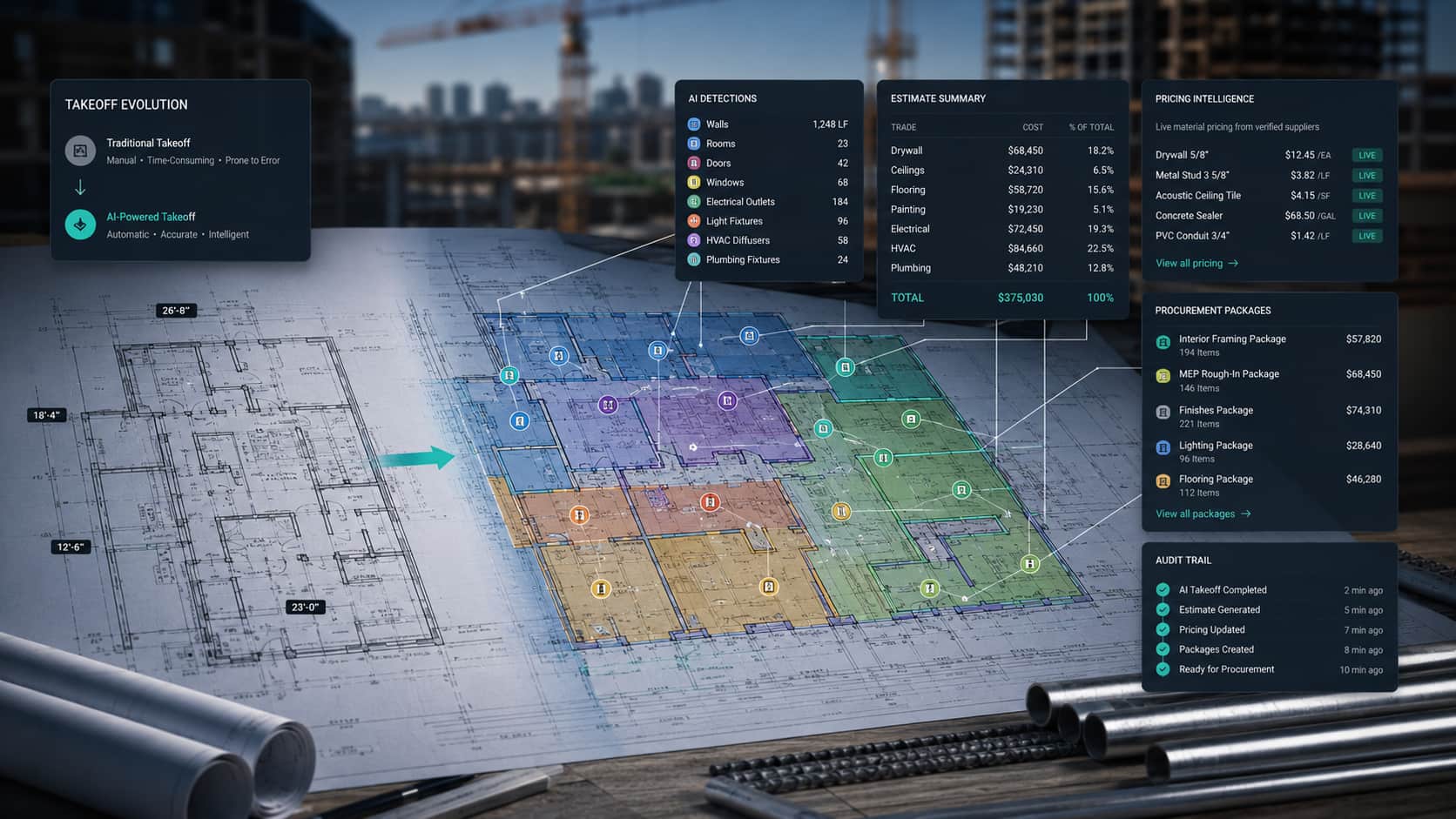
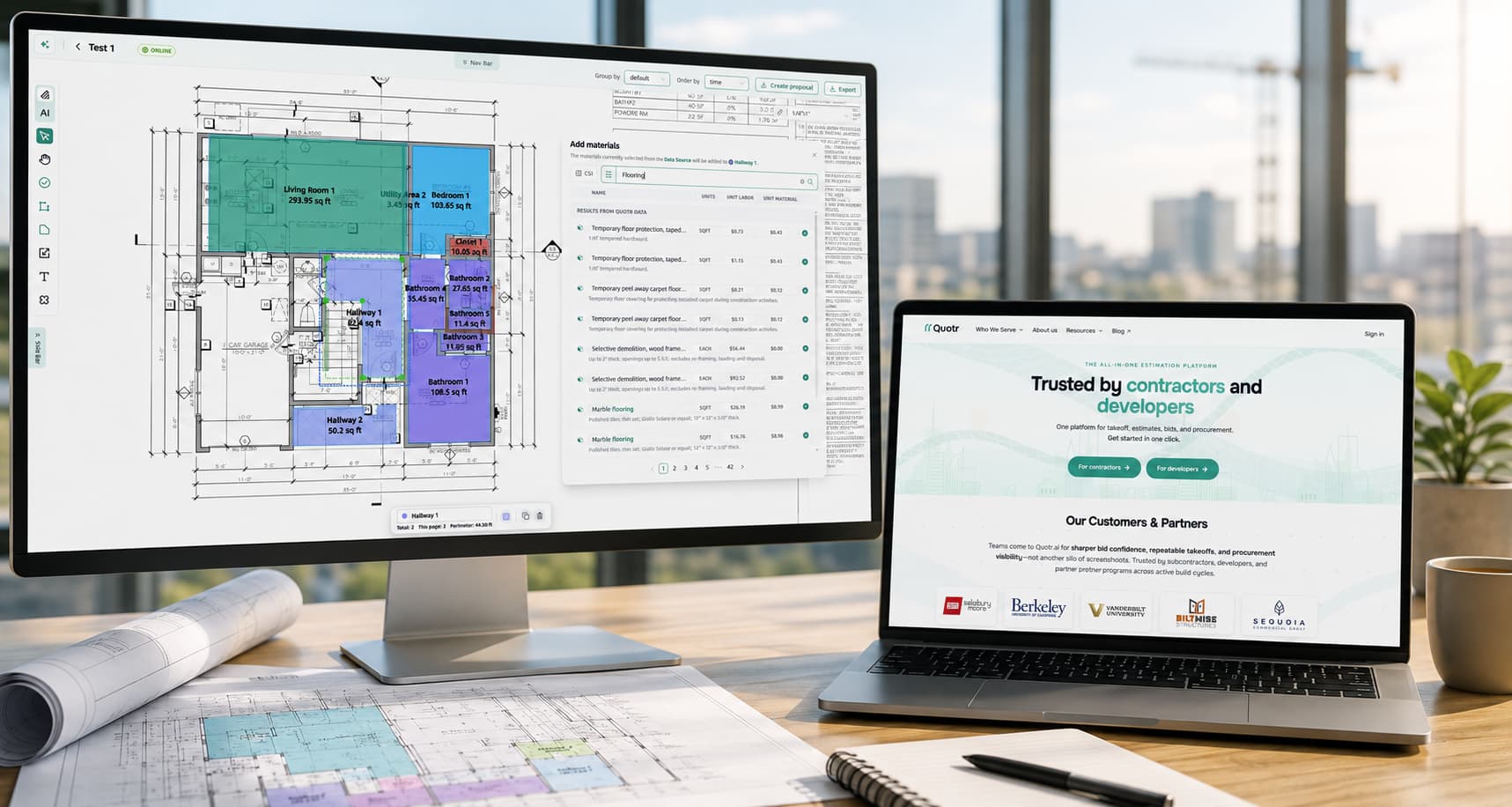
Quotr.ai is not simply a digital ruler; it is a full preconstruction operating system engineered specifically for high-volatility markets. Built explicitly for contractors and developers who need to quote high volumes of work without expanding back-office headcount, the system bridges the gap between architectural plans and buyable material orders.
Quotr comes in three parts, so teams can either run the work themselves or hand it off:
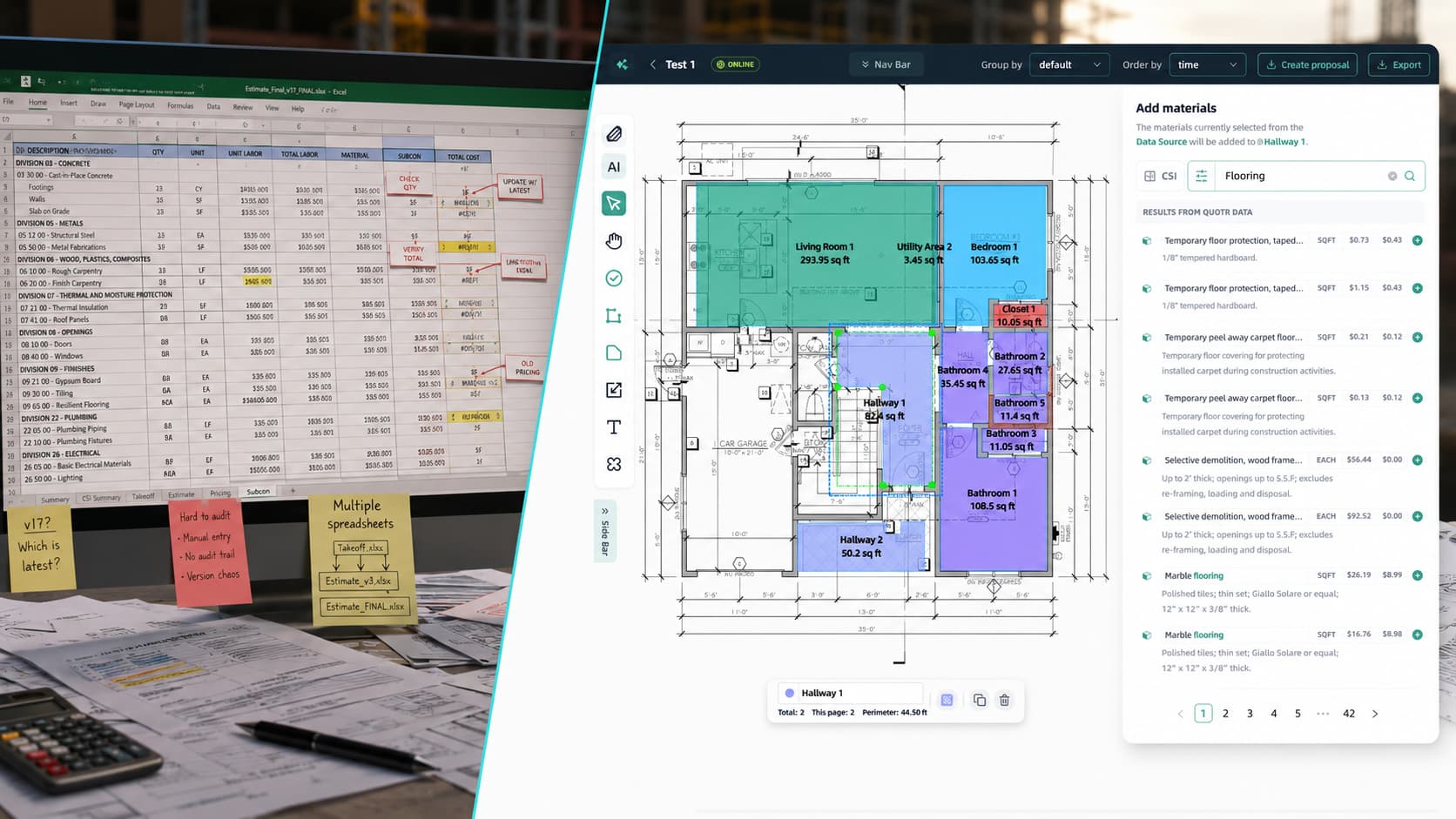
- Quotr Software — the self-serve AI takeoff, estimating, and bidding platform your team drives. The estimator uploads a PDF blueprint; Quotr’s computer vision engine maps measurements at 95–99% accuracy on clean vector PDFs (Quotr internal benchmarking), instantly populating a living cost matrix. The Quotr AI Agent lives inside Quotr Software — ask your plans anything (symbol counts, room dimensions, openings) and get direct answers cited to the sheet, without hunting through the drawings yourself.
- Quotr Service — the done-for-you option. If you’d rather not run the takeoff in-house, Quotr’s in-house cost estimator delivers a development cost estimate in 3–4 business days or a deal-level pro forma in 2–3 business days, priced per project and scoped before work begins. It’s how developers and busy subs get a decision-ready number without buying a seat or staffing a preconstruction desk. (See Construction Estimating Services: What They Do and When to Use One.)
- Quotr Procurement — the sourcing layer. Instead of leaving the estimator to hunt down local supplier quotes, Quotr links quantities to a network of 50+ verified factories across Foshan and Guangdong, China, delivering US-certified materials door-to-door (DDP) at prices roughly 40–55% below standard distributor markups — one number covering factory cost, freight, duties, and final-mile delivery. Best Fit: Commercial subcontractors (electrical, drywall, HVAC, plumbing) and developers looking for fast, ironclad cost validation — whether they run it themselves in Quotr Software or hand it to Quotr Service.
2. Togal.AI – Best Dedicated Point Solution for Pure Takeoff Speed
Togal.AI remains one of the strongest purely takeoff-centered platforms on the market. It utilizes high-end semantic machine learning to automatically color-code floor plans, classify rooms, and measure footprints in a web browser.
- How it Works: It analyzes drawing pixels to run counts and area classifications, reducing manual clicking by up to 80%.
- The 2026 Catch: Togal has recently focused on API tie-ins with external tools like Ediphi to handle cost estimates. However, because it lacks a built-in pricing engine or direct factory supply chain connections, it requires maintaining a multi-software stack.
- Best Fit: Independent quantity estimators who only want to expedite counting tasks and are happy exporting data to external spreadsheets.
- Deep Dive: Read our full, unfiltered head-to-head analysis: Quotr.ai vs. Togal.AI Comparison.
3. Autodesk Takeoff (with Automated Symbol Detection) – Best for Heavy BIM Ecosystems
Autodesk has steadily reinforced its construction cloud by threading automated pattern recognition directly into its cloud hosting environment.
- How it Works: It scans 2D sheets or 3D models to automatically pull counts for items like electrical fixtures or structural steel nodes.
- The 2026 Catch: It operates perfectly if your entire team—from the architect to the field superintendent—lives strictly within the expensive Autodesk Build sandbox. For agile specialty subcontractors working off general PDF plans, the setup friction can be restrictive.
- Best Fit: Enterprise-level general contractors managing complex, multi-million dollar institutional builds tied to massive model files.
4. Kreo / Civils.ai – Best for Civil Engineering and Earthwork Scopes
These tools focus specifically on geometric soil layouts, structural grading, and heavy infrastructural takeoffs rather than vertical building interiors.
- How it Works: They read topological vectors and structural details to automate cut-and-fill volume calculations.
- The 2026 Catch: They are highly specialized. They will not assist a finishes sub or an electrical contractor trying to quote a commercial build.
- Best Fit: Civil, sitework, and structural concrete subcontractors.
Head-to-Head: Best Construction Takeoff Software Comparison
| Platform | Core Strength | Workflow Notes | Pricing Structure |
|---|---|---|---|
| Quotr.ai | Takeoff → Estimate → Sourcing + AI Agent, plus a done-for-you Service option | Cloud-native; best on clean vector PDFs, with per-item confidence scores + human review built in | Software from $299.90/mo (7-day trial); Service per project ($0.25/sq ft <50k, $0.10/sq ft >50k) |
| Togal.AI | High-speed footprint detection | Stops at quantity output; no procurement | Per-user subscription (Growth ~$299/user/mo) |
| Autodesk Takeoff | Enterprise model coordination | High setup complexity; expensive ecosystem | Custom enterprise licensing |
| Kreo | Cut/Fill mass volume math | Weak for MEP or interior finishes trades | Tiered user licensing |
Decoupling from the Past: Why Legacy Tools Are Falling Behind
If your preconstruction workflow still relies heavily on standard manual estimating, your firm is absorbing invisible profit leaks. Moving away from legacy systems is no longer a matter of software preference—it is a mandatory shift for survival:
- The Problem with Excel: While a custom spreadsheet feels familiar, it creates disconnected data islands. Manually typing measurements from a screen into a grid exposes your firm to catastrophic math errors. (See the math: Quotr.ai vs. Excel.)
- The Problem with PlanSwift: As a local desktop client, PlanSwift lacks cloud processing power. It cannot scale calculation speed across multi-thousand-page addenda sets. (See our Quotr.ai vs. PlanSwift comparison.)
- The Problem with Bluebeam: While unmatched for marking up plans and collaboration, standard Bluebeam relies entirely on human tracing. Tracing every line manually eats up 50% to 60% of an estimator’s schedule. To truly capture high-intent efficiency, the workflow must mirror a singular path: Blueprint to Priced Estimate in under 12 minutes.
Final Buyer’s Framework: How to Select Your System
- Don’t Buy Just a Ruler: If a tool only handles quantity counting, it only solves half of the preconstruction bottleneck. Ensure the platform seamlessly links your quantities to localized or factory-direct costs.
- Demand a Live Audit Trail: Ensure that when a number in your estimate changes, you can click it to instantly highlight the exact symbol on the plan view. This is critical for defending your proposal to a developer or lender.
- Prioritize Human-in-the-Loop: Avoid “black box” platforms that generate a final cost without letting your senior estimators override labor productivity, waste margins, or supply choices.
- Decide Who Runs It: Some teams want to own the takeoff; others just want the number. Pick a platform that gives you both paths — run it yourself, or hand it off. Stop counting and start winning. However you want to work, Quotr covers the whole path: run it yourself in Quotr Software, hand it off to Quotr Service for a done-for-you estimate or pro forma, and source materials factory-direct through Quotr Procurement. See how the AI construction takeoff workflow works, or talk to our team and bring your hardest plan set.
Frequently Asked Questions (FAQ)
Is AI construction estimating software accurate enough for commercial bids?
Yes. On clean, vector-based PDF blueprints, modern AI tools achieve 95% to 99% accuracy (Quotr internal benchmarking). As we outlined in our unfiltered industry look, Is AI Takeoff Actually Accurate Yet?, the software should never be treated as a fully automated black box. The best industry practice is a “human-in-the-loop” model, where the AI eliminates the repetitive hours of manual tracing, and the senior estimator owns final risk analysis and scope adjustments.
What is the difference between an AI takeoff tool and an AI estimating system?
An AI takeoff tool uses computer vision solely to count symbols, trace lines, and calculate dimensions on a sheet. An AI estimating system takes those extracted quantities and automatically converts them into structured cost line items, applies labor rates, and builds standard proposals. To see how these tools transform raw drawings into finished project quotes, check out our piece on How AI Construction Estimating Works.
Can I hire someone to do my construction estimate instead of doing it myself?
Yes. If you’d rather not run takeoff software in-house, a done-for-you construction estimating service turns your plans into a priced estimate for a per-project fee. Quotr Service delivers a development cost estimate in 3–4 business days (or a deal-level pro forma in 2–3), combining AI takeoff with an in-house cost estimator’s review — see Construction Estimating Services.
Can I upload hand-drawn redlines or low-resolution scans into an AI takeoff platform?
Computer vision systems depend heavily on image clarity. If plans are crisp and saved at 300+ DPI, detection is near-flawless. For pixelated files, faint scans, or erratic hand-drawn markings, the platform’s accuracy can drop. Elite tools like Quotr.ai handle this safely by providing a visible verification step, which is a major part of learning how to do a construction takeoff from a PDF blueprint accurately.
How does using AI software impact our bid capacity?
By compressing the time required to do a manual takeoff from 6–8 hours down to under 30 minutes, AI software increases individual estimator capacity substantially. This allows small, agile preconstruction teams to pursue far more bid opportunities without forcing the company to scale office headcount during a tight labor market.
Why does a direct procurement link matter within an estimating platform?
Material costs are highly volatile, moving at double-digit rates year-over-year. Traditional estimating separates the takeoff from the actual material purchase, creating a dangerous data gap where a project’s margins can be wiped out before buyout. Closing The Takeoff-to-Transaction Gap with a sourcing layer like Quotr Procurement ensures that your proposed bid matches current, actionable material market prices.
References
- Associated General Contractors of America (AGC) — construction input cost and workforce data. https://www.agc.org/
Related Reading
- What Is AI Construction Estimating Software?
- AI Construction Estimating Software: Buyer’s Guide
- Construction Estimating Services: What They Do and When to Use One
- Quotr.ai vs. Togal.AI Comparison (2026)
- Is AI Takeoff Actually Accurate Yet?
Published on the Quotr.ai blog. Quotr.ai is an AI-powered construction estimation, takeoff, and procurement platform based in San Francisco.