Construction Estimating Services: What They Do and When to Use One
Short answer: A construction estimating service is a done-for-you engagement where an outside team turns your plan set into a priced, decision-ready estimate — quantities, costs, and a clear breakdown — usually in days, for a per-project fee. Builders and developers use one to underwrite deals without staffing a full preconstruction desk; subcontractors use one to keep bidding when their own estimator is at capacity.
Not every project justifies a full-time estimator, and not every team wants to run takeoff software in-house. That’s the gap a construction estimating service fills: you hand over drawings and scope, and a specialist hands back a number you can build a bid, a buyout, or a go/no-go decision on. This guide covers what these services actually deliver, what they cost, when they beat hiring or software, and how Quotr Service does it with an AI-plus-human workflow and transparent per-project pricing.
What a Construction Estimating Service Actually Does
A construction estimating service produces the same core outputs an in-house estimator would, delivered as a scoped engagement rather than a salaried role. The work breaks into three layers:
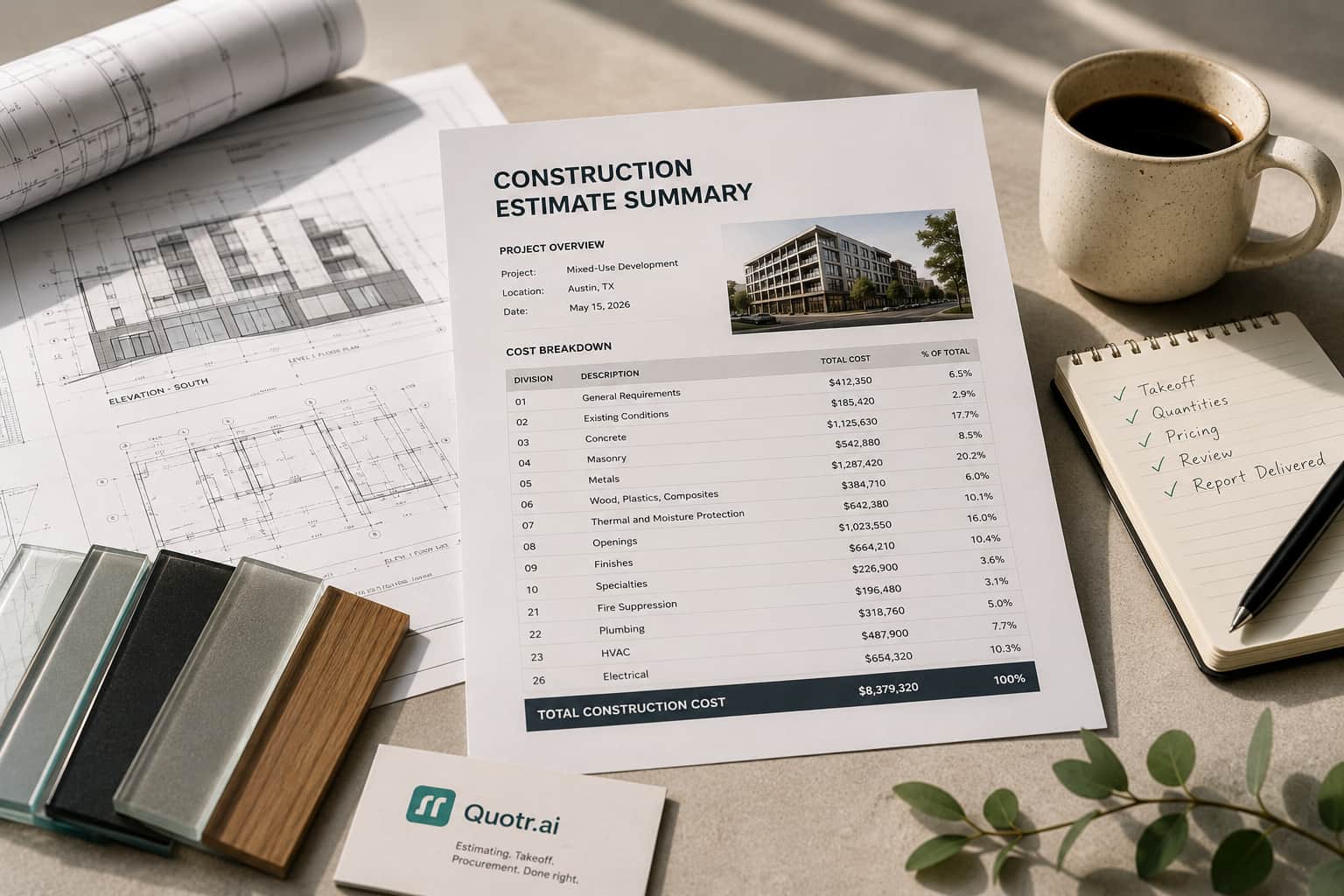
Quantity takeoff. The service measures the work from your drawings — areas, counts, linear footage, member and fixture schedules — by trade and division. This is the labor-intensive part most teams want off their desk.
Cost estimate. Those quantities get priced: materials, labor rates adjusted for your market, equipment, and the markups your team applies. You get a structured breakdown you can defend to a GC, an owner, or a lender — not just a lump sum.
Decision framing (for developers). For owners and developers, the better services go one step further and tie the hard-cost estimate into a deal-level pro forma — dollars, timing, and returns — so the estimate feeds an underwriting decision, not just a bid.
The deliverable is the point. A good estimating service doesn’t just send a spreadsheet; it sends something formatted for the next conversation — the bid, the buyout, the lender packet, or the go/no-go call.
In-House Estimator vs. Estimating Software vs. Estimating Service
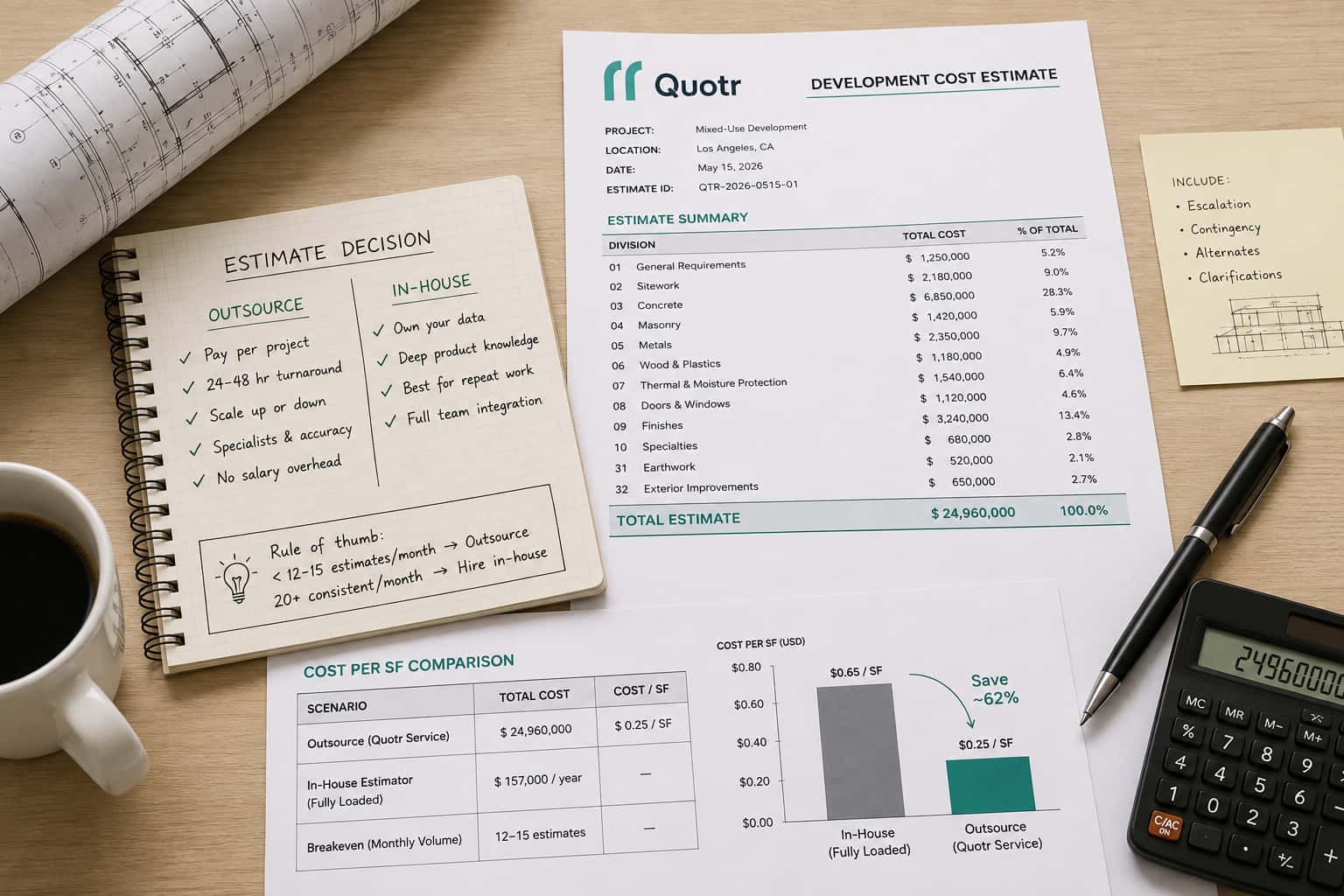
Most teams are choosing between three ways to get an estimate done. They’re not mutually exclusive — many teams run software day-to-day and lean on a service for overflow or underwriting — but the trade-offs are distinct.
| Option | Best for | Turnaround | Cost model | Who does the work |
|---|---|---|---|---|
| In-house estimator | Steady, high bid volume that justifies a salary | Ongoing | $80k–$130k+/yr fully loaded | Your employee |
| Estimating software (e.g., Quotr Software) | Teams that want to own the takeoff and bid daily | Same day, once trained | Per seat / subscription | Your team, AI-assisted |
| Estimating service (e.g., Quotr Service) | Overflow, one-off deals, underwriting, no in-house desk | Days, per project | Per project | The service’s estimators |
The honest rule of thumb: if you bid enough to keep an estimator busy, hire or license software. If your volume is lumpy — a developer underwriting a few deals a quarter, or a sub slammed for three weeks then quiet — a service lets you pay only when you have a project in front of you.
When Builders and Developers Should Use a Service
For homebuilders, developers, and owner-builders, the case for a construction estimating service is usually about speed to a decision, not headcount. You’re evaluating a site or a deal and you need a credible hard-cost number before you commit capital — but the deal isn’t closed, so standing up a preconstruction team for it makes no sense.
A service gives you an underwriting-grade estimate on demand: describe the project, share drawings and assumptions, and get quantities, costs, and — when you need it — a pro forma that puts dollars, timing, and returns in one narrative your lenders and partners can share. That’s exactly what Quotr Service is built for. Teams use it early to compare options, test sensitivities, and build a go/no-go framework before spending more time and money.
Critically, a service doesn’t replace your judgment or your GC. It removes the spreadsheet grind and hands your decision-makers a cleaner, auditable baseline for the lender, GC, and partner conversations that follow.
When Subcontractors Should Use a Service
For subcontractors and trade contractors, the trigger is almost always capacity. Bid volume isn’t smooth — you’ll have five invitations land the same week your one estimator is buried, and every bid you skip is revenue you handed a competitor. Turning down work because you can’t get the takeoff done is the most expensive kind of “no.”
A construction estimating service is overflow insurance. When you’re slammed, you send the plan set out and get quantities and a priced estimate back in days, so you stay in the running on more bids without hiring for your peak. When things are quiet, you pay nothing. For subs weighing whether to buy software or use a service, the answer is often both: software for the bids you run yourself, a service for the weeks you can’t keep up.
How Much Do Construction Estimating Services Cost?
Pricing across the industry usually lands in one of three shapes: per project (commonly $200 for small scopes up to $1,000+ for large ones), monthly retainers (roughly $1,000–$1,500/month for ongoing takeoff volume), or percentage-of-project-cost for large or specialized work. Most reputable providers price per project rather than hourly, using a cost database plus estimator experience and adjusting for local labor and material rates. (iAmBuilders, World Estimating)
The catch with much of the market is that you don’t see the number until you ask. Quotr Service prices differently and publicly: per project, by square footage — $0.25/sq ft under 50,000 sq ft and $0.10/sq ft above 50,000 sq ft — with the scope and price sent and approved before any documents are processed. No per-seat licenses, no hidden fees, no “request a quote” wall. For a 20,000 sq ft project that’s a known, transparent number before work starts; for anything above 50,000 sq ft the rate steps down.
How Quotr Service Works
Quotr Service is the done-for-you side of Quotr — distinct from Quotr Software, the self-serve takeoff and estimating tool your team drives itself. Quotr Software is a tool you operate; Quotr Service is a deliverable we produce for you. With the service, you describe what you need and receive a finished report; you don’t run the software at all.
The workflow is a scoped engagement from request to final output:
- Scope the request. On software.quotr.ai, tell the agent what you need — a development cost estimate, a pro forma, or both — and share drawings, assumptions, timeline constraints, and material preferences. Each request is scoped and priced per project before processing starts.
- AI runs the analysis. Quotr processes your inputs in the background, extracting quantities and cost signals from the plan set while your team keeps moving on design and underwriting.
- Human review adds the judgment. An estimator adds an explicit assumptions-and-risk layer — this is where the in-house cost estimator earns their keep, turning raw extraction into a defensible baseline.
- You get a decision-ready report, formatted for lender, partner, and internal review.
Two core deliverables
- Development cost estimate — quantities, cost signals, and a clear breakdown for procurement, pricing alignment, and go/no-go. Typical delivery: 3–4 business days.
- Deal-level pro forma — the financial story of the deal: dollars, timing, and returns in one narrative so lenders, investors, and your team share the same baseline. Typical delivery: 2–3 business days. What separates the Quotr approach is grounding. The estimate is tied to real blueprint context — building envelopes, square footage, location — connected to market data, rather than typed-in, unverified hard-cost numbers. The AI takeoff runs at 95–99% accuracy on counts and areas on clean vector PDFs (Quotr internal benchmarking), and a human reviews the flagged edge cases before anything ships. You get the speed of automation with an estimator’s sign-off on top.
Software or service — your call. If your team wants to own the takeoff and bid daily, Quotr Software is the AI takeoff, estimating, and bidding platform you drive yourself. If you’d rather hand off the whole thing and get a report back, Quotr Service does it for you. Same estimating DNA, two ways to consume it.
From Estimate to Buyout
An estimate is only half the job — the other half is actually buying the materials at the number you priced. That’s where the estimate connects to procurement: once quantities are set, Quotr Procurement can source materials factory-direct, delivered door-to-door (DDP) with no distributor markup, for categories like windows, doors, cabinetry, flooring, and FF&E. For builders and developers, that closes the loop from underwriting number to real buyout price. (More on the full path in The Construction Procurement Process: From Takeoff to Buyout.)
Get a Decision-Ready Estimate
Whether you’re underwriting a deal or covering a bidding surge, you can hand off the takeoff and get a priced, decision-ready estimate back in days. Scope your project on software.quotr.ai and see your per-project price before any work begins, or talk to our team about the right fit for your pipeline.
Frequently Asked Questions
What is a construction estimating service? A construction estimating service is a done-for-you engagement where an outside team turns your drawings into a priced estimate — quantity takeoff, costs, and a structured breakdown — for a per-project fee. Builders and developers use it to underwrite deals; subcontractors use it to keep bidding when their in-house estimator is at capacity.
How much do construction estimating services cost? Most construction estimating services charge per project, commonly from around $200 for small scopes to $1,000+ for large ones, or $1,000–$1,500/month on a retainer. Quotr Service prices publicly by square footage: $0.25/sq ft under 50,000 sq ft and $0.10/sq ft above, scoped and approved before work begins.
What’s the difference between construction estimating software and an estimating service? Estimating software is a tool your team operates to run takeoff and build bids yourself; an estimating service is a done-for-you deliverable produced by outside estimators. Quotr offers both — Quotr Software for teams that bid daily, and Quotr Service for overflow, one-off deals, or underwriting without an in-house desk.
When should a builder outsource construction estimating? Outsource estimating when your bid volume is uneven or a deal isn’t yet closed — when hiring a full-time estimator or standing up a preconstruction team can’t be justified. A service delivers an underwriting-grade estimate on demand, so you get a credible cost number before committing capital, then scale back to zero when the pipeline is quiet.
How fast can you get a construction cost estimate? Turnaround varies by provider, but many services deliver in 24–48 hours to a few business days. Quotr Service typically delivers a development cost estimate in 3–4 business days and a deal-level pro forma in 2–3 business days, once scope and inputs are confirmed and priced.
Does an estimating service replace an in-house estimator? No. A construction estimating service removes the repetitive takeoff and spreadsheet work and gives your internal decision-makers a cleaner, auditable baseline — it doesn’t replace human commercial judgment, your GC, or final subcontractor buyout. Most teams use a service to augment an existing estimator or cover overflow, not to eliminate the role.
Can AI do construction estimating? Yes, for the takeoff and quantity layer. AI reads plan sets and extracts counts, areas, and quantities — at 95–99% accuracy on clean vector PDFs in Quotr’s internal benchmarking — with a human estimator reviewing flagged edge cases and adding assumptions. Quotr Service combines AI extraction with estimator sign-off so the final number is both fast and defensible.
Related Reading
- The Quotr Developer Desk: Underwriting-Grade Estimates in 72 Hours
- The Construction Proforma Software Every Developer Should Use
- From Takeoff to Buyout: Why Estimating Without Procurement Is Half a Tool
- What Is Construction Procurement? (2026 Guide)
- What Is AI Construction Estimating Software?
References
- iAmBuilders — California Estimating Services — per-project estimating pricing model.
- World Estimating — Pricing — published per-project estimating price ranges.
- Quotr.ai Service — deliverables, delivery timelines, and per-project pricing.
Published on the Quotr.ai blog. Quotr.ai is an AI-powered construction estimation, takeoff, and procurement platform based in San Francisco.