The Construction Procurement Process: Takeoff to Buyout
The construction procurement process is the end-to-end sequence a project team follows to turn a set of drawings into delivered, installed materials — from quantity takeoff and requisition through sourcing, quoting, bid leveling, purchase orders, submittals, logistics, and closeout. Done well, it protects your budget and schedule. Done loosely, it is where money and time quietly leak out of a job.
That leak is not small. A McKinsey Global Institute study spanning 20 countries and 70 years found the average cost overrun across construction projects is 28%, and roughly 85% of projects come in over budget (McKinsey, via Propeller). About 32% of those overruns trace back to estimating errors (SmartPM) — errors that almost always originate upstream, in how quantities are counted and how materials are bought.
This is a practitioner walk-through of the nine stages that take a project from takeoff to buyout, the roles and documents at each one, and the pitfalls that trip up even experienced teams. In the back half, we show how a connected takeoff → estimate → buyout workflow and a factory-direct procurement layer compress the whole thing.
Procurement vs. purchasing: a quick clarification
Before the steps, one distinction worth locking down. Purchasing is the transactional act of buying — cutting a PO, placing the order. Procurement is the broader, strategic process that surrounds it: defining what you need, evaluating suppliers, negotiating, managing risk, and owning the supplier relationship over the life of the job (Kissflow). Purchasing is a subset of procurement. Everything below is procurement; the purchase order is one step inside it.
The construction procurement process in nine steps
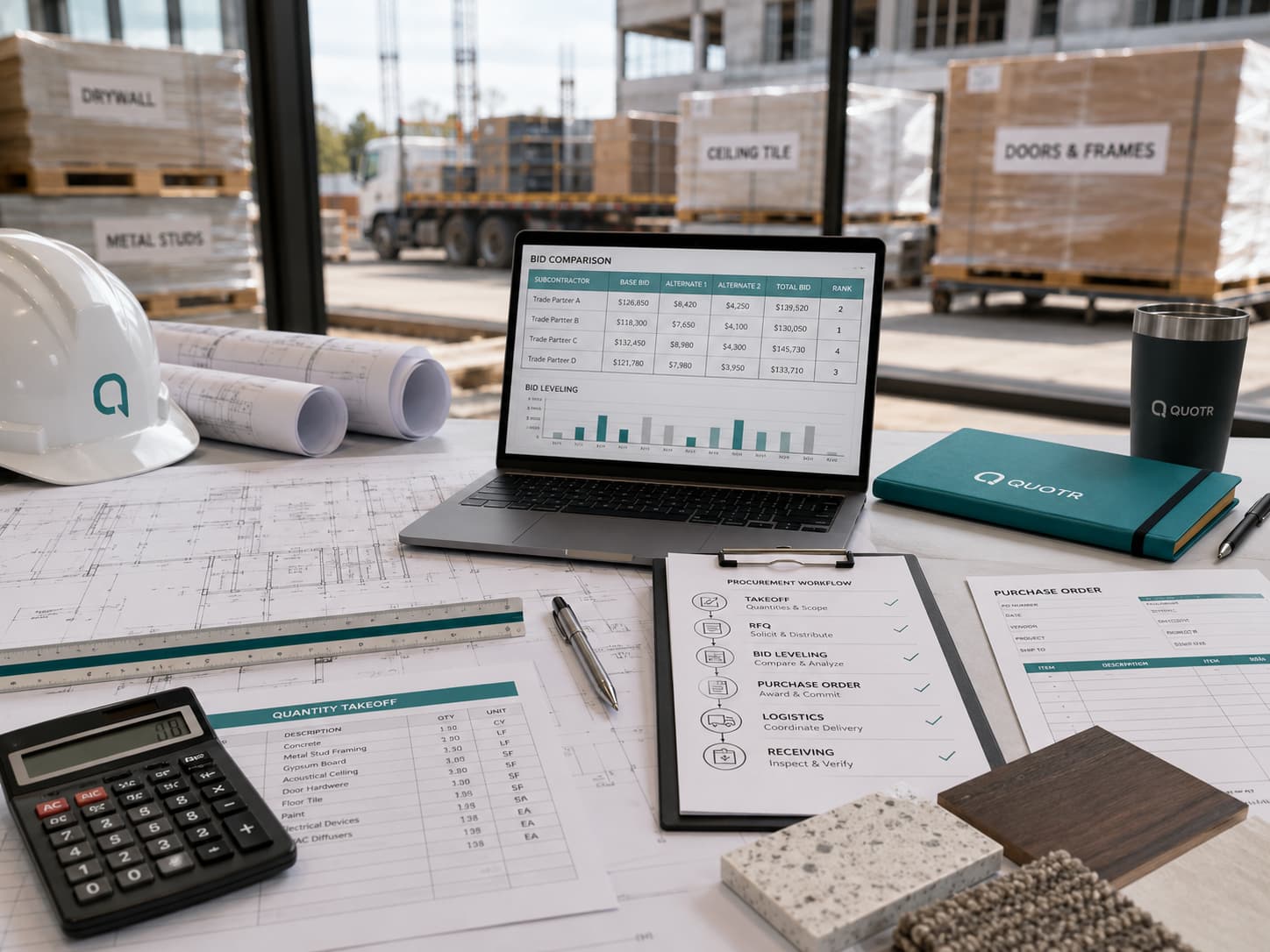
Here is the full sequence at a glance. Each step is expanded below.
- Takeoff and requisition — define quantities and specifications.
- Sourcing and supplier identification — build the vendor shortlist.
- RFQ and quote solicitation — request pricing against your scope.
- Bid leveling and comparison — normalize quotes to compare apples to apples.
- Purchase order and contract — commit terms in writing.
- Submittals and spec approval — confirm products meet design intent.
- Logistics and delivery — move material to site, including DDP for imports.
- Receiving and QC — verify what arrived against what was ordered.
- Closeout and records — settle accounts and archive documentation.
Step 1 — Takeoff and requisition
Everything downstream inherits the accuracy of this step. The estimator performs a quantity takeoff — counting fixtures, measuring linear and square footage, tallying assemblies — off the construction drawings and specifications. The output is a requisition: a structured list of quantities tied to specs (model, finish, rating, dimensions).
- Roles: estimator (owns the count), project manager (validates scope).
- Key documents: drawing set, specification sections, takeoff sheet, material requisition.
- Common pitfall: manual takeoffs drift. A miscount on a window schedule or a missed revision multiplies through every quote that follows. Because roughly a third of overruns start as estimating errors (SmartPM), an audit trail on quantities is not optional.
Step 2 — Sourcing and supplier identification
With quantities defined, the procurement lead identifies who can actually supply them. This is the strategic heart of procurement: assembling a shortlist of vendors capable of meeting spec, volume, timeline, and certification requirements.
- Roles: procurement lead, PM.
- Key documents: approved vendor list, supplier prequalification records, spec sheets.
- Common pitfall: defaulting to the same local distributor for everything. Convenience is real, but distributor markups on materials commonly run 30–60%, and a narrow vendor pool removes your leverage before you have quoted a single item.
Step 3 — RFQ and quote solicitation
The team issues a Request for Quotation (RFQ) to the shortlist, packaging the requisition, specs, and delivery expectations so every vendor prices the same scope.
- Roles: procurement lead, estimator (clarifies scope questions).
- Key documents: RFQ package, scope of work, delivery schedule.
- Common pitfall: ambiguous or inconsistent RFQs. If one vendor prices tempered glass and another does not, the quotes are not comparable — and you will not discover it until leveling, or worse, at delivery.
Step 4 — Bid leveling and comparison
Quotes rarely arrive in the same shape. Bid leveling normalizes them — matching line items, isolating inclusions and exclusions, and adjusting for freight, taxes, and lead time — so you compare true delivered cost, not headline price.
- Roles: estimator, procurement lead, PM.
- Key documents: bid tabulation / leveling sheet, quote comparison matrix.
- Common pitfall: buying on lowest number. The cheapest quote often excludes freight, certification documents, or has a lead time that blows the schedule. Level on total landed cost and delivery date, not sticker price.
Step 5 — Purchase order and contract
Once a vendor is selected, terms go in writing. For material orders, that is a purchase order; for larger or ongoing supply, a supply contract. This is the purchasing act inside the wider procurement process — quantities, unit prices, delivery dates, payment terms, and remedies all get committed.
- Roles: procurement lead, PM, sometimes legal or finance.
- Key documents: purchase order, supply agreement, terms and conditions.
- Common pitfall: vague delivery and acceptance terms. If the PO does not specify delivery date, delivery point, and what constitutes acceptance, you have no leverage when material shows up late or wrong.
Step 6 — Submittals and spec approval
Before manufacturing, the product must be confirmed against design intent. A submittal is written or physical information — shop drawings, product data sheets, samples, mockups — sent by the contractor for approval by the design team, confirming the planned materials meet contract requirements (Procore). The subcontractor prepares it, the GC checks it for completeness, and the architect or engineer approves, approves with comments, or returns it for revision.
- Roles: subcontractor (prepares), GC (reviews), architect/engineer (approves).
- Key documents: submittal register, shop drawings, product data, samples.
- Common pitfall: ordering before approval. Because submittals gate procurement, jumping ahead risks fabricating the wrong product — a costly, schedule-killing mistake that the submittal process exists to prevent (BuildSync).
Step 7 — Logistics and delivery
Approved product now has to reach the site. For domestic orders this is freight scheduling and delivery windows. For imported materials, the cleanest structure is DDP — Delivered Duty Paid — where the supplier’s single price covers factory cost, export packing, ocean freight, US customs and duties, and final-mile delivery, so you are not stitching together a broker, a freight forwarder, and a trucking company yourself.
- Roles: procurement lead, PM, logistics coordinator.
- Key documents: bill of lading, delivery schedule, customs and certification docs (e.g., NFRC, CARB, cUPC).
- Common pitfall: underestimating lead time. Custom windows commonly run 4–16 weeks, with aluminum windows at 16+ weeks (SOCO Windows & Doors) — and lead times have expanded 2x–3x their pre-2020 norms across many materials (CyberStockroom). Long-lead items must be procured against the schedule, not the calendar.
Step 8 — Receiving and QC
When material lands, someone verifies it matches the PO and the approved submittal — correct quantity, correct spec, no transit damage. This is your last checkpoint before an error becomes an installed problem.
- Roles: site super, PM, receiving crew.
- Key documents: packing slip, delivery receipt, QC/inspection checklist, non-conformance report.
- Common pitfall: signing for deliveries without inspecting. A signed delivery ticket can waive claims. Count, inspect against the submittal, and document discrepancies before the truck leaves.
Step 9 — Closeout and records
The final step settles the money and preserves the paper. The team reconciles invoices against POs and delivery receipts, releases retainage, closes out the contract, and archives certifications, warranties, and O&M documentation.
- Roles: PM, procurement lead, finance.
- Key documents: final invoice reconciliation, lien releases, warranties, certification records, as-built documentation.
- Common pitfall: thin records. Missing certifications and warranty docs surface at the worst time — during inspection, a warranty claim, or a future dispute. Closeout is where a clean audit trail pays off.
Where the process breaks — and how a connected workflow fixes it
Read the nine steps again and the failure pattern is obvious: the process is a relay race run with disconnected tools. Takeoffs live in one system, estimates in a spreadsheet, RFQs in email, POs in accounting software. Every handoff is a chance for a quantity to drift, a spec to get lost, or a markup to creep in. That is how a third of overruns become estimating errors, and how the average project still lands 28% over budget.
Quotr.ai is an AI-powered construction estimation, takeoff, and procurement platform built for subcontractors, GCs, and developers to close those gaps by keeping the whole chain connected.
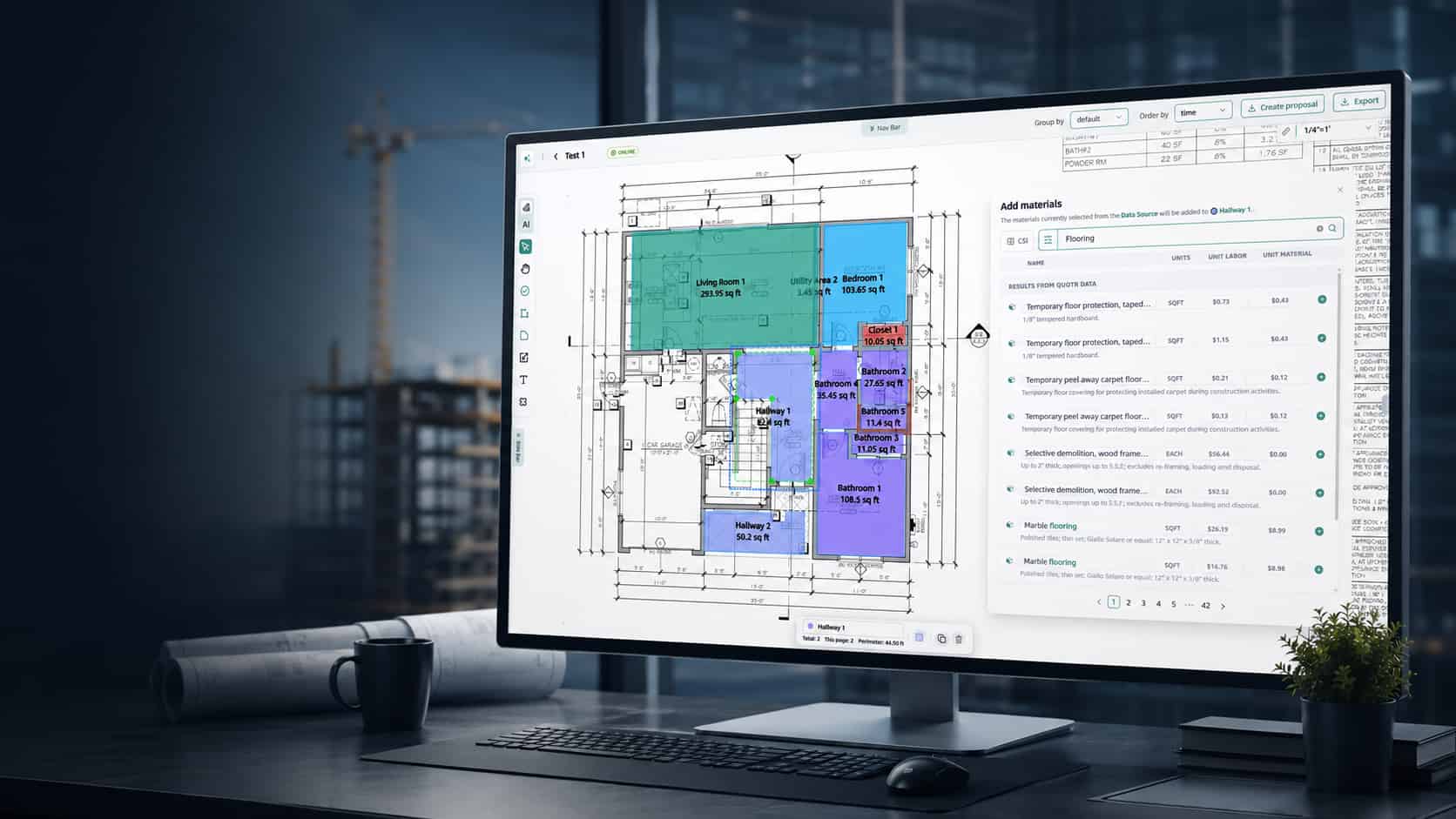
- AI takeoff (Steps 1–2). Quotr’s AI counts items automatically and applies per-item confidence scoring through Smart Matching, with a full audit trail on every quantity. On clean vector PDFs it reaches 95–99% accuracy (Quotr internal benchmarking), and it stays human-in-the-loop so an estimator reviews and confirms before anything moves downstream. The takeoff flows straight into a structured estimate — no re-keying, no drift between the count and the bid.
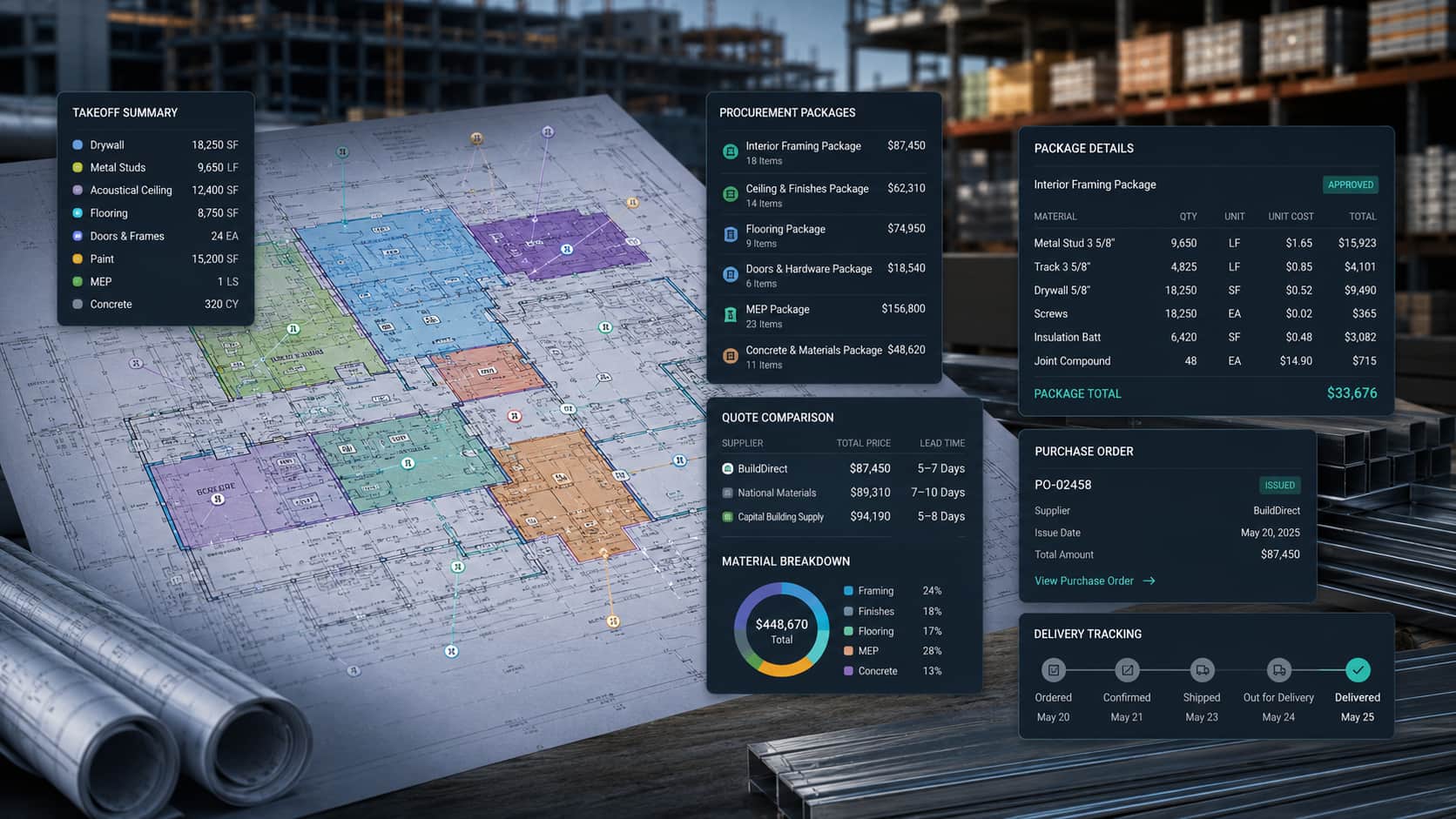
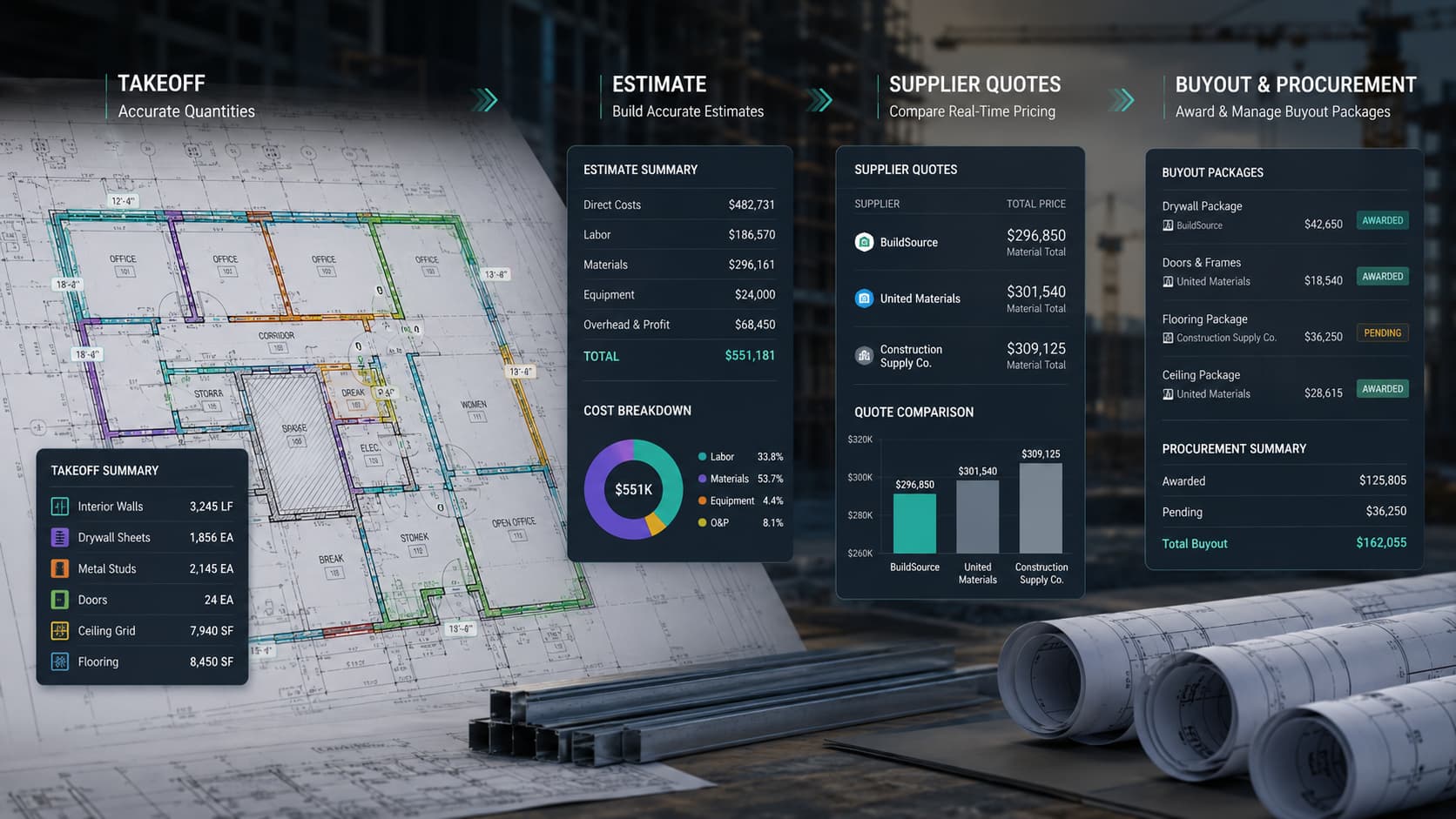
- Estimate to bid to buyout (Steps 3–5). Because the estimate is structured data, not a static spreadsheet, quantities carry cleanly into RFQs, leveling, and buyout. The relay handoffs that lose scope simply do not happen when takeoff, estimate, and procurement share one source of truth. Read the full walk-through in Takeoff to Buyout.
The factory-direct procurement layer
Steps 5 through 9 — sourcing, PO, submittals, logistics, receiving — are exactly where distributor markups and coordination risk concentrate. Quotr’s procurement layer addresses them as a dedicated sourcing partner that delivers factory-direct materials door-to-door on DDP terms, with no distributor markups.
- One number, fully landed. DDP means a single price covering factory cost, export packing, ocean freight, US customs and duties, final-mile delivery, and certification documents (NFRC, CARB, cUPC) — the Step 7 logistics stack, handled.
- Managed quality, not just sourcing. Factory vetting and audits, sample approval, shop-drawing and spec lock, and in-factory QC map directly onto Steps 6 and 8, so approval and quality control happen before material ships rather than after it lands.
- Real savings. Factory-direct sourcing runs 40–55% less per project than Bay Area dealers and avoids the 30–60% distributor markup that quietly inflates buyout.
- The network. 50+ verified factories across Foshan and Guangdong, China, supplying US-certified materials across windows and doors, garage doors, cabinetry and millwork, flooring, and bath and plumbing fixtures. Quotes typically return in about 3–5 business days; reach the team at procurement@quotr.ai. Good to know: the procurement layer is a managed sourcing service with typical quote turnaround of 3–5 business days, so long-lead categories should be engaged early against your project schedule.
Developers running multiple projects can see the same connected model applied at portfolio scale on the developers page. For contractors, plans start at Solo $299.90/mo, Team (2–6) $499.90/mo, and Enterprise (custom), all with a 7-day trial.
Ready to connect your takeoff, estimate, and buyout? Contact us to see it on one of your live projects.
Frequently asked questions
What are the stages of the construction procurement process?
The construction procurement process moves through nine practical stages: takeoff and requisition, sourcing, RFQ and quoting, bid leveling, purchase order and contract, submittals and spec approval, logistics and delivery, receiving and QC, and closeout. At a higher level these group into planning, acquisition, and contract management phases (Autodesk).
What is the difference between procurement and purchasing in construction?
Purchasing is the transactional act of buying materials — placing the order and cutting the PO. Procurement is the broader strategic process around it: defining needs, evaluating and selecting suppliers, negotiating, and managing supplier relationships and risk over the project. Purchasing is a subset of procurement (Kissflow).
What are the main procurement methods in construction?
There are five main construction procurement methods: design-bid-build, design-build, construction management, management contracting, and public-private partnerships. Design-bid-build separates design and construction contracts and is the most common; design-build combines both under one contract to shorten timelines (NetSuite).
What is a submittal in the procurement process?
A submittal is written or physical information — shop drawings, product data, or samples — sent by the contractor for design-team approval to confirm materials meet contract requirements. Because approval gates procurement, submittals act as a quality checkpoint that prevents fabricating the wrong product (Procore).
What is bid leveling and why does it matter?
Bid leveling is normalizing supplier quotes so you compare identical scope — matching line items and adjusting for freight, taxes, exclusions, and lead time. It matters because the lowest headline price often hides excluded costs or a delivery date that breaks the schedule, so leveling reveals true landed cost before you commit.
How long are lead times for construction materials?
Lead times vary widely by product and customization. Custom windows commonly run 4–16 weeks and aluminum windows 16+ weeks (SOCO Windows & Doors), and lead times across many materials have expanded 2x–3x their pre-2020 norms (CyberStockroom). Long-lead items should be procured against the project schedule.
What does DDP mean in construction procurement?
DDP (Delivered Duty Paid) is a delivery term where the supplier’s single price covers factory cost, export packing, ocean freight, US customs and duties, and final-mile delivery. For imported materials it consolidates the entire logistics stack into one number, so the buyer avoids coordinating brokers, freight forwarders, and trucking separately.
Related reading
- Takeoff to Buyout: The Connected Estimating and Procurement Platform
- Construction Procurement Software
- Construction Takeoff Software with Built-In Procurement
- What Is AI Construction Estimating Software?
- How to Bid Commercial Construction Projects: A Subcontractor’s Estimating and Takeoff Guide
- Tariff-Aware Estimating: Material Escalation in Every Bid
References
- McKinsey Global Institute cost-overrun findings, via Propeller Aero — https://www.propelleraero.com/blog/10-construction-project-cost-overrun-statistics-you-need-to-hear/
- SmartPM, Construction Cost Overruns — https://smartpm.com/blog/construction-cost-overruns
- Autodesk, The Construction Procurement Process Explained — https://www.autodesk.com/blogs/construction/procurement/
- Kissflow, Procurement vs. Purchasing — https://kissflow.com/procurement/procurement-vs-purchasing/
- NetSuite, The 5 Types of Construction Procurement Methods — https://www.netsuite.com/portal/resource/articles/erp/types-of-construction-procurement.shtml
- Procore, Ultimate Guide to Submittals in Construction — https://www.procore.com/library/construction-submittals
- BuildSync, Construction Submittal Review Process — https://buildsync.ai/resources/complete-guide-to-construction-submittal-reviews
- SOCO Windows & Doors, Understanding Lead Times — https://socoww.com/doors/understanding-lead-times-when-ordering-windows-and-doors/
- CyberStockroom, Managing Long Lead-Time Materials — https://blog.cyberstockroom.com/2025/12/02/managing-long-lead-time-materials-in-construction-projects/
Published on the Quotr.ai blog. Quotr.ai is an AI-powered construction estimation, takeoff, and procurement platform based in San Francisco.