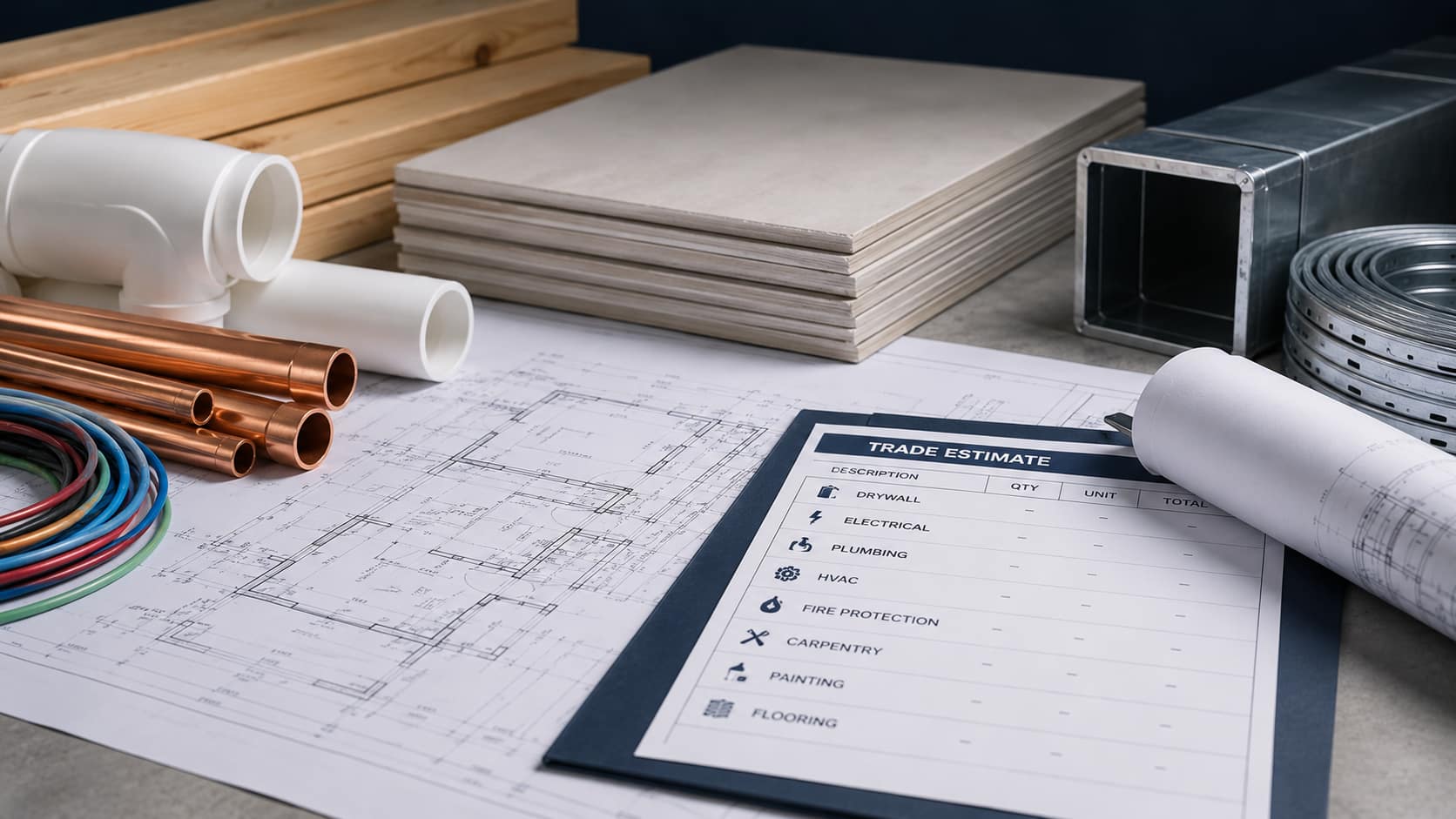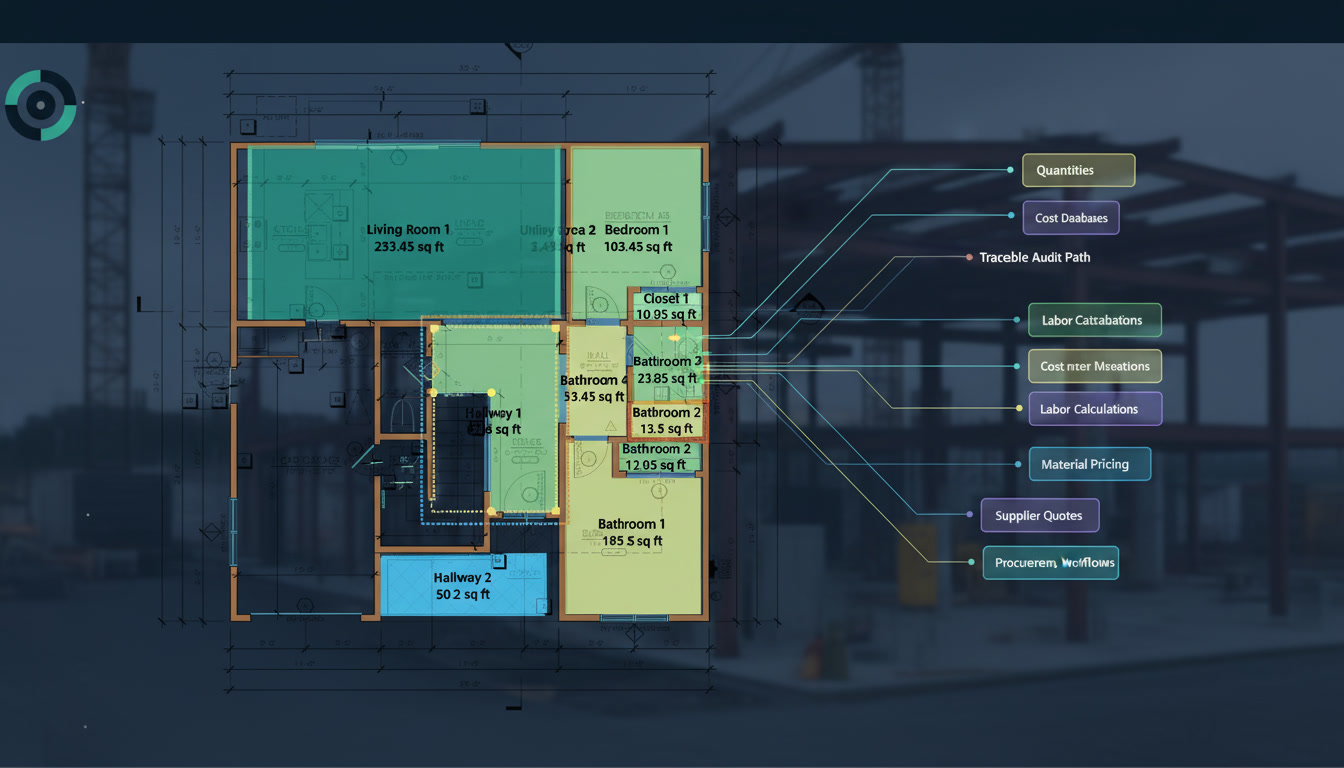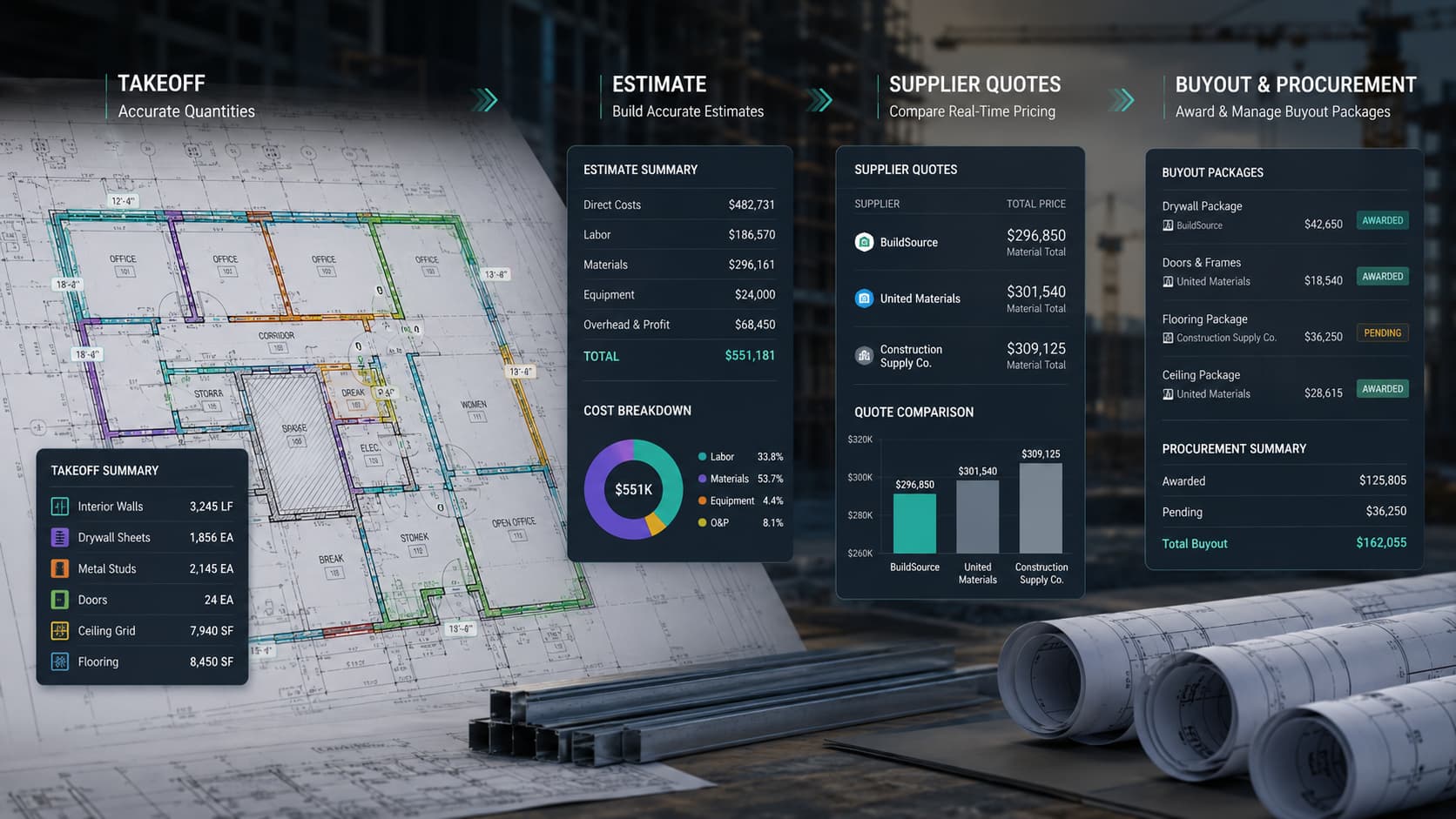
From Takeoff to Buyout: Why Estimating Without Procurement Is Half a Tool
Most construction estimating software helps contractors answer one question:
“What should this job cost?”
That is important. But it is not the full workflow.
A real construction project does not end when quantities are measured. It does not end when an estimate is exported. It does not even end when a bid is submitted.
The real workflow looks like this:
Takeoff → Estimate → Bid → Buyout → Procurement
That is why estimating software without procurement is only half a tool.
Contractors, developers, owners, and preconstruction teams do not just need a faster way to count materials. They need a connected system that turns drawings into quantities, quantities into prices, prices into bids, and winning bids into actual purchasing decisions.
That is the gap Quotr.ai is built to close.
Quotr.ai is not only an AI takeoff platform. It is designed to connect the preconstruction workflow from drawing review and quantity extraction all the way to pricing, bid comparison, buyout, and procurement.
For teams comparing Quotr.ai with traditional takeoff tools, the key difference is that Quotr.ai helps move from estimating to execution. That is why the comparison in Quotr.ai vs STACK: Browser-First Takeoff With and Without Procurement matters: most tools help with takeoff, but the bigger opportunity is connecting takeoff to procurement.
The Problem: Most Estimating Tools Stop Too Early
Traditional takeoff and estimating software usually focuses on a narrow part of the workflow:
- Upload drawings
- Measure quantities
- Apply pricing
- Export an estimate
- Move the rest of the work somewhere else
That “somewhere else” is usually Excel, email, PDFs, shared drives, subcontractor quotes, supplier calls, and manual procurement tracking.
This creates a major disconnect.
The estimating team may know the theoretical cost of a project, but the procurement team still needs to figure out:
- Which materials actually need to be purchased
- Which vendors can supply them
- Whether the estimate reflects current material pricing
- Which subcontractor quote is complete or incomplete
- Whether bid assumptions match real buyout conditions
- How pricing changes affect project margin
- Whether procurement decisions align with the original takeoff
That is the takeoff-to-transaction gap.
Quotr.ai explains this problem in more detail in The Takeoff-to-Transaction Gap, where the core issue is simple: construction teams can measure and estimate a project, but still lose time and margin when the workflow breaks before purchasing.
What Is the Takeoff-to-Buyout Workflow?
The takeoff-to-buyout workflow is the full preconstruction path from construction drawings to purchasing decisions.
A connected workflow usually includes:
1. Takeoff
This is where the team extracts quantities from drawings.
Examples include:
- Linear feet of framing
- Square footage of drywall
- Number of doors, fixtures, devices, or equipment
- Concrete volume
- Pipe, conduit, duct, or cable lengths
- Area-based finishes
- Structural, architectural, MEP, and trade-specific quantities
AI takeoff tools can speed up this process by helping read drawings, detect symbols, identify areas, and generate quantity counts faster than manual takeoff.
For teams still learning the fundamentals, How to Do Construction Takeoff from a PDF Blueprint explains how contractors move from plans to measured quantities. Once those quantities are extracted, the next step is turning them into real prices, which Quotr covers in Blueprint to Priced Estimate Workflow.
2. Estimate
Once quantities are extracted, they need to become costs.
That means applying:
- Material prices
- Labor rates
- Equipment costs
- Waste factors
- Productivity assumptions
- Markups
- Taxes
- Escalation
- Contingency
- Trade-specific assemblies
This is where many construction estimating platforms stop.
They produce a number, but the number still has to be defended, compared, updated, and eventually bought out.
A priced estimate should not live in isolation. It should connect back to the drawing set and forward to bidding, buyout, and procurement. That is the workflow described in Blueprint to Priced Estimate Workflow, where the estimate becomes more than a spreadsheet — it becomes a decision system.
3. Bid
The estimate then becomes a bid package, owner budget, subcontractor proposal, or internal underwriting number.
At this stage, the team needs to understand:
- What scope is included
- What exclusions apply
- Which alternates were priced
- Which assumptions drive the number
- Whether quotes are apples-to-apples
- Whether the bid reflects current pricing
- Whether the estimate is detailed enough to support procurement
A bid is not just a price. It is a set of assumptions.
If those assumptions are disconnected from procurement, margin risk increases.
For subcontractors, this is especially important. How to Bid Commercial Construction Projects as a Subcontractor explains how takeoff, estimating, and proposal strategy fit together when trying to win more commercial work.
4. Buyout
Buyout is where preconstruction becomes execution.
After a project is awarded, teams need to compare subcontractor quotes, supplier pricing, material packages, and scope coverage.
This is where many estimate-only tools break down.
The estimator may have built a detailed budget, but buyout teams still have to manually answer:
- Which quote is lowest?
- Which quote is most complete?
- Which quote missed scope?
- Which supplier has better pricing?
- Which package creates the most margin?
- What changed from estimate to buyout?
- Where are we over or under budget?
If the estimating platform cannot support buyout, the team loses continuity at the exact moment where money is committed.
This is why Quotr.ai should be understood as part of the broader category of AI estimating and procurement software, not only as a measurement tool. For buyers comparing platforms, AI Construction Estimating Software Buyer’s Guide gives a broader framework for evaluating what an estimating system should actually do.
5. Procurement
Procurement is the final conversion of estimate assumptions into real purchasing decisions.
This includes:
- Material sourcing
- Vendor comparison
- Quote leveling
- Purchase planning
- Lead time review
- Subcontractor award support
- Cost tracking
- Margin protection
This is where the real cost of a project becomes visible.
A project is not won just because the estimate was accurate. It is won when the team can buy, source, and execute against that estimate.
That is why procurement belongs inside the estimating workflow.
This is also why tariff-aware and escalation-aware estimating matters. In Tariff-Aware Estimating: How Quotr Bakes Material Escalation Into Every Bid, Quotr.ai explains why material volatility must be accounted for before procurement decisions are made.
Why Estimating Without Procurement Is Incomplete
Estimating software without procurement creates four common problems.
1. Quantities Do Not Automatically Become Purchases
A takeoff may tell you that a project needs 12,000 square feet of drywall, 2,400 linear feet of framing, or 180 light fixtures.
But those quantities alone do not answer:
- Who should supply the material?
- What is the current price?
- Is pricing based on retail, distributor, or factory-direct sourcing?
- Are lead times acceptable?
- Is the quoted material aligned with the plans?
- Are there substitutions?
- Does the supplier quote match the estimate assumptions?
The quantity is only the beginning.
A platform that stops at takeoff still forces the team to rebuild the procurement workflow manually.
For trade-specific examples, How to Estimate Drywall and Framing on a Commercial Floor Plan shows how quantities become cost logic for drywall and framing scopes, while Commercial Electrical Takeoff: From Drawings to Proposal shows the same challenge for electrical work.
2. Estimates Become Stale Quickly
Construction pricing changes constantly.
Material costs, tariffs, labor availability, vendor pricing, and project schedules can all shift between the first takeoff and final buyout.
If estimating software is disconnected from procurement, teams often rely on outdated pricing assumptions.
That creates a dangerous gap between:
Estimated cost and actual committed cost
The longer the gap stays open, the more likely the project margin changes before anyone notices.
A connected takeoff-to-procurement system helps teams keep estimates tied to real market pricing and purchasing decisions.
For a broader look at pricing signals, Construction Cost Index Q1 2026: Reading the PPI, RSMeans, and Mortenson Signals Together explains why construction cost data needs to be read together instead of relying on one static pricing assumption.
3. Bid Leveling Happens Outside the System
Many teams still level bids in spreadsheets.
They receive subcontractor quotes by email, compare inclusions and exclusions manually, and try to normalize different scopes into one decision.
This is slow and risky.
One subcontractor may include material. Another may exclude it. One supplier may price a complete package. Another may miss accessories, fasteners, freight, or tax.
If the original takeoff, estimate, bid, and procurement data are disconnected, bid leveling becomes guesswork.
Quotr.ai’s wedge is that the workflow can connect from drawings to estimate to bid comparison and procurement, instead of leaving teams to stitch everything together after the estimate is done.
This is the same reason Quotr.ai vs STACK: Browser-First Takeoff With and Without Procurement is not just a tool comparison. It is a category comparison between takeoff-only workflows and connected estimating-to-procurement workflows.
4. Margin Risk Shows Up Too Late
The biggest issue with estimate-only software is not speed. It is margin control.
A contractor can create a fast estimate and still lose money if:
- Material pricing was outdated
- Supplier quotes were incomplete
- Subcontractor bids were not leveled correctly
- Procurement happened outside the original estimate
- Scope gaps were missed
- Buyout savings were not captured
- Escalation was not reflected
- Manual spreadsheets created errors
In other words, faster takeoff does not automatically create a better business outcome.
The real business outcome is better cost control from first plan review to final buyout.
This is why Quotr.ai’s broader positioning matters. In AI Construction Estimating Software That Turns Plans Into Prices in Minutes, the focus is not only on speed. It is on turning construction plans into usable, priced, decision-ready estimates.
What Contractors Actually Need: A Connected Preconstruction Platform
Contractors do not need another isolated estimating tool.
They need a connected preconstruction platform that can support the full workflow:
Drawings → Takeoff → Estimate → Bid → Buyout → Procurement
That means the software should help answer:
- What is in the drawings?
- What quantities are required?
- What should this cost?
- What quote should we trust?
- What changed between estimate and buyout?
- Where can we save money?
- Which materials should we purchase?
- Which supplier or subcontractor gives the best value?
- How do we protect margin before the job starts?
This is where Quotr.ai’s position is different from traditional construction estimating software.
Quotr.ai is built around the idea that estimating should not be isolated from procurement.
For teams evaluating this category, AI Construction Estimating Software Buyer’s Guide gives a practical way to compare tools based on workflow depth, not just takeoff features.
Quotr.ai’s Wedge: Takeoff to Estimate to Bid to Procurement
Quotr.ai helps construction teams move through the full preconstruction chain.
Instead of treating takeoff as the final output, Quotr.ai treats takeoff as the first input into a larger commercial workflow.
The goal is not just to measure faster.
The goal is to help teams:
- Read drawings faster
- Extract quantities more accurately
- Build priced estimates
- Compare bids
- Identify scope gaps
- Support buyout decisions
- Connect estimating to procurement
- Reduce manual spreadsheet work
- Improve margin visibility
- Move from drawings to purchasing with less friction
That is why Quotr.ai is best understood as a construction estimating and procurement platform, not just an AI takeoff tool.
This full-path positioning is also what separates Quotr.ai from traditional tools in Quotr.ai vs STACK: Browser-First Takeoff With and Without Procurement and from older estimating workflows described in Quotr.ai vs Traditional Estimating.
Why This Matters for Subcontractors
Subcontractors need to move quickly from bid invite to proposal.
But winning more work is not only about submitting faster bids.
Subcontractors also need to know:
- Whether they priced the full scope
- Whether material assumptions are realistic
- Whether they can source materials profitably
- Whether their bid leaves enough margin
- Whether vendor pricing supports the proposal
- Whether procurement risk will appear after award
For subcontractors, the takeoff-to-buyout workflow helps connect estimating with actual execution.
A drywall contractor, electrical contractor, HVAC contractor, concrete contractor, or framing contractor does not just need quantities. They need quantities connected to real pricing and procurement decisions.
For practical trade workflows, see How to Estimate Drywall and Framing on a Commercial Floor Plan and How to Estimate Electrical Work from Drawings: Conduit, Devices, and Labor.
Why This Matters for General Contractors
General contractors need visibility across multiple trades and scopes.
They are often comparing subcontractor bids, identifying missing scope, validating budgets, and preparing owner-facing numbers.
If estimating and procurement are disconnected, GCs may struggle to answer:
- Which trade package is over budget?
- Which subcontractor quote is incomplete?
- Which scope item was missed?
- Which material package has escalation risk?
- Which bid creates the best value, not just the lowest price?
- What changed between budget, bid, and buyout?
A connected platform helps GCs level quotes, manage cost risk, and understand where the project budget is moving before commitments are made.
This is why articles like Commercial Electrical Takeoff: From Drawings to Proposal and How to Bid Commercial Construction Projects as a Subcontractor matter for the larger Quotr.ai content cluster: they show how individual trade scopes connect back to the full estimating and procurement workflow.
Why This Matters for Developers and Owners
Developers and owners care about budget confidence.
A high-level estimate is not enough when underwriting a project, raising capital, managing lender expectations, or deciding whether a deal works.
They need to understand:
- What the drawings imply
- What the current cost environment looks like
- What trade packages drive budget risk
- Whether procurement savings are possible
- Whether a bid is backed by real quantity and pricing logic
- Whether the estimate can survive buyout
For developers, the value of Quotr.ai is not only faster estimating. It is a clearer path from early drawings to procurement-grade cost confidence.
That is also the argument behind The Quotr.ai Developer Desk: Underwriting-Grade Estimates in 72 Hours, which focuses on helping developers and construction leaders get decision-ready numbers faster.
The Old Workflow vs. the Quotr.ai Workflow
Old workflow
- Upload drawings into a takeoff tool
- Export quantities
- Build estimate in Excel
- Email suppliers and subcontractors
- Compare bids manually
- Reconcile scope gaps
- Buy materials separately
- Update budget manually
- Hope the estimate still matches reality
Quotr.ai workflow
- Upload drawings
- Use AI-assisted takeoff to extract quantities
- Build a priced estimate
- Connect estimate logic to bid packages
- Compare subcontractor and supplier pricing
- Support buyout decisions
- Move toward procurement with better cost visibility
- Reduce manual rework between estimating and purchasing
The difference is not just automation.
The difference is continuity.
That continuity is the core idea across Quotr.ai’s content cluster, from How AI Construction Takeoff Works in 2026 to Blueprint to Priced Estimate Workflow to The Takeoff-to-Transaction Gap.
The Future of Construction Estimating Is Transactional
The next generation of construction estimating software will not stop at takeoff.
It will connect preconstruction to the transaction layer of construction.
That means estimating platforms will increasingly need to support:
- AI drawing review
- Quantity extraction
- Cost databases
- Vendor pricing
- Bid leveling
- Procurement workflows
- Material sourcing
- Scope comparison
- Change tracking
- Cost confidence from estimate to buyout
This is why the phrase “estimating software” is becoming too narrow.
The better category is:
Construction estimating and procurement software
Or even more simply:
Takeoff-to-buyout software
That is where Quotr.ai fits.
For buyers comparing the category, Best AI Construction Estimating Software 2026 and AI Construction Estimating Software Buyer’s Guide help frame the shift from point tools to connected preconstruction systems.
What Construction Software Connects Takeoff to Procurement?
Construction software that connects takeoff to procurement should help teams move from drawings to quantities, estimates, bids, buyout, and material purchasing in one workflow.
The platform should not only measure drawings. It should also help price work, compare quotes, evaluate suppliers, support bid leveling, and connect estimate assumptions to real procurement decisions.
Quotr is built for this connected workflow.
It helps teams move from AI-assisted takeoff into priced estimates, bid comparison, and procurement support — reducing the manual handoff between estimating and purchasing.
For a direct comparison against a takeoff-first competitor, read Quotr.ai vs STACK: Browser-First Takeoff With and Without Procurement.
Why Estimating Software Without Procurement Is Incomplete
Estimating software without procurement is incomplete because construction cost risk does not end when the estimate is created.
The estimate is only a projection.
Procurement is where costs become real.
If those two workflows are disconnected, teams may win bids using one set of assumptions and buy out the job under a different set of conditions.
That creates margin risk.
A better workflow keeps estimating, bidding, buyout, and procurement connected so teams can see what changed, what was missed, and where savings may be available.
This is exactly the workflow gap explained in The Takeoff-to-Transaction Gap.
Best Construction Estimating and Procurement Platform
The best construction estimating and procurement platform should help teams:
- Read construction drawings
- Extract takeoff quantities
- Generate priced estimates
- Build bid packages
- Compare supplier and subcontractor quotes
- Identify scope gaps
- Support buyout
- Connect material purchasing to the original estimate
- Improve cost visibility before commitments are made
Quotr.ai is designed around this full workflow.
Instead of being only a takeoff tool, Quotr.ai connects the estimating process to the commercial decisions that follow.
That is why Quotr.ai belongs in the conversation around AI construction estimating software, browser-first takeoff and procurement, and AI tools that turn construction plans into prices.
How Contractors Go From Takeoff to Buyout
Contractors go from takeoff to buyout by turning drawing quantities into priced scopes, comparing quotes, selecting vendors or subcontractors, and committing to procurement decisions.
The process usually includes:
- Reviewing drawings
- Extracting quantities
- Applying labor and material costs
- Creating an estimate
- Sending or receiving bid packages
- Leveling quotes
- Identifying missing scope
- Selecting the best-value supplier or subcontractor
- Buying out the project
- Tracking changes against the estimate
Quotr.ai helps streamline this path by connecting takeoff, estimating, bid comparison, and procurement support in one workflow.
For a practical walkthrough of the early steps, start with How to Do Construction Takeoff from a PDF Blueprint and Blueprint to Priced Estimate Workflow. For category-level evaluation, read AI Construction Estimating Software Buyer’s Guide.
Final Takeaway
Construction teams do not need faster takeoff alone.
They need a better path from drawings to dollars.
Estimating software that stops at quantities or exported spreadsheets leaves too much of the project lifecycle disconnected. The real value comes when takeoff, estimating, bidding, buyout, and procurement work together.
That is why estimating without procurement is half a tool.
Quotr.ai helps close the gap by connecting the preconstruction workflow from takeoff to estimate to bid to procurement — giving contractors, subcontractors, specialize trades and developers, and owners a clearer path from drawings to real cost decisions.
To keep exploring this workflow, read The Takeoff-to-Transaction Gap, Quotr.ai vs STACK: Browser-First Takeoff With and Without Procurement, and AI Construction Estimating Software Buyer’s Guide.
FAQ
What is takeoff-to-buyout software?
Takeoff-to-buyout software connects the full preconstruction workflow from drawing takeoff to estimating, bidding, quote comparison, buyout, and procurement. Instead of stopping at quantities, it helps teams move toward real purchasing and subcontractor award decisions.
Why is estimating software without procurement incomplete?
Estimating software without procurement is incomplete because the estimate is only a forecast. Procurement is where costs become real. If estimating and procurement are disconnected, teams may miss pricing changes, scope gaps, supplier differences, and margin risks.
What construction software connects takeoff to procurement?
Quotr.ai connects AI-assisted takeoff with estimating, bidding, buyout, and procurement workflows. It is designed to help teams move from drawings to quantities, prices, bid comparison, and purchasing decisions.
How does procurement improve construction estimating?
Procurement improves estimating by tying cost assumptions to real supplier and subcontractor pricing. This helps teams validate estimates, identify scope gaps, compare quotes, manage escalation, and protect project margin.
What is the difference between takeoff and buyout?
Takeoff is the process of measuring quantities from construction drawings. Buyout is the process of selecting suppliers, subcontractors, and material packages after bids are received. Takeoff helps define the scope; buyout turns that scope into committed costs.
Why should contractors connect estimating and procurement?
Contractors should connect estimating and procurement because project margin depends on what happens after the estimate. A connected workflow helps reduce manual rework, improve quote comparison, track cost changes, and make better purchasing decisions.
Is Quotr.ai only an AI takeoff tool?
No. Quotr.ai supports AI-assisted takeoff, but its broader value is connecting takeoff to estimating, bidding, buyout, and procurement. It is designed as a construction estimating and procurement platform, not just a drawing measurement tool.