ChatGPT for Construction Estimating: Can It Do Takeoff?
Short answer: ChatGPT is a genuinely useful assistant for construction estimators. It writes scope narratives, explains code terms, drafts proposals, and builds spreadsheet formulas in seconds. But it is not a reliable quantity-takeoff engine, and the reasons are structural, not a matter of better prompting. A general chatbot does not calibrate to a drawing’s scale, it returns different counts when you ask the same question twice (it is non-deterministic), and it cannot link a count back to the exact sheet it came from. OpenAI’s own documentation says GPT-4 “is not fully reliable” and “hallucinates facts,” and there is no published benchmark showing a general chatbot reads construction drawings at the accuracy a bid requires. For the counting-and-pricing core of estimating, a domain AI agent built on your actual plan set, like the Quotr AI agent inside Quotr Software, is the tool that holds up under a bid.
Can ChatGPT do construction estimating?
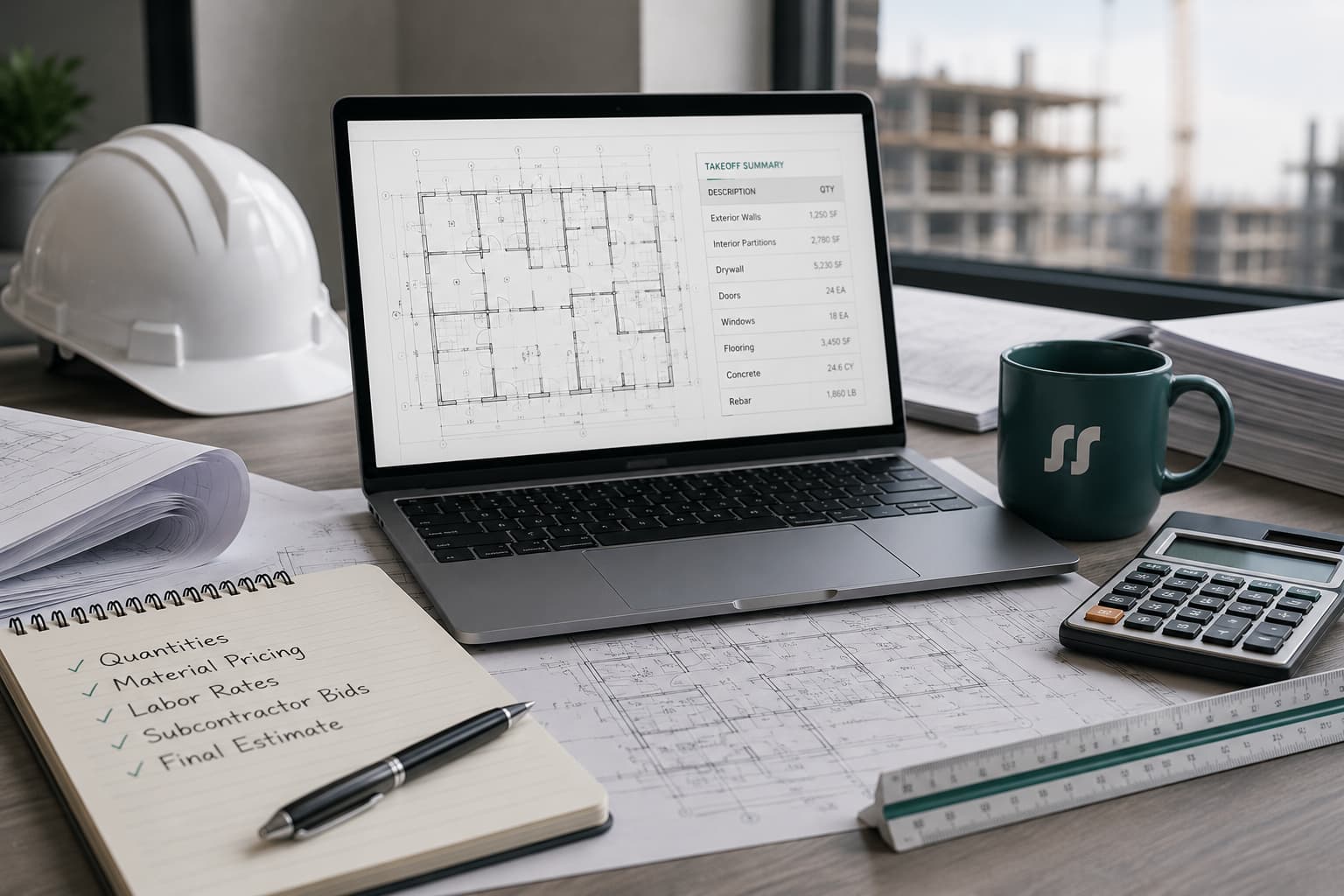
Partly, and it depends entirely on which part of estimating you mean. Estimating is really two jobs stacked together. The first is extraction: reading the plans and counting what is there, from fixtures to linear feet of conduit to square footage of drywall to cubic yards of concrete. The second is judgment: pricing that scope, applying local labor rates, leveling bids, value engineering, and deciding what to include and exclude.
ChatGPT is a strong helper on the language around estimating and a weak, risky tool on the measurement. That distinction is the whole article, so it is worth being precise about both sides.
What ChatGPT is genuinely good at for contractors
Used as an AI chatbot for contractors, not a takeoff engine, ChatGPT earns its place in the workflow:
- Writing and rewriting. Scope-of-work narratives, proposal cover letters, bid-clarification emails, subcontractor RFQs, and change-order explanations. It drafts fast and cleans up tone.
- Explaining the language. What bid leveling means, how a general-conditions line differs from overhead, the difference between markup and margin. It is a solid on-demand glossary.
- Spreadsheet help. Excel and Google Sheets formulas, pivot structures, and macro logic for a home-grown estimating sheet. This is exactly what contractors ask it (“can I build my own estimating program using Excel and PDF drawings?”), and for the spreadsheet scaffolding it genuinely helps.
- Summarizing text. Pulling key dates, exclusions, or submittal requirements out of a written spec section or an addendum.
- First-pass idea generation. Sanity-checking an approach, brainstorming line items you might have missed, or outlining a schedule. None of that touches a scaled drawing. That is the point: ChatGPT is excellent at the words and math around the estimate, and shaky at reading the drawing the estimate is built on.
Where ChatGPT breaks on a real plan set
Here is what everyday use and the available evidence surface when you ask a general-purpose chatbot to actually count and price from construction documents.
No scaled measurement. ChatGPT reads an image; it does not calibrate to a drawing’s scale. It cannot reliably measure linear feet of pipe or square footage of a room from a PDF the way a takeoff tool measures against a set scale. This alone rules it out as a quantity engine.
It hallucinates, and will not flag it. OpenAI’s own GPT-4 technical report states the model “is not fully reliable (it ‘hallucinates’ facts and makes reasoning errors).” A chatbot will confidently return “42 receptacles” whether or not it found 42, and it will not signal its own uncertainty. Independent measurements of hallucination vary widely by task, which is exactly the problem: you cannot predict when it is wrong.
No published bidding-grade benchmark. There is no named, peer-reviewed study showing a general chatbot reads construction drawings accurately enough to bid on. The closest analogues, tests of GPT-4’s vision on technical images, report considerable inaccuracy in image understanding. On a takeoff, a quantity you cannot verify is a quantity you have to redo.
It is not repeatable. Ask the same question twice and you can get two different counts. Estimating needs deterministic, checkable results.
Large sets overwhelm it. A real bid package is dozens to hundreds of sheets. General chatbots have context limits and degrade as inputs get complex (multiple layers, mixed units, cross-referenced schedules), giving inconsistent or oversimplified answers.
No live material pricing. ChatGPT’s pricing knowledge is frozen at its training cutoff and blind to your region. Construction wages alone vary 25 to 35% between markets, and material prices move monthly. It cannot see today’s number.
No audit trail. When ChatGPT gives you a count, it cannot link that number back to the exact symbol on the exact sheet. You cannot verify it, so you have to redo it, which defeats the purpose.
Confidentiality risk. Uploading a client’s drawings and pricing into a consumer chatbot can breach the confidentiality terms you signed with the GC or owner.
The consensus among estimators testing these tools is consistent: general AI is fine for preliminary extraction and design-stage planning, but every output needs human validation before a number reaches a client. AI amplifies estimators; it does not replace them. (More on that in our guide to whether AI will replace construction estimators.)
Why a domain AI agent wins for takeoff and estimating
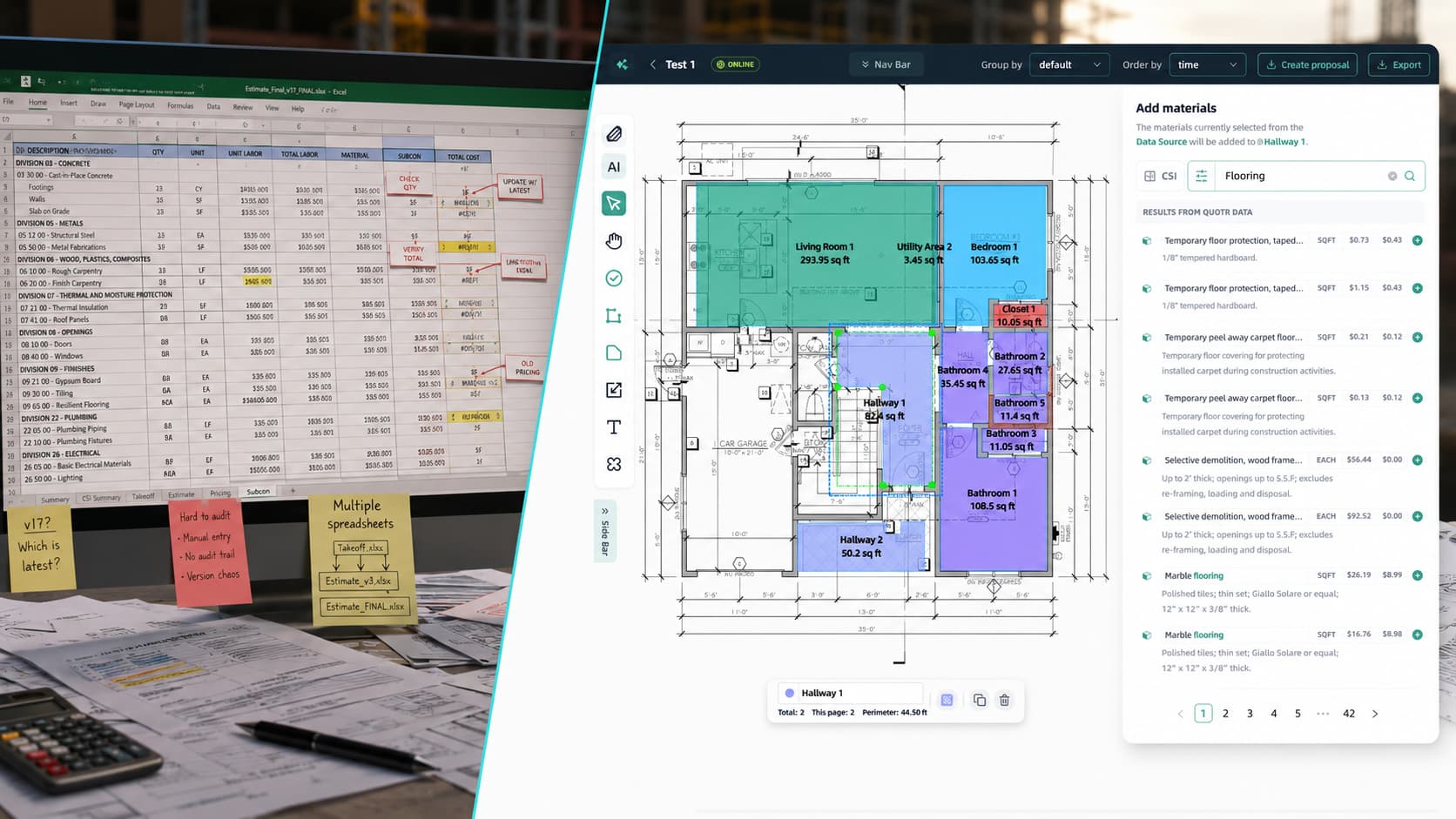
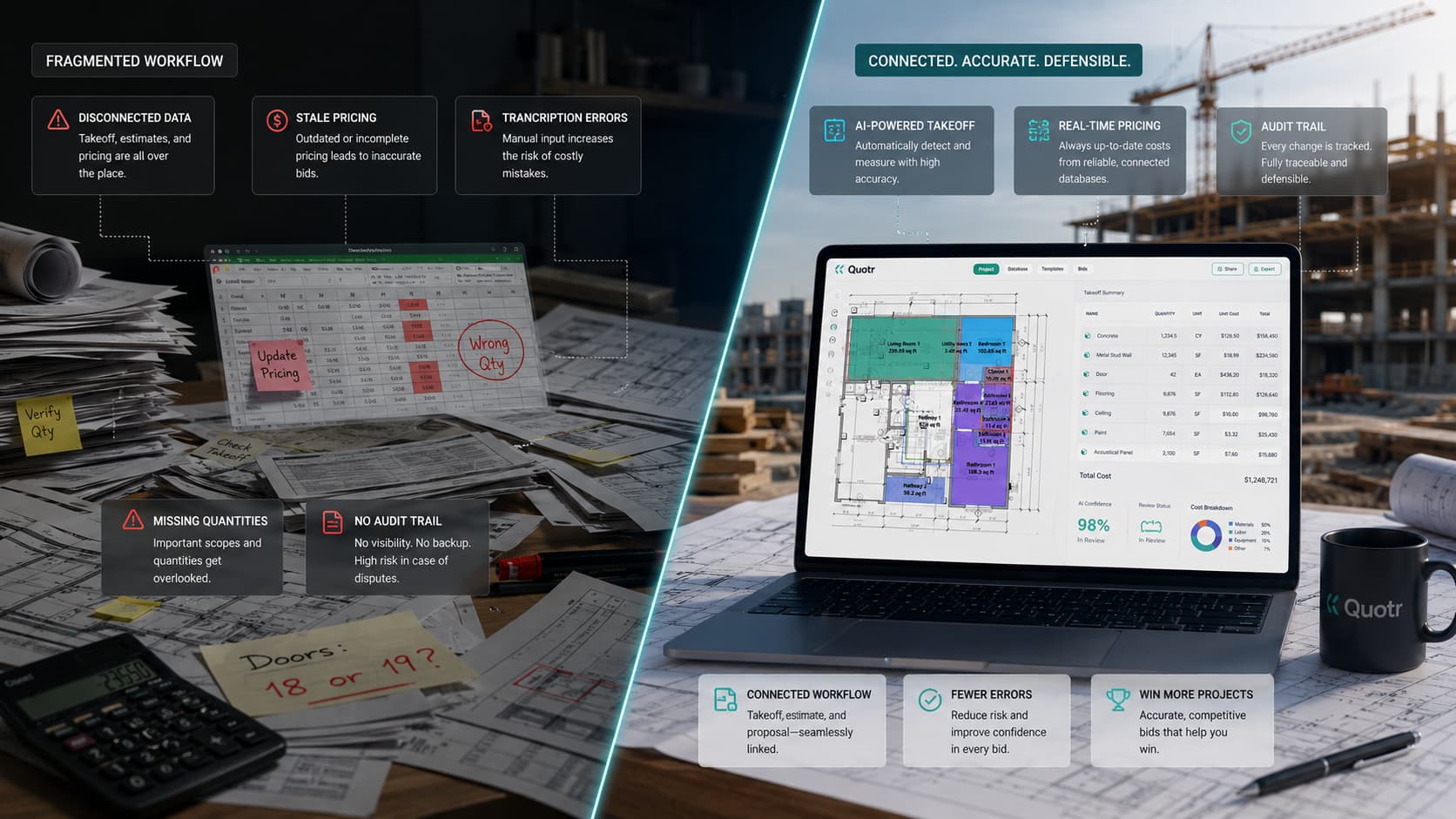
The difference is not “smarter AI.” It is an AI scoped to your project and built for the job, instead of a general assistant guessing at a drawing. ChatGPT is a general assistant you wrangle with prompts; Quotr Software is designed end to end for how estimators actually work: load the plan set, let the agent read and count it, review the confidence flags, and carry the takeoff straight into a priced estimate and buyout.
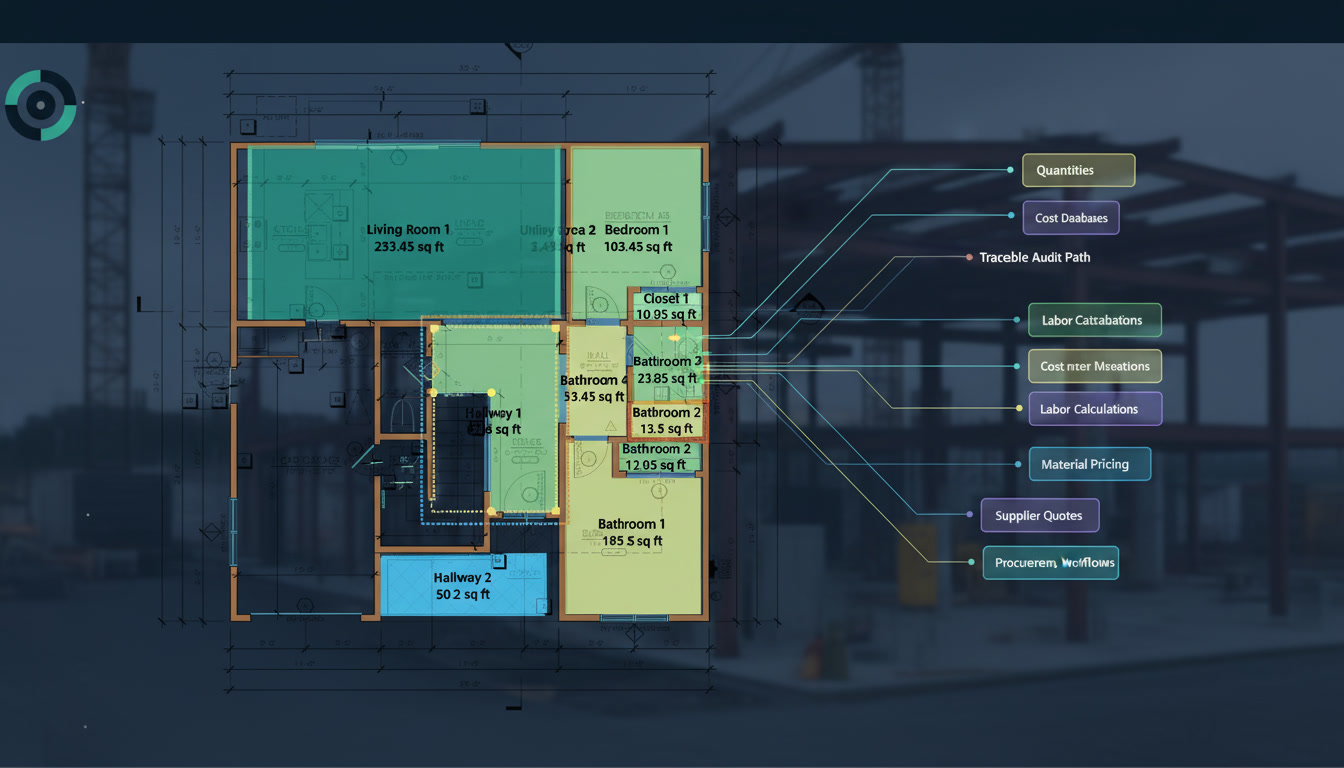
The Quotr AI agent is a feature inside Quotr Software, Quotr’s AI takeoff, estimating, and bidding platform. Instead of a chat window with no memory of your plans, it works on top of the plan set you loaded, and it is built so every answer is checkable:
- Grounded in your project, cited to the sheet. Ask it “how many recessed lights are on level 2?” and it answers from your actual drawings and points you to the sheet, not a hallucinated number.
- Reads and classifies the whole set by trade, finds any sheet or schedule in seconds, and pulls a single trade’s scope on request.
- Per-item confidence and full audit trail. Quotr’s Smart Matching scores every count and links it to the exact symbol on the exact sheet, so you see which quantities to trust before the bid goes out. On clean vector PDFs, Quotr’s AI takeoff runs at 95 to 99% accuracy on counts and areas (Quotr internal benchmarking); low-res scans run lower and get a human check.
- CSI/MasterFormat classification with real codes, so your takeoff breaks down by division automatically.
- Coverage and missed-scope flagging. It tracks which systems have not been reviewed and runs a pre-bid gap analysis, the “what did I forget” pass a chatbot cannot do because it does not know your whole set.
- Human-in-the-loop by design. The agent finds, reads, counts, scopes, classifies, and flags gaps; you keep the final judgment. What it deliberately does not do: invent prices it cannot source, draw markup on the canvas for you, or produce a finished bid with no review. Those limits are the honest ones, and they are the same discipline a good estimator already works with.
For the full picture of how the agent reads a bid package, see the Quotr AI agent for construction, and for the category overview start with our pillar on what AI construction estimating software is.
The honest answer: use both, for different jobs
The smart move is not ChatGPT or a domain agent. It is using each for what it is good at. Keep ChatGPT for the language and spreadsheet work: proposals, emails, scope narratives, formulas, explanations. Use a domain agent grounded in your plans, the Quotr AI agent inside Quotr Software, for the part where accuracy is money: reading the set, counting to a confidence score, classifying by CSI, flagging missed scope, and carrying quantities into a priced estimate and buyout.
ChatGPT vs the Quotr AI agent, side by side
| Capability | ChatGPT (general assistant) | Quotr AI agent (inside Quotr Software) |
|---|---|---|
| Reads a plan set | Views an image; struggles at scale | Reads and classifies the full set by trade |
| Quantity takeoff accuracy | No published bidding-grade benchmark; non-deterministic | 95 to 99% on clean vector PDFs (Quotr internal benchmarking) |
| Scaled measurement | No drawing-scale calibration | Yes, measures against set scale |
| Counts cited to the sheet | No | Yes, every count linked to the symbol and sheet |
| Per-item confidence | No | Yes, Smart Matching confidence score |
| Handles large multi-sheet sets | Degrades / context limits | Built for full bid packages |
| CSI/MasterFormat breakdown | Generic, ungrounded | Real codes, tied to your counts |
| Missed-scope / pre-bid gap check | No | Yes, coverage flagging + gap analysis |
| Live material pricing | No (training cutoff) | Pricing tied to your estimate; factory-direct via Quotr Procurement |
| Repeatable results | No | Yes, deterministic and checkable |
| Client-drawing confidentiality | Risk on consumer tools | Handled inside your project workspace |
| Proposals, emails, formulas | Excellent | Not its job, but can generate professional proposals |
Good to know: like every AI takeoff tool, Quotr flags edge cases for a quick human check. That is per-item confidence plus human-in-the-loop, universal to the category, not a workaround.
FAQ
Can ChatGPT do construction takeoff?
Not reliably. ChatGPT can look at a PDF and describe it, but it does not calibrate to drawing scale, it returns different counts on the same question, and it cannot cite a count back to the sheet. There is no published benchmark showing a general chatbot counts construction drawings accurately enough to bid on. Use it for preliminary reads only, and validate every quantity before it reaches a client.
Is ChatGPT accurate for construction estimating?
For the language of estimating (scope narratives, proposals, formulas), yes. For the numbers (counting quantities and pricing them), no. OpenAI’s own documentation notes GPT-4 “hallucinates facts,” and ChatGPT has no live regional material pricing, so its estimates can be confidently wrong.
What is the difference between ChatGPT and a construction AI agent like Quotr’s?
ChatGPT is a general assistant with no memory of your plans. The Quotr AI agent, a feature inside Quotr Software, works on your actual loaded plan set: it counts to a per-item confidence score, cites every quantity to the sheet, classifies by CSI, and flags missed scope, results you can audit and bid on.
Can I build my own estimating tool with ChatGPT and Excel?
ChatGPT is great for building the spreadsheet: formulas, structure, macros. It is not built to read your PDF drawings to scale and count accurately, which is the hard part of estimating. Most contractors pair a spreadsheet with a purpose-built takeoff tool rather than asking a chatbot to measure plans.
Is it safe to upload construction drawings to ChatGPT?
Be careful. Client drawings and pricing are usually covered by confidentiality with the GC or owner, and uploading them to a consumer chatbot may breach those terms. A dedicated platform keeps your project documents inside your own workspace.
Should estimators use AI at all?
Yes, as an amplifier, not a replacement. AI handles the repetitive extraction and calculation; the estimator handles value engineering, risk, and the client relationships that win bids. See our take on whether AI will replace construction estimators.
Related Reading
- The Quotr AI Agent: An AI Agent for Construction That Reads Your Whole Bid Package
- What Is AI Construction Estimating Software?
- AI Construction Estimating Software: Buyer’s Guide
- Is AI Takeoff Actually Accurate Yet?
- Will AI Replace Construction Estimators?
See how the agent works on your own plans: explore Quotr Software, start a free trial, or talk to our team and bring the hardest plan set you have.
About the author
Junzhe Shi is Co-Founder and CTO of Quotr, where he leads the computer-vision and AI-agent systems behind Quotr’s takeoff engine. He writes about what AI can and cannot do on real construction documents.
References
- OpenAI, GPT-4 Technical Report (model “is not fully reliable… hallucinates facts and makes reasoning errors”). https://cdn.openai.com/papers/gpt-4.pdf
- ELS Publishing, Can ChatGPT assist in cost analysis and bid pricing in construction? (peer-reviewed study). https://pdf.elspublishing.com/paper/journal/open/SC/2024/sc20240009.pdf
- OpenAI Developer Community, Integrating ChatGPT with a Construction Estimation Tool (real-world integration limits). https://community.openai.com/t/looking-for-suggestions-integrating-chatgpt-with-a-construction-estimation-tool/1365157
- Quotr Software (AI takeoff, estimating & bidding; the Quotr AI agent). https://quotr.ai/software