Best AI Bid Software for Construction 2026
Construction bidding has always been a race. The job goes to whoever gets an accurate number out the door fastest — and for most of the industry’s history, that meant the contractor with the most experienced estimator and the most disciplined process. In 2026, it increasingly means the contractor with the right software.
AI bid software for construction isn’t a single category. It spans takeoff tools that read plan sets automatically, estimating platforms that price quantities against live cost databases, bid management systems that coordinate subcontractor outreach, and procurement tools that convert a winning bid into actually-bought materials at a known price. The best platforms combine more than one of these. The weakest are one-trick tools marketed as something broader.
This guide covers the best AI bid software for construction in 2026 — what each category does, the tools worth your shortlist, and how to select the right one for your operation.
What AI Bid Software Actually Does
Before comparing tools, it’s worth being precise about what “AI bid software” covers — because vendors stretch the term in every direction.
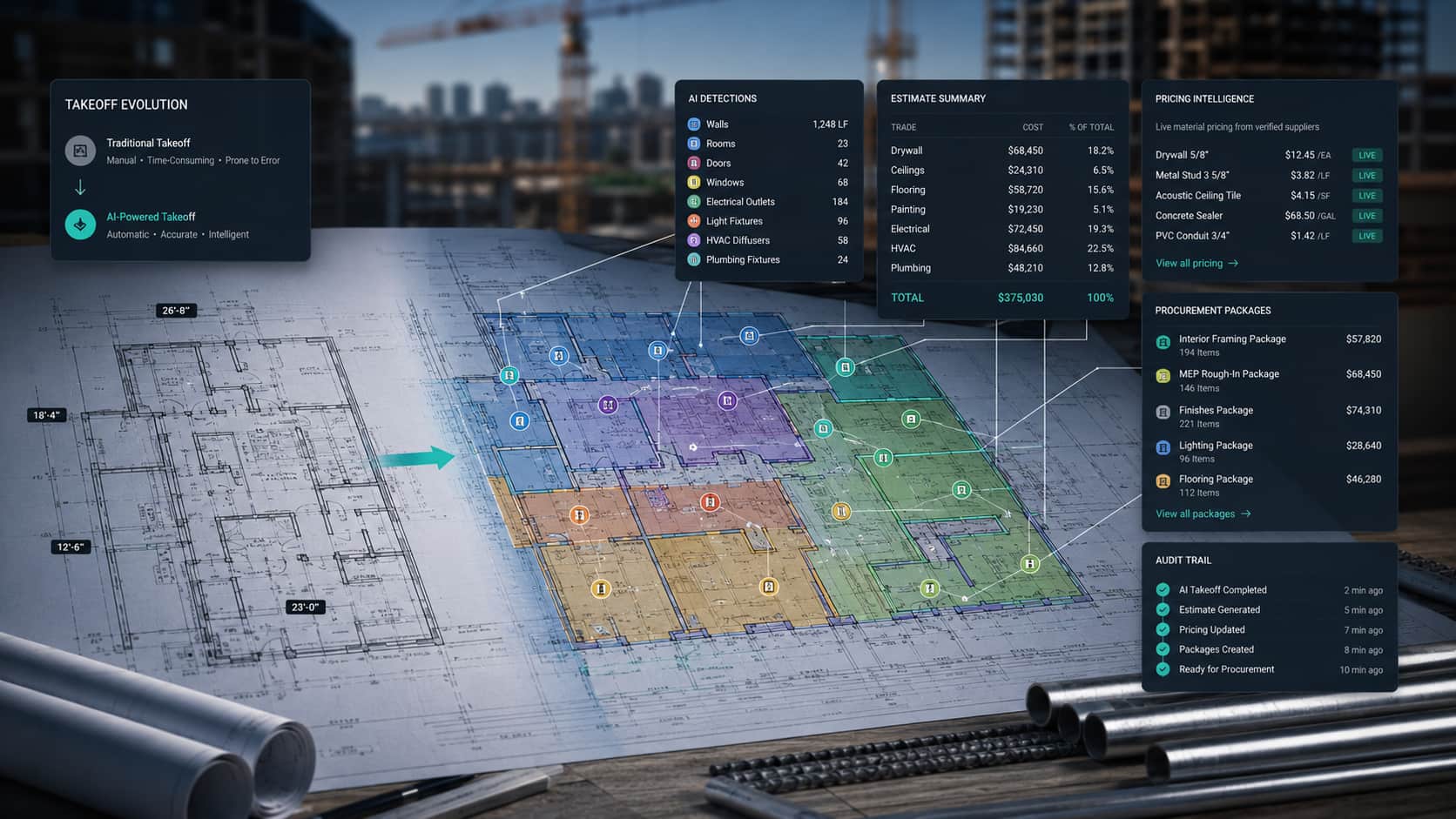
AI takeoff uses computer vision to read construction drawings, extract quantities (symbol counts, room areas, linear measurements), and return them with confidence scores so an estimator knows which counts to trust and which to review. This is the part of the bidding workflow where AI has the clearest, most measurable impact in 2026.
AI estimating ties those quantities to a cost database — material rates, labor rates, and assemblies — to produce a fully priced bid. The best platforms localize pricing by zip code and let you layer in your own rates. The weakest use a static national average that’s out of date before you open it.
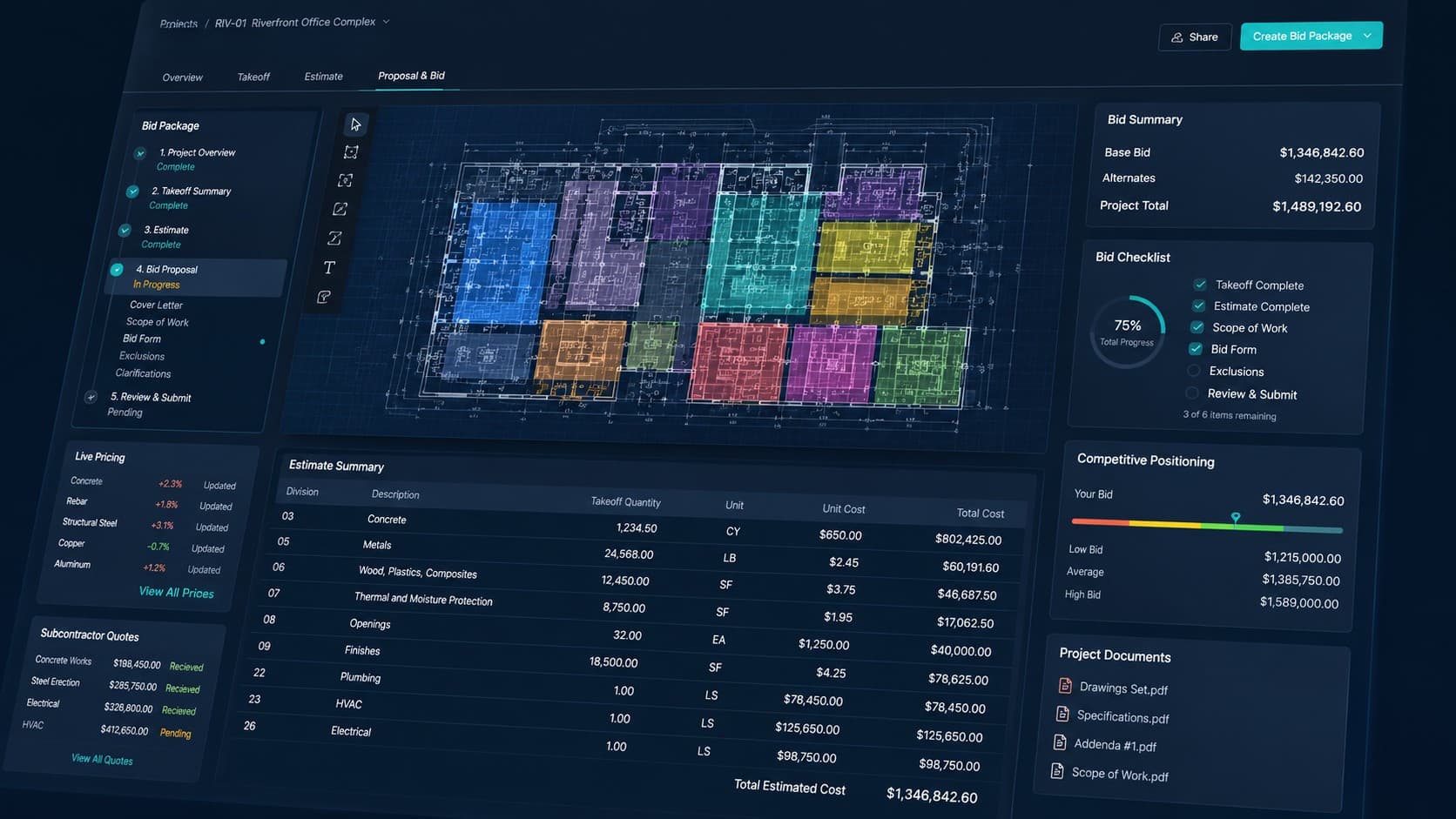
AI bid management handles the coordination layer — sending bid invitations to subcontractors, tracking responses, leveling scopes, and managing the bid package through to submission. This is where GCs and owners spend most of their bid-phase time; it’s also where a lot of generic software lives that isn’t genuinely AI-assisted.
AI procurement converts a winning bid into a material buy — sourcing supplier quotes, comparing bids, or connecting to factory-direct pricing so the estimate turns into actually-bought materials at a known cost. This is the layer almost no competitor has built end to end.
The contractors winning more work in 2026 aren’t using four separate tools that don’t talk to each other. They’re using platforms where takeoff, estimating, and procurement share one source of truth — a change to a quantity flows straight through to price and buyout without re-keying.
How to Select the Best AI Bid Software for Construction
Before looking at specific tools, three questions narrow the field fast:
What’s your role in the bid chain? A GC coordinating subcontractor bids needs different software than an electrical sub doing high-volume takeoff. A developer running early-stage feasibility needs something different still. Match the tool to your actual workflow — not the one with the most features on the marketing page.
Where does your bid process currently break down? Is it the takeoff that takes too long? The pricing that’s inaccurate? The sub outreach that falls through the cracks? The material buyout that blows up after award? The right AI bid software solves your specific bottleneck, not every possible bottleneck at once.
Do you need self-serve, done-for-you, or both? Some operations want a platform their team drives. Others are in a bid surge and need a number fast without running the process themselves. A few need both depending on the job type. The answer shapes which tools are worth evaluating.
The Best AI Bid Software for Construction in 2026
1. Quotr.ai — Best overall for AI takeoff, estimating, and procurement end to end
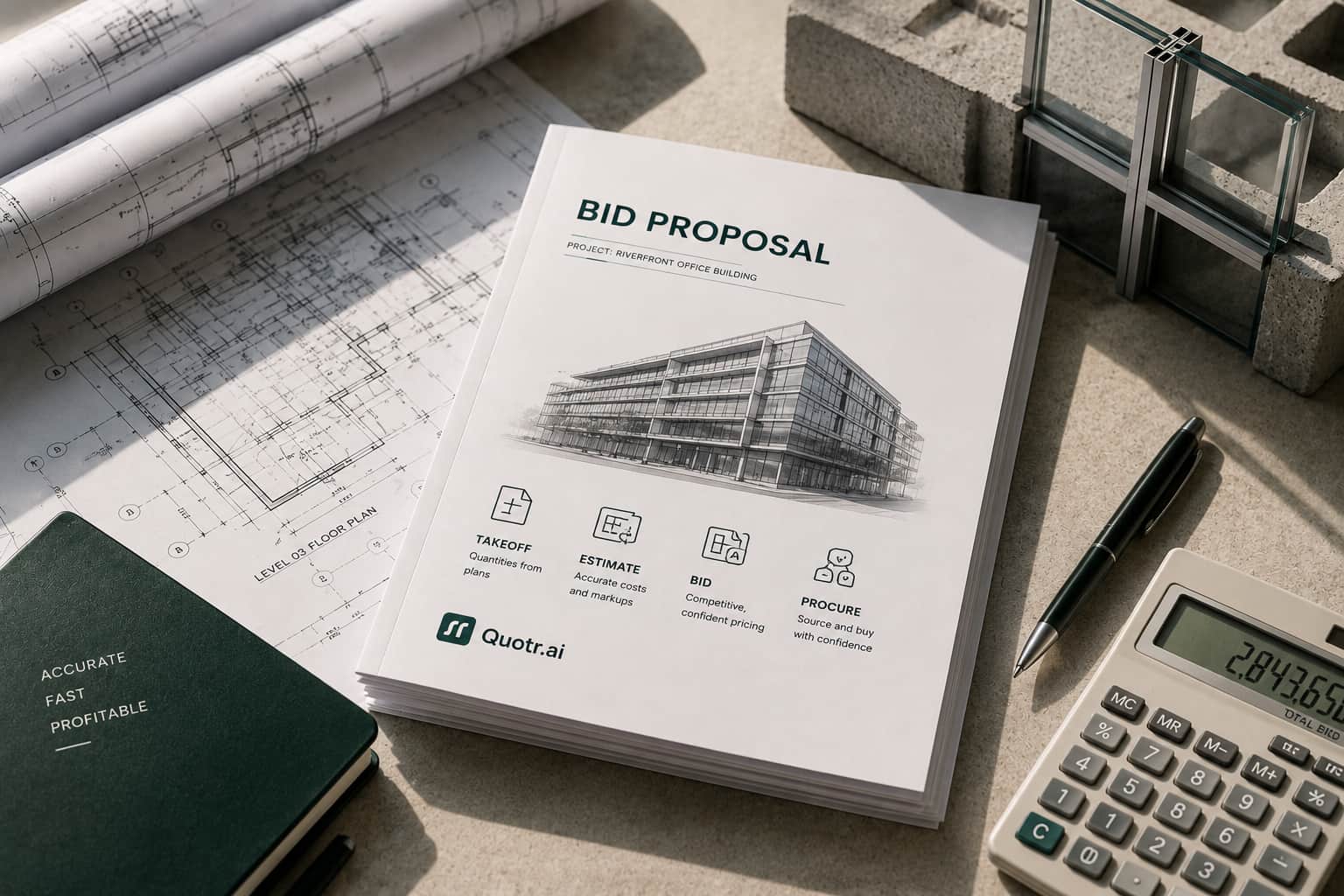
Quotr.ai is the most complete AI bid platform for construction contractors and developers in 2026 — covering takeoff, estimating, bidding, and procurement in one connected workflow, with three distinct options depending on how much of the process you want to own.
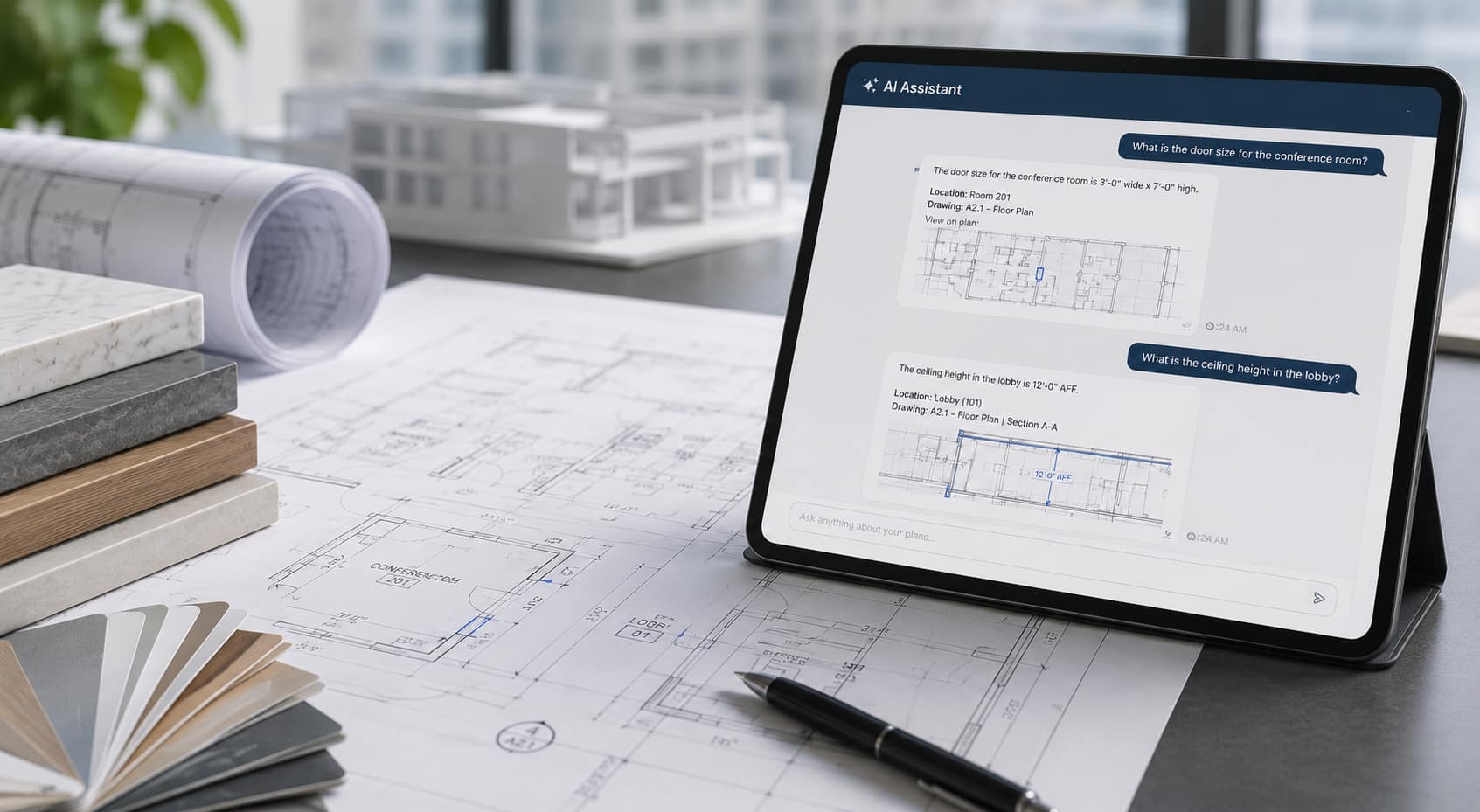
Quotr Software is the self-serve platform your team drives. Upload PDF or image plans and Quotr’s computer-vision AI detects rooms, counts, openings, doors, windows, and key symbols with confidence-scored Smart Matching at 95–99% accuracy on clean vector PDFs (Quotr internal benchmarking). An estimator refines from there. Quotr then prices those quantities instantly against a built-in cost database of thousands of line items — with zip-code-localized labor and material rates, or your own custom rates. Takeoff and estimating share one source of truth, so a change to a count flows straight through to the price — no re-keying, no version drift. The Quotr AI Agent lives inside Quotr Software: ask your plans anything in plain language — symbol counts, room dimensions, openings — and get answers cited back to the sheet, without hunting through the drawings yourself.
Quotr Service is the done-for-you option. Don’t want to run the takeoff yourself? Quotr’s in-house cost estimators deliver a development cost estimate in 3–4 business days, or a deal-level pro forma in 2–3 business days, priced per project. It’s how developers and busy subs get a decision-ready number during a bid surge without buying a seat or running the process in-house.
Quotr Procurement is the buyout layer — and the piece almost no competitor has built end to end. Instead of leaving you to chase local supplier quotes after you’ve won the job, Quotr sources materials factory-direct from a network of 50+ verified factories across Foshan and Guangdong, China, delivered door-to-door (DDP) at roughly 40–55% below standard distributor markups. The estimate turns into actually-bought materials at a known price, not a best-guess that gets repriced at buyout.
Quotr is multi-trade by design — proven today across electrical, concrete, flooring, drywall, structural steel, glazing, and more, and expanding into plumbing and MEP — so subs get workflows tuned to how they actually bid their trade, and developers get fast cost visibility for underwriting.
Best for: Subcontractors doing high-volume bidding who want AI takeoff and trade-specific estimating; developers who need fast feasibility and pro forma support; any contractor who wants to close the loop between estimate and material buyout.
Pricing: Published — Solo from $299.90/month (from $249/seat/mo billed yearly), Team (2–6 seats) $499.90/month, Enterprise custom. Quotr Service is per-project. Quotr Procurement pricing depends on scope. Every software plan includes a 7-day free trial.
Watch-outs: Newer to market than the legacy desktop systems. Complex schematic drawings and non-standard symbol sets still benefit from estimator review — which Quotr flags automatically with confidence scores.
2. Procore — Best for GC bid management and subcontractor coordination
Procore is the dominant project management platform in commercial construction, and its bidding module — including Procore Estimating (formerly Esticom) — handles the GC-side bid coordination workflow: subcontractor invitation to bid, bid leveling, scope comparison, and award management. For GCs who live in Procore and need their bid process connected to project management, RFIs, and subcontract administration, it’s the natural choice.
Best for: GCs who need subcontractor bid coordination connected to a broader project management workflow.
Pricing: Quote-based; Procore pricing scales by construction volume. Contact Procore for current rates.
Watch-outs: Not a subcontractor takeoff tool — the AI takeoff depth for specialty trades is lighter than purpose-built platforms. Broad platform strength; trade-specific estimating depth requires add-ons or third-party integrations.
3. Buildxact — Best for residential builders and smaller GCs
Buildxact is an estimating and job management platform designed for residential builders and smaller general contractors. It offers on-screen takeoff, a supplier price catalog integration, and job costing connected to estimating — in a workflow built for the residential build process rather than commercial subcontractor bidding.
Best for: Residential builders, small GCs, and remodelers who want estimating connected to job management and scheduling.
Pricing: Reported ~$169–$509/month; free trial available. Confirm with Buildxact.
Watch-outs: Geared to residential and smaller jobs; lighter on trade-specific AI takeoff depth and commercial bid management features.
4. STACK — Best cloud takeoff and estimating for commercial contractors
STACK is a widely used cloud takeoff-and-estimate platform across multiple trades — concrete, drywall, roofing, and others — with a strong assembly library, good plan management, and a clean multi-user workflow. For commercial contractors who want cloud-based takeoff connected to estimating without a desktop install, STACK is a credible, well-established option.
Best for: Commercial GCs and subs who want cloud takeoff and estimating with strong plan management and multi-user collaboration.
Pricing: Reported ~$2,599–$2,999/year per user; confirm with STACK.
Watch-outs: Takeoff and estimating only — no integrated procurement, factory-direct sourcing, or AI Agent. AI assistance is assembly-aided rather than computer-vision takeoff. Annual contract.
5. Autodesk Construction Cloud (ACC) — Best for large GCs and owners with complex bid programs
Autodesk Construction Cloud brings together Autodesk’s construction tools — including BIM 360, PlanGrid, and BuildingConnected — into an integrated platform for large GCs and owners. BuildingConnected within ACC is the leading bid management tool for large commercial GCs, handling subcontractor prequalification, invitation to bid, bid leveling, and award across complex multi-trade bid programs.
Best for: Large GCs and owners managing complex, multi-trade bid programs with significant subcontractor coordination requirements.
Pricing: Quote-based; ACC is a significant investment priced by module and construction volume. Contact Autodesk for current rates.
Watch-outs: Enterprise-scale tool with enterprise-scale overhead — significant setup, training, and total cost of ownership. Overkill for most subcontractors and smaller GC operations.
6. Bid4Build — Best simple bidding tool for smaller contractors
Bid4Build is a straightforward, template-driven estimating and bidding tool for smaller contractors and specialty trades who need a fast way to build itemized bids without the overhead of a full takeoff platform. For contractors pricing primarily from site visits and scope descriptions rather than full drawing sets, it offers a low-friction way to produce professional bid documents.
Best for: Smaller contractors and specialty subs pricing from site visits and scope descriptions rather than plan sets.
Pricing: Subscription-based; confirm current pricing with Bid4Build.
Watch-outs: Not a takeoff tool — no PDF measurement, no AI detection, no computer-vision quantity extraction. Works for service and smaller scopes; not built for commercial plan-set bidding.
AI Bid Software Comparison (2026)
| Tool | Best for | AI takeoff | Estimating | Bid management | Procurement | Pricing |
|---|---|---|---|---|---|---|
| Quotr.ai | Subs + developers, end-to-end | Yes — computer vision + confidence scores | Yes — zip-localized, custom rates | Yes — proposals + RFQs | Yes — factory-direct, 40–55% savings | Published: from $299.90/mo |
| Procore | GC subcontractor coordination | Via Procore Estimating add-on | Via Procore Estimating | Yes — ITB, leveling, award | Limited | Quote-based |
| Buildxact | Residential builders / small GCs | Limited | Yes — supplier catalog | Limited | No | ~$169–509/mo |
| STACK | Commercial multi-trade takeoff | Assembly-assisted | Yes | Limited | No | ~$2,599–2,999/yr |
| Autodesk ACC | Large GC / owner bid programs | Via integrations | Via integrations | Yes — BuildingConnected | No | Quote-based |
| Bid4Build | Small contractors / service work | No | Template-driven | Limited | No | Subscription |
Competitor pricing is third-party-reported; confirm with each vendor. Quotr.ai pricing is published on the pricing page.
How to Choose: Matching the Tool to Your Operation
If you’re a specialty subcontractor doing high-volume bidding from plan sets — electrical, concrete, drywall, glazing, structural steel, or any other trade — your priority is AI takeoff accuracy, trade-specific quantity logic, and speed from plan to priced bid. Quotr.ai is built for this workflow. STACK is a strong alternative if you don’t need AI computer-vision takeoff.
If you’re a general contractor coordinating subcontractor bids on commercial projects, your priority is bid management — invitation to bid, scope leveling, and award coordination. Procore and Autodesk ACC are the category leaders; the right one depends on your project scale and how much of the Autodesk or Procore ecosystem you’re already in.
If you’re a developer or owner running early-stage feasibility and underwriting, your priority is getting to a defensible cost number fast without running a full takeoff process. Quotr Service delivers that in 3–4 business days per project. Quotr Software handles it yourself if you have the internal capacity.
If you’re a smaller contractor or remodeler pricing from site visits rather than full drawing sets, Buildxact or Bid4Build keep the process simple without the overhead of a full commercial estimating platform.
Frequently Asked Questions
What is the best AI bid software for construction in 2026? For subcontractors doing plan-set-based bidding, Quotr.ai leads on AI takeoff accuracy, trade-specific estimating, and the procurement layer that turns a winning bid into a material buy. For GC bid coordination, Procore and Autodesk ACC are the category standards. The right answer depends on your role in the bid chain and where your current process breaks down.
How do I select the best AI bid software for construction? Start with your role — GC, sub, or developer — and identify where your bid process currently breaks down: takeoff speed, pricing accuracy, sub coordination, or post-award buyout. Match the tool to that bottleneck first. Then evaluate on accuracy (ask for a pilot on your own plan sets), pricing transparency (published rates vs. quote-only), and whether the tool covers enough of your workflow to reduce rather than add to your app stack.
What is the best construction bid management software? For large GCs managing multi-trade bid programs, Procore and Autodesk BuildingConnected are the dominant platforms. For subcontractors who need takeoff, estimating, and bid output in one workflow, Quotr.ai covers the full process from plan set to proposal and RFQ without separate bid management software.
How accurate is AI construction takeoff? On clean vector PDFs with standard symbology, modern AI takeoff tools reach 95–99% accuracy on counts and area calculations (Quotr internal benchmarking). Accuracy drops to 80–88% on low-resolution scanned PDFs without human review. Per-item confidence scoring — available in Quotr.ai — tells you which counts to trust and which to review before the bid goes out.
Does AI bid software replace estimators? No — and the platforms that claim otherwise are overselling. AI handles the counting, measuring, and pricing pass. Estimators handle scope judgment, labor strategy, client relationships, and the bids worth chasing. The contractors pulling ahead in 2026 are using AI to eliminate the counting grind so their estimators can focus on the work that requires their experience.
The Bottom Line
The best AI bid software for construction in 2026 is the one that solves your actual bottleneck — whether that’s takeoff speed, pricing accuracy, sub coordination, or post-award buyout. No single platform is the right answer for every operation, but the contractors winning more work aren’t the ones with the biggest teams. They’re the ones who closed the gap between plan set and priced bid, and between winning bid and actually-bought materials.
If you want AI takeoff, trade-specific estimating, and factory-direct procurement under one roof — with pricing you can see before you talk to sales — start a free trial of Quotr.ai or talk to our team. Bring your hardest plan set. The audit is the point.
Related reading:
- AI Construction Estimating Software: Buyer’s Guide
- Is AI Takeoff Actually Accurate Yet? Honest 2026 Answer
- Quotr AI Agent: The AI Agent for Construction Takeoff
- What Is Construction Procurement? (2026 Guide)
- AI Agents for Construction Procurement and Buyout
- The Best AI Construction Estimating Software in 2026
References:
- Procore
- Autodesk Construction Cloud
- Buildxact
- STACK
- Quotr.ai — For Contractors.