
Still have questions?
Talk with our team
Product questions, pricing, or rollout — we'll get back within one business day.
Contact usConstruction AI
Junzhe Shi, Yuan Gan, Hanyang Liu, and Jaron Erba
NVIDIA GTC 2027 poster · Quotr AI
We trained a specialized vision-language model to recognize the small symbols that determine construction quantities.
Quotr has trained its own AI model for engineering drawings. It specializes in recognizing the lights, outlets, sensors, and other small symbols that drive construction quantities.
Built on an open-weight Qwen model and trained by Quotr for this task, it learns the visual distinctions that matter in dense drawings. Combined with our safe tiling method, Quotr’s model outperformed the frontier models in our symbol-recognition benchmark.
Quotr is a member of NVIDIA Inception.
01 / The benchmark
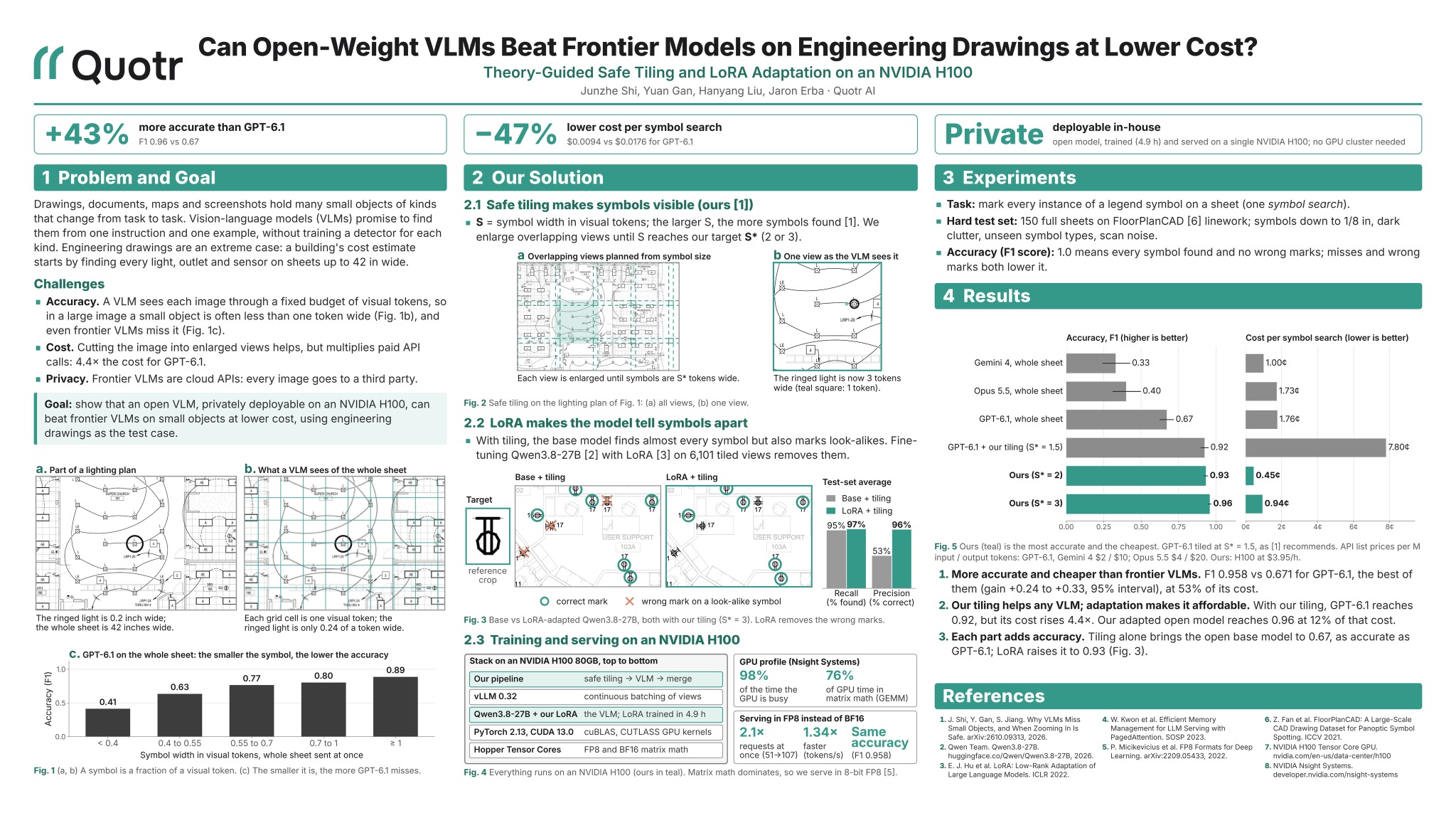
For this benchmark, we deliberately selected 150 difficult engineering drawings, including tiny symbols and dense linework, to stress-test our model and visual processing workflow.
+43%
Better symbol detection
F1 versus GPT-6.1 on whole sheets.
Quotr
Trained in-house
Specialized for engineering drawings.
Private
Deploy on your terms
Infrastructure you control.
These results compare our system with GPT-6.1 processing whole sheets: 0.958 versus 0.671 F1. F1 balances finding the right symbols with avoiding incorrect marks. A symbol search locates every instance of a reference symbol on a drawing.
The advantage also holds when both models use our tiling method. In a separate 30-drawing comparison, Quotr’s model achieved 0.958 F1 versus 0.924 for GPT-6.1.
On typical engineering drawings, Quotr’s symbol-recognition accuracy can reach 99.13%.
02 / The poster
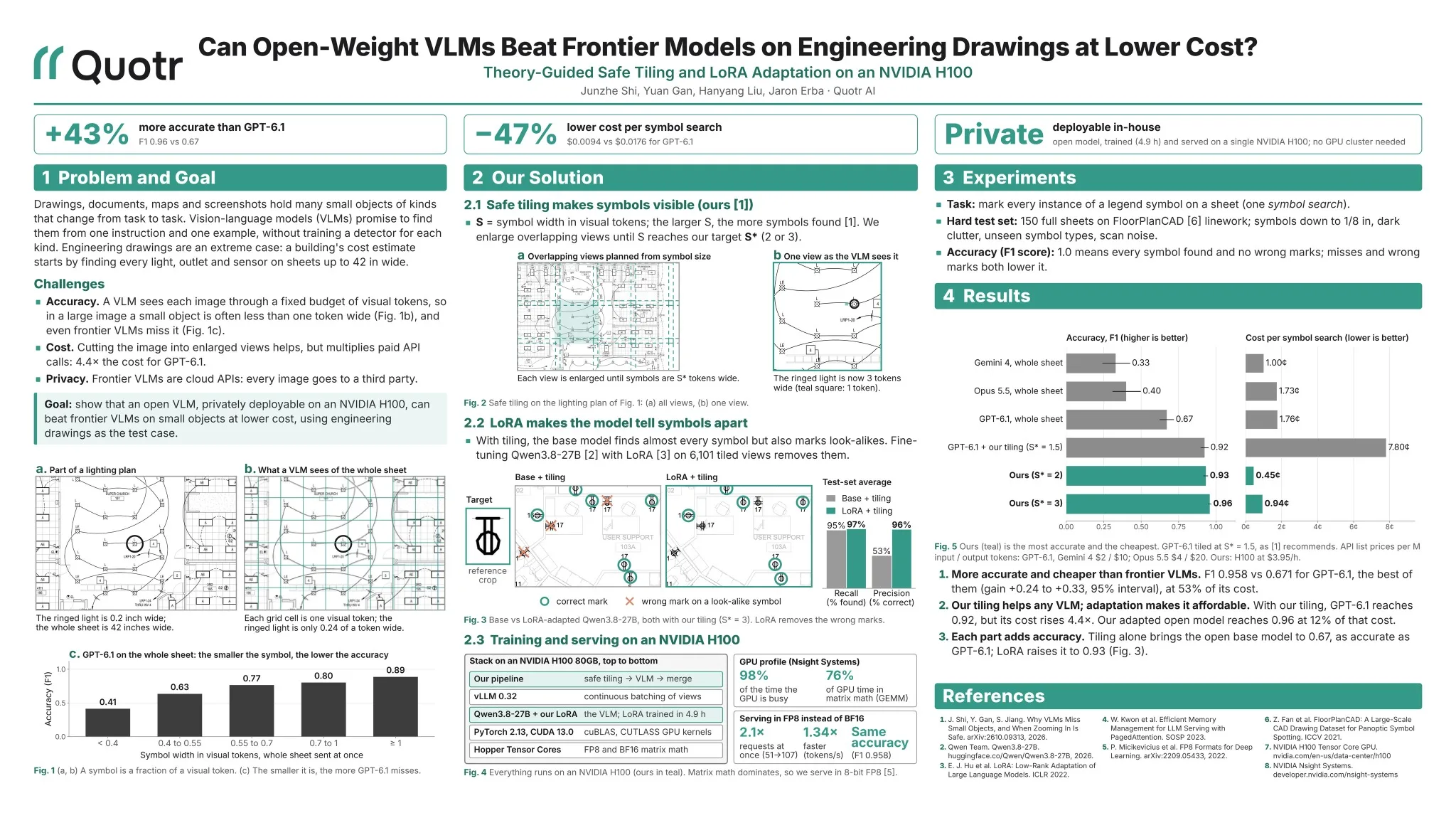
We’ve submitted this research as a poster to NVIDIA GTC 2027 and hope to see you there.
03 / The challenge
Engineering drawings pack small symbols into dense linework. When an entire sheet is compressed into a model’s visual input, the details that distinguish a fixture from a lookalike can become difficult to recognize.
For AI construction takeoff, those distinctions matter. Missing a symbol can undercount a quantity; marking the wrong symbol can overcount it. Reliable recognition requires both finding the target and distinguishing it from similar marks.
This approach builds on our research into why vision-language models miss small objects and when zooming in is safe.
Our model
Using LoRA, Quotr trained the model on 6,101 drawing views, improving its ability to distinguish the requested symbol from similar marks.
Our model
Our safe tiling method gives the model overlapping close-up views, helping it see small symbols clearly across the sheet.
Our model
Our training and inference workflow runs on NVIDIA GPUs, giving Quotr control over model adaptation, serving, and versioning.
Research at Quotr
Quotr connects original AI research, model training, and construction expertise to improve how drawings are understood. Better symbol recognition strengthens the foundation for quantities that teams can review, price, and use.
We are building construction AI around models we train, methods we develop, and results we measure.
Still have questions?
Product questions, pricing, or rollout — we'll get back within one business day.
Contact usLive walkthrough
See takeoff, estimates, and bid management tailored to how your team works today.
Schedule demo