
Best Flooring Estimating Software in 2026
Best Flooring Estimating Software in 2026: Top Tools for Flooring Contractors
By Quotr.ai
Flooring estimates live and die on area calculations — and on everything that happens after the square footage lands. Waste factors by material type, labor rates that actually reflect installation complexity, subfloor prep that doesn’t get buried in the base rate, and material pricing that’s current enough to hold through a job start. Get all of that right and you’re competitive. Miss one and you’re either losing jobs on price or winning them at a loss.
The market in 2026 splits into two categories: legacy desktop estimating systems that flooring contractors have used for years, and a newer wave of cloud-native, AI-assisted platforms that read plan sets and extract room areas automatically. This guide covers the best flooring estimating software in 2026 — five tools worth your shortlist — with honest notes on who each one fits, what it costs, and where it falls short.
If you want the full evaluation framework before you shop, pair this with our flooring estimating how-to guide, which covers waste factors, labor pricing by material type, subfloor prep, and how to win more work without cutting price. This article is the shortlist. That one is the scorecard.
What Flooring Estimating Software Actually Does
Flooring estimating software automates the most labor-intensive parts of pricing a job: area takeoff (calculating room square footage from plan sets, including waste factors and pattern match overages), material pricing (tying those areas to current costs by product type), and labor calculation (applying installation rates by floor type, subfloor condition, and site complexity).
The best platforms connect all three so a quantity change flows straight through to material and labor cost. The weakest are spreadsheets with a cleaner interface.
For flooring work specifically, two things separate real tools from generic ones: the ability to calculate waste by material type and install pattern (not just net square footage), and labor rate flexibility that lets you differentiate between a floating LVP install on a clean slab and a glue-down herringbone hardwood over an uneven subfloor. Flat-rate labor across all floor types is how flooring estimates go wrong.
How We Picked These Tools
We weighted flooring-specific area calculation, waste factor handling, labor rate flexibility, material pricing freshness, deployment model, and transparent pricing. We build Quotr.ai, an AI estimating platform used by flooring contractors, so we’re upfront about that — and we’ve tried to keep the comparisons fair and useful regardless of which tool you choose.
The 5 Best Flooring Estimating Software Tools in 2026
1. Quotr.ai — Best overall for AI-assisted flooring takeoff and procurement
Quotr.ai is a cloud-native estimating platform that runs the full subcontractor workflow — takeoff, estimates, pricing, bids, and procurement — in one product. For flooring contractors, the differentiator is AI that reads plan sets and extracts room areas automatically, room by room and finish zone by finish zone, with waste factors applied and every quantity mapped back to its source on the plan.
On clean vector PDFs, Quotr’s AI takeoff hits 95–99% accuracy on area calculations — the kind of consistency that’s hard to sustain across a high bid volume when areas are being measured manually. Every count comes with a per-item confidence score, so you know exactly which rooms or zones to review before the estimate leaves your desk. What used to take an hour of manual area measurement takes minutes.
Beyond takeoff, Quotr connects quantity accuracy to procurement: you can send quote requests to material suppliers, compare bids side by side, and source factory-direct — turning a flooring takeoff into a buyout workflow in the same platform.
Best for: Flooring contractors doing high bid volumes on commercial, multifamily, or mixed-use projects who want AI takeoff speed plus integrated bidding and procurement.
Pricing: Published and transparent — Solo from $299.90/month (from $249/seat/mo billed yearly), Team (2–6 seats) $499.90/month, Enterprise custom. Every plan includes a 7-day free trial.
Watch-outs: Newer to market than legacy desktop systems. Irregular room geometries and complex pattern layouts with unusual tile sizes still benefit from estimator review, as they do across every AI takeoff tool.
2. RFMS (Retail Floor Management Systems) — Best for flooring-specific business management
RFMS is a dedicated flooring industry platform that goes beyond estimating into full business management — job costing, inventory, installation scheduling, and customer management built specifically for flooring dealers and contractors. For flooring businesses that want their estimate to connect directly to operations, RFMS offers depth that general construction estimating software doesn’t match.
Best for: Flooring dealers and contractors who want estimating integrated into a flooring-specific business management system.
Pricing: Quote-based; contact RFMS directly for current pricing.
Watch-outs: More system than some flooring-only estimating needs require; the operational depth can be overkill for contractors who just need faster takeoff and bidding.
3. Measure Square — Best for detailed flooring layout and material optimization
Measure Square is a specialized flooring takeoff and layout tool used widely by flooring contractors and retailers. It handles room measurement, material optimization (minimizing waste on pattern-matched tile and hardwood), seam planning for carpet, and visual layout presentation for client proposals. For contractors who do a lot of pattern work, large-format tile, or carpet seam planning, the layout optimization features are a genuine time-saver.
Best for: Flooring contractors and retailers who need detailed layout planning, pattern match optimization, and client-facing visual proposals.
Pricing: Subscription-based; plans reported by aggregators starting around $99–$199/month depending on tier. Confirm current pricing with Measure Square.
Watch-outs: Primarily a takeoff and layout tool — material pricing and labor calculation are less developed than in full estimating platforms. Works best as part of a broader workflow rather than a standalone estimating system.
4. FloorRight (by Broadlume) — Best for residential flooring dealers and retailers
FloorRight is a flooring-specific estimation and business management tool designed primarily for residential flooring dealers. It handles room measurement, product selection, pricing, and proposal generation in a workflow built around the retail flooring sales process. For contractors who work closely with homeowners and need a customer-facing estimate and proposal tool, it fits that workflow well.
Best for: Residential flooring dealers and contractors with a strong retail or direct-to-consumer sales component.
Pricing: Quote-based through Broadlume; contact directly for current pricing.
Watch-outs: Residential and retail focus makes it a weaker fit for commercial flooring contractors, GC subcontract work, or high-volume plan-set-based bidding.
5. Stack — Best for general contractors and multi-trade estimating that includes flooring
Stack is a cloud-based construction estimating platform used across multiple trades. For general contractors who self-perform or closely manage flooring scopes, or for flooring contractors who want a familiar general construction estimating interface, Stack offers a capable takeoff and estimating workflow with good plan management features.
Best for: GCs managing flooring scopes, or flooring contractors comfortable with a general construction estimating workflow.
Pricing: Plans start around $2,999/year for the Pro tier; confirm current pricing with Stack.
Watch-outs: Not flooring-specific — waste factor handling and material type differentiation require manual setup rather than flooring-native logic. Labor rate flexibility depends on how much custom configuration you’re willing to invest upfront.
Flooring Estimating Software Comparison (2026)
| Tool | Best for | Deployment | AI takeoff | Procurement built in | Pricing model |
|---|---|---|---|---|---|
| Quotr.ai | AI takeoff + bidding + procurement | Cloud | Yes, area-based + confidence scores | Yes | Published: from $299.90/mo |
| RFMS | Flooring business management | Cloud/desktop | Limited | Via inventory module | Quote-based |
| Measure Square | Layout planning + pattern optimization | Cloud | Manual-assisted | No | From ~$99–$199/mo |
| FloorRight | Residential dealers and retailers | Cloud | Limited | No | Quote-based |
| Stack | Multi-trade / GC use | Cloud | Manual-assisted | No | From ~$2,999/yr |
Pricing for legacy and quote-based vendors is based on third-party aggregator estimates and should be confirmed directly with each vendor. Quotr.ai pricing is published on the pricing page.
How to Choose the Right Flooring Estimating Software
Match the tool to your work mix. If you’re bidding high volumes of commercial or multifamily flooring from plan sets and want to compress takeoff hours, prioritize a cloud platform with AI area extraction and waste factor handling built in. If you’re a flooring dealer with a strong residential sales process, a tool like FloorRight fits that workflow. If pattern layout and seam planning are central to your work, Measure Square handles those details better than most general estimating tools.
Three checks decide most shortlists: Can you test the tool on your own plan set before buying? Does it handle waste by material type and install pattern — not just net square footage? And does it differentiate labor rates by installation complexity, or force you into a flat rate? A demo on a clean sample room tells you nothing about a herringbone hardwood job with an uneven subfloor.
When you’re ready to pressure-test the shortlist, our guide on how to quote flooring jobs covers the full evaluation framework, and Is AI Takeoff Actually Accurate Yet? gives the honest accuracy breakdown across plan types.
Frequently Asked Questions
What is the best flooring estimating software in 2026? The best flooring estimating software depends on your work mix, but the non-negotiables are consistent: accurate area calculation with waste factors by material type, labor rates you can differentiate by installation complexity, and material pricing that stays current. Quotr.ai was built around those requirements with AI-powered takeoff, while RFMS and Measure Square remain strong choices for specific workflows.
How much does flooring estimating software cost? Pricing ranges from around $99/month for specialized tools like Measure Square up to $299.90/month and above for full-platform solutions like Quotr.ai. Legacy and business management systems are typically quote-based. Always confirm current pricing directly with each vendor.
Is AI flooring takeoff accurate enough to bid from? On clean vector PDFs, AI area extraction hits 95–99% accuracy on room areas in Quotr’s internal benchmarking. Accuracy drops on low-resolution scans and highly irregular geometries, which is why per-item confidence scoring and a short human review of flagged areas matter before a bid goes out.
Can flooring estimating software handle waste factors automatically? It depends on the tool. The best platforms apply waste factors by material type and install pattern automatically — accounting for the difference between a straight-lay LVP install and a diagonal hardwood or pattern-matched tile. Many tools require you to apply waste manually, which reintroduces the calculation step you’re trying to eliminate.
What’s the difference between a flooring takeoff tool and a flooring estimating tool? A takeoff tool extracts quantities — room areas, linear footage, material counts — from drawings or measurements. An estimating tool adds material pricing and labor calculation on top of those quantities to produce a fully burdened bid. The best platforms combine both so a quantity change flows automatically through to cost, rather than requiring a re-key between tools.
The Bottom Line
The flooring contractors winning more work in 2026 aren’t consistently the lowest bid. They’re the ones turning around accurate, detailed estimates faster — with waste factors explained, subfloor prep scoped separately, and labor priced by installation complexity rather than flat-rated across every job type.
Any tool on this list moves you in that direction. The right one depends on your work mix, your deployment preference, and how much of the takeoff-to-buyout workflow you want in one place.
If you want AI takeoff, integrated bidding, and procurement under one roof — with pricing you can see before you talk to sales — start a free trial of Quotr.ai and bring a current flooring job. The audit is the point.
Related reading:
Related Stories
-
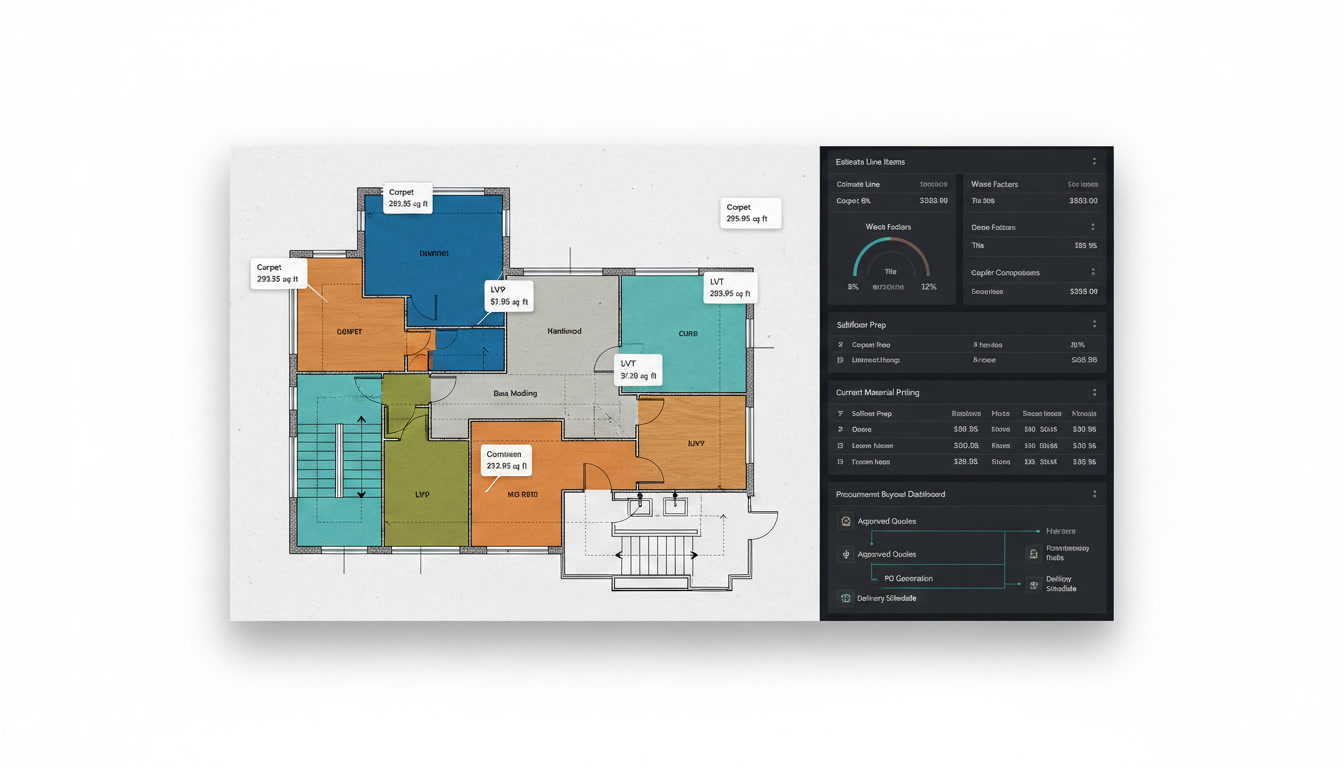
Flooring Trades: How to Quote Flooring Jobs and Win More Work
Learn how to quote flooring jobs accurately in 2026 — waste factors, labor pricing by material type, subfloor prep, and how to win more bids without cutting price.
-
How to Estimate HVAC and Sheet Metal From a Mechanical Plan
Learn how to estimate HVAC and sheet metal from mechanical plans, including ductwork linear feet, equipment counts, fittings, insulation, and labor hours.
-
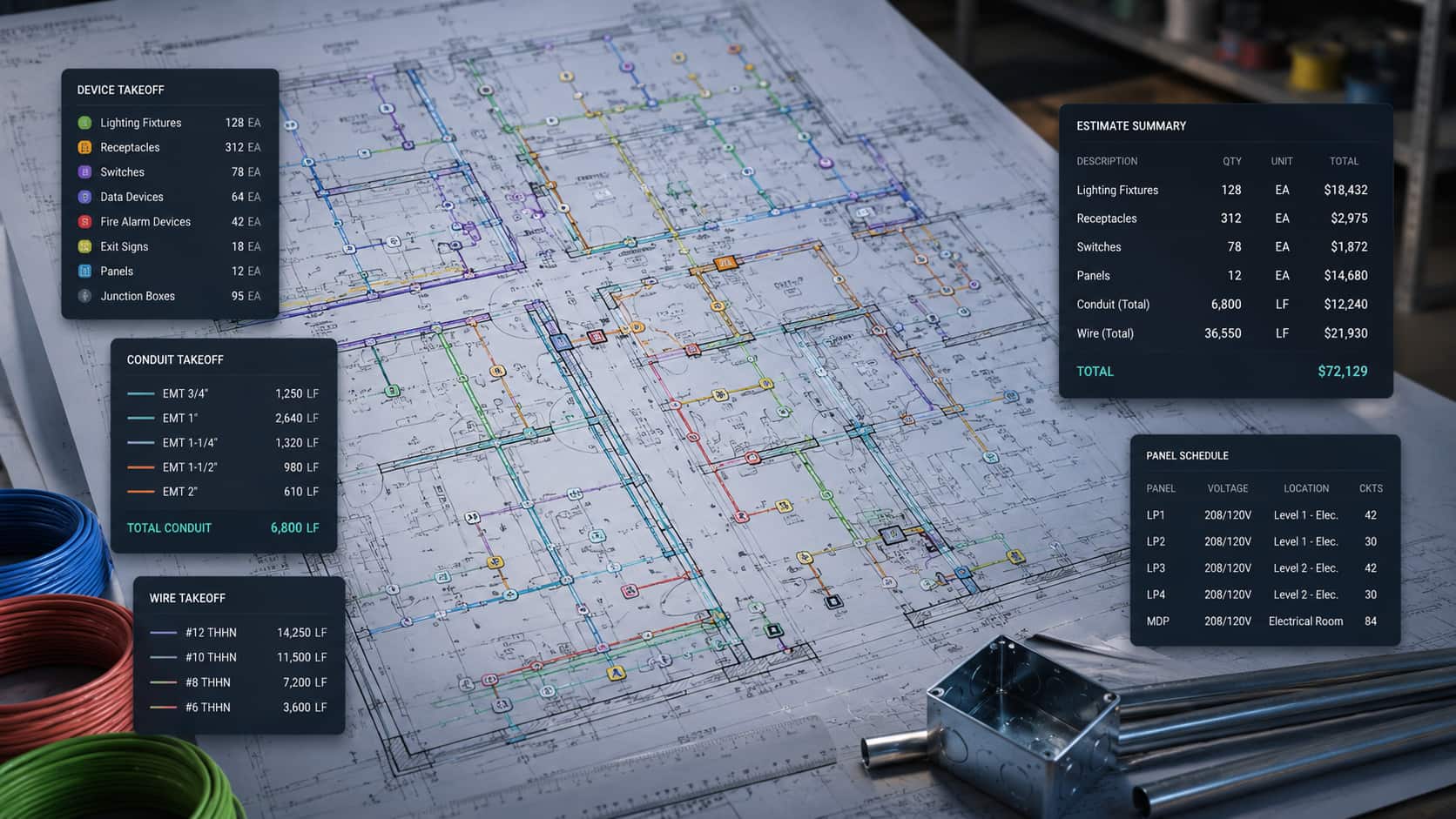
Electrical Estimating Software: 2026 Buyer's Guide
Electrical estimating software in 2026: real AI takeoff accuracy, device classification, panel schedules, and the questions to ask before trusting a live bid.