Flooring Trades: How to Quote Flooring Jobs and Win More Work
Flooring estimates look simple from the outside. Measure the area, pick a material, multiply by a rate. But anyone who’s been doing this work for more than a season knows the number that wins the job and the number that makes money on the job aren’t always the same — and the gap usually lives in the details most flooring contractors rush through when they’re busy.
This post covers how to quote flooring jobs accurately, where most flooring estimates go wrong, how to price different material types and installation conditions, and what the contractors winning more work are doing differently in 2026.
The Foundation of a Flooring Estimate
Flooring estimating software automates the area takeoff, applies a waste factor by material and pattern, and ties quantities to current material and labor pricing — so the number that goes out is fast, consistent, and auditable. Done by hand, the same work is a tape measure, a calculator, and a spreadsheet. Either way, the estimate rests on four components.
A flooring estimate has four components. Get all four right and you’re competitive. Miss one and you’re either leaving money on the table or losing jobs you shouldn’t have lost.
1. Area calculation This is the starting point — the square footage of the space, calculated correctly. That means accounting for room geometry (L-shapes, alcoves, and irregular layouts add up fast), waste factor by material type, and pattern match requirements on tile and wood that increase material consumption beyond the raw square footage.
A common error: estimating net square footage and forgetting waste. Carpet typically requires 10–15% overage. Hardwood with a diagonal or herringbone install can require 15–20%. Tile with a pattern match can require 10% or more depending on the tile size and pattern scale. Underestimate waste and you’re making a second material order at retail pricing mid-job.
2. Material cost Material cost varies more in flooring than almost any other finish trade — from budget LVP at under $2/sq ft to custom hardwood or large-format porcelain that runs $15–$25/sq ft or more (figures vary by market and supplier). The estimate needs to reflect the actual specified product, not a ballpark by category.
In 2026, material pricing also moves. Supply chain conditions affect imported tile and hardwood in particular. An estimate built on pricing from three months ago can be meaningfully off by the time the job starts. Any flooring estimate on a project with a delayed start date needs a pricing validity window — and the customer needs to know it.
3. Labor cost Labor is where flooring estimates diverge most between contractors — and where the most margin gets lost. Labor rates should account for:
- Floor type and installation method — glue-down hardwood takes longer than floating LVP; large-format tile takes longer than 12x12; pattern work takes longer than straight lay
- Subfloor condition — a level, clean concrete slab and a subfloor that needs grinding, patching, or self-leveling compound are completely different labor inputs
- Site conditions — floor height, furniture moving, access restrictions, occupied spaces, and phased work all affect labor hours
- Transition and detail work — thresholds, stair nosings, floor vents, and base/shoe removal and reinstall are often quoted as afterthoughts and consistently underpriced The contractors we see losing margin most reliably are the ones using a flat labor rate per square foot regardless of installation complexity. A $4/sq ft labor rate might be right for a straightforward LVP install on a clean slab. It’s wrong for a glue-down hardwood with a herringbone pattern on an uneven subfloor that needs leveling.
4. Overhead, markup, and margin Your direct costs — material and labor — are inputs into the estimate, not the estimate itself. The bid price needs to cover your overhead (tools, vehicle, insurance, admin time, estimating time) and leave you a margin. What that markup looks like depends on your market, your volume, and your positioning — but it needs to be intentional, not whatever’s left over after you’ve priced the job to win.
Where Flooring Estimates Go Wrong
Most flooring estimate errors trace back to one of four patterns:
Skipping the site visit on subfloor condition Subfloor issues are the single biggest source of flooring estimate blowouts. A job that looked like a straightforward install becomes a day of grinding, patching, and self-leveling before a single plank goes down. If you’re not seeing the subfloor before you bid — especially on renovation work, older buildings, or anything over a crawlspace — you’re assuming the best case and pricing accordingly. That assumption will cost you.
Flat-rating complex installations Pattern work, diagonal installs, stairs, and transitions take meaningfully more time than a straight-lay floor in a rectangular room. If your estimate doesn’t differentiate, you’re systematically underpricing the complex jobs and competing on price against contractors who’ve done the same math.
Ignoring material lead times on the bid If the specified material is on a 6-week lead time and the GC needs floors done in 4 weeks, that’s a scope conversation before the bid goes in — not a problem you discover after you’ve won the job. Material availability is part of the estimate.
Underpricing prep and demo Demo of existing flooring, adhesive removal, subfloor prep, and moisture mitigation are frequently treated as line items to keep the bid competitive rather than costs to price accurately. They’re also the work types most likely to expand once the job is open. Price them right or exclude them explicitly — don’t bury a low number that you’ll regret when the floor comes up.
Pricing by Material Type: What to Know
LVP and LVT The most straightforward flooring install in most cases. Floating installs are faster than glue-down; subfloor flatness tolerances are tighter than most customers expect. Price subfloor prep separately and explicitly — it’s the most common scope expansion on LVP jobs.
Hardwood Material pricing variability is high. Acclimation time adds a job phase many contractors absorb without billing for. Finish work (sanding, staining, sealing) on site-finished hardwood is a separate skilled labor input from installation. If you’re doing both install and finish, quote them as separate line items — it’s clearer for the customer and easier for you to defend.
Tile and stone Large-format tile (24x24 and up) requires more precise subfloor prep, more layout time, and more waste than standard formats. Pattern work multiplies labor time significantly. Grout joint specification affects both material and labor. Heated floor systems add a separate installation phase. Each of these needs its own line item — a single square footage rate for tile work is how estimates go wrong.
Carpet Seam planning on carpet affects both material quantity and installation quality. Furniture moving, stair work, and tackstrip installation are frequently underpriced add-ons. On commercial carpet tile, the grid layout and starting point matter for the final appearance — build that planning time into the estimate.
How to Win More Flooring Work Without Cutting Price
The flooring contractors winning more jobs in 2026 aren’t consistently the lowest bid. They’re the ones whose estimates communicate competence before the job starts.
Be specific about what’s included — and what isn’t A detailed scope breakdown tells the customer what they’re buying. It also protects you when subfloor conditions are worse than expected, when the customer decides they want a different tile size after you’ve priced the job, or when the GC tries to expand the scope without changing the contract. Vague estimates invite scope creep. Specific estimates prevent it.
Show your waste factor and explain it Most customers don’t know that a herringbone hardwood install requires 15–20% overage. When you explain it — and show it as a line item — it builds trust and pre-empts the “why do I need to buy more material than the room square footage” conversation later.
Price subfloor prep as a separate line item with a contingency Instead of burying subfloor prep in your square footage rate, quote it separately with a clear scope: “subfloor prep based on current conditions, assessed at time of demo.” Give the customer a range based on what you expect vs. what you might find. It sets realistic expectations, protects your margin, and positions you as the contractor who’s thought this through — not the one who shows up and surprises them with a change order.
Turn estimates around fast Flooring decisions — especially on residential renovation and light commercial — are often made quickly. The contractor who responds within 24 hours with a detailed, professional estimate wins a disproportionate share of those decisions, regardless of price. Speed is a competitive differentiator that costs you nothing except a faster process.
How Quotr.ai Helps Flooring Contractors Quote Faster and Win More
Manual flooring estimates — spreadsheets, paper takeoffs, calculator and tape measure — work until they don’t. When you’re bidding multiple jobs a week, the math changes. Time spent on takeoff and pricing is time not spent on site visits, customer relationships, and the next bid. Quotr.ai runs the whole flooring workflow — takeoff, pricing, bids, and procurement — in one place, the same way it does for electrical and the other finish trades.
AI flooring takeoff: how it works
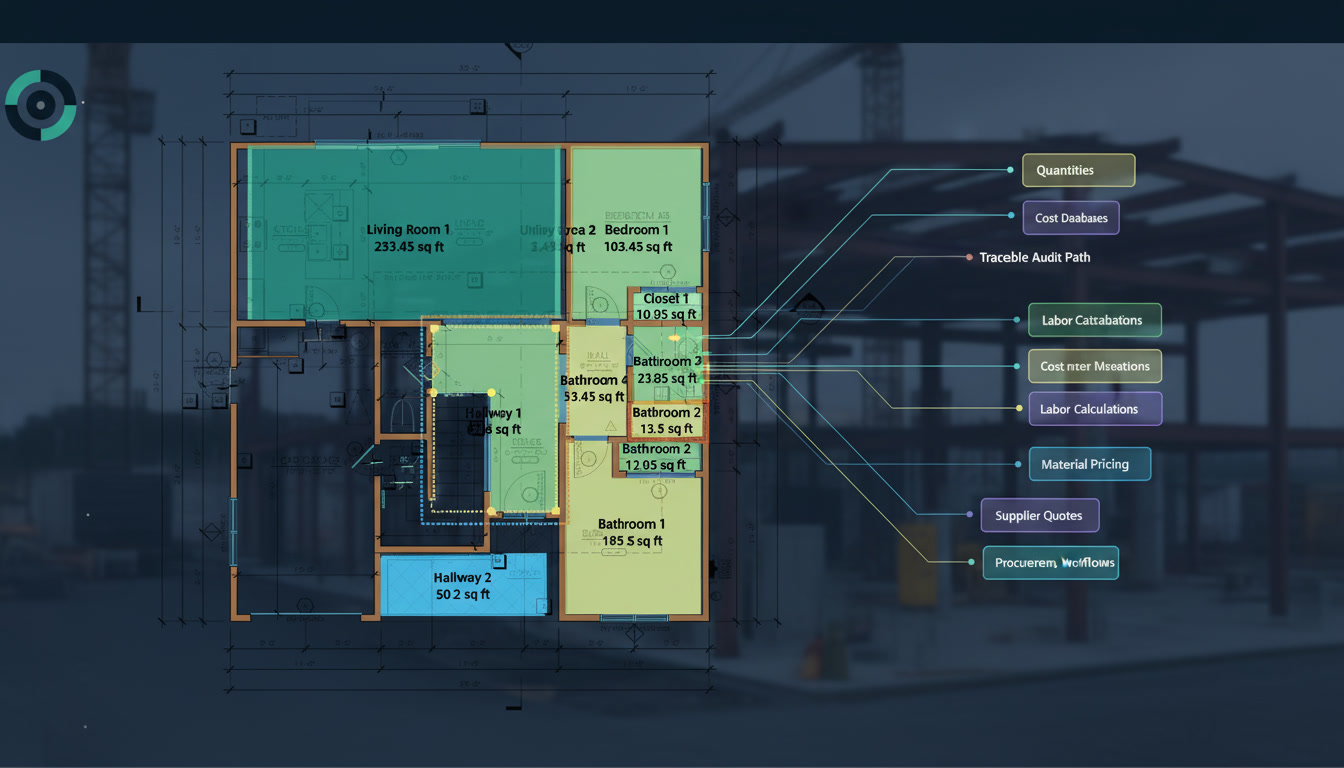
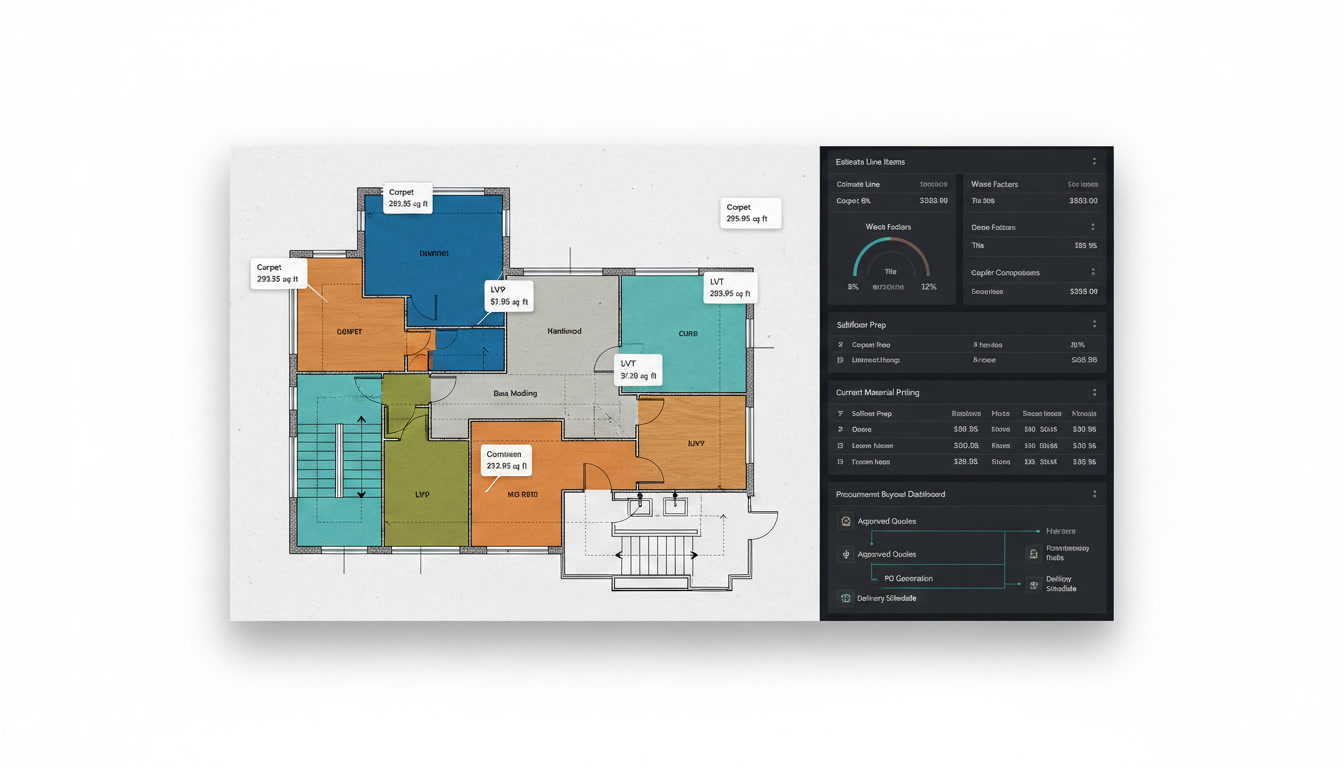
Quotr.ai’s AI takeoff reads your plan set and extracts flooring areas automatically — room by room, finish type by finish type (LVP, tile, hardwood, carpet) — rather than handing back one undifferentiated square-footage number. From there it:
- Applies the right waste factor by material and pattern, so the 10–20% overage discussed above is built into the quantity, not bolted on afterward.
- Returns a confidence level on every match through Smart Matching, so estimators know which rooms to review before the bid goes out.
- Keeps a full audit trail — every quantity links back to its source on the plan, so you can defend the number to a GC or owner. On clean vector PDFs, Quotr’s AI takeoff runs at 95–99% accuracy on counts and areas in internal benchmarking, with a short human review of flagged items closing the gap on lower-quality scans. What used to take an hour of manual measurement takes minutes — and the estimate that goes out is more consistent and more auditable than one done by hand.
Room templates that price flooring the same way every time
Define a room once and Quotr.ai suggests the flooring, transitions, and finishes that go with it — so you don’t rebuild the same line-item list job after job. For flooring contractors running repeat scopes across multifamily, hospitality, or tenant-improvement work, room templates turn a consistent takeoff into a consistent price, with far less setup per project.
From flooring takeoff to material buyout
Flooring material pricing is volatile and import-heavy — imported tile and hardwood move with supply chain conditions, and a stale database quietly mis-prices every bid. Quotr.ai connects your takeoff straight to procurement: send supplier quote requests from inside the app, compare responses side by side, and — when you want sharper numbers — source factory-direct on materials like LVP, tile, and hardwood without managing tariffs or logistics yourself. Quantity accuracy becomes buyout accuracy, in one workflow instead of three tools.
Manual vs. generic AI takeoff vs. Quotr.ai for flooring
| Capability | Manual takeoff | Generic AI takeoff | Quotr.ai |
|---|---|---|---|
| Area detection by room | Tape measure / on-screen, slow | Automated, total area | Automated, room-by-room |
| Finish-type classification | Manual | Often lumped together | LVP, tile, hardwood, carpet — separated |
| Waste factors | Manual, easy to forget | Inconsistent | Applied by material + pattern |
| Confidence scoring + audit trail | None | Rare | Per-match confidence, source-linked |
| Material pricing | Static spreadsheet | Static / none | Live database + factory-direct sourcing |
| Procurement / buyout | Separate process | Not included | Built in — quotes, comparison, buyout |
For flooring contractors doing high bid volumes on commercial, multifamily, or mixed-use projects, that difference compounds into a real competitive edge — more bids out, faster turnaround, and fewer errors making it to the bid sheet.
Bottom Line
Knowing how to quote flooring jobs accurately comes down to four things: getting the area calculation right including waste, pricing material at current costs with a validity window, differentiating labor by installation complexity and subfloor condition, and building in real overhead and margin — not whatever’s left over.
The contractors winning more work aren’t cutting price. They’re submitting faster, scoping more clearly, and pricing the complex work correctly while their competitors flat-rate it and hope for the best.
A better estimate process doesn’t just protect your margin. It’s the thing that makes customers trust you before the job starts.
Frequently Asked Questions
How do you quote a flooring job accurately?
Quote four components: area (net square footage plus a material-specific waste factor), material cost at current pricing, labor differentiated by installation method and subfloor condition, and overhead plus margin. Most errors come from forgetting waste, flat-rating complex installs, or skipping a subfloor site visit before bidding.
What waste factor should I use for flooring?
It depends on material and pattern. Carpet typically needs 10–15% overage, straight-lay hardwood around 10%, and diagonal or herringbone hardwood 15–20% per NWFA guidance. Tile runs about 10% for a straight set and 15–20% for pattern or diagonal layouts. Always confirm against the specific product and layout.
Why do flooring estimates go over budget?
The biggest cause is subfloor condition discovered after the bid — grinding, patching, or self-leveling that wasn’t priced. Other common causes are flat-rating complex installs, ignoring material lead times, and underpricing demo and prep. Pricing these explicitly, or excluding them clearly, prevents most overruns.
How should labor be priced on a flooring install?
Not as a flat per-square-foot rate. Labor should reflect floor type and installation method, subfloor condition, site conditions like furniture moving and access, and detail work such as thresholds and stair nosings. A glue-down herringbone on an uneven subfloor is a different labor input than floating LVP on a clean slab.
How fast should a flooring estimate be turned around?
As fast as you can while staying accurate. Flooring decisions on residential renovation and light commercial are often made quickly, and the contractor who returns a detailed, professional estimate within 24 hours wins a disproportionate share — frequently regardless of price. AI-assisted takeoff makes fast turnaround repeatable.
Can AI do flooring takeoff?
Yes. AI takeoff reads plan sets and extracts flooring areas automatically, room by room and finish type by finish type, applying waste factors as it goes. Tools like Quotr.ai run at 95–99% accuracy on clean vector PDFs in internal benchmarking, with confidence scores flagging which rooms need a quick human review.
What is the best flooring estimating software?
The best flooring estimating software detects area by room and finish type, applies the correct waste factor by material and pattern, keeps an audit trail back to the plan, and ties quantities to live material pricing. Quotr.ai adds built-in procurement, so the same workflow takes you from takeoff to material buyout.
How accurate is AI flooring takeoff?
On clean, vector-based PDF plan sets, AI flooring takeoff reaches 95–99% accuracy on area and counts in Quotr’s internal benchmarking. Accuracy drops on low-resolution scans, which is why per-match confidence scoring and a short human review of flagged rooms matter before the bid goes out.
Want to see what a faster flooring takeoff looks like on your own plan sets? Start a Quotr.ai trial and bring a current job — the audit is the point. Questions about your workflow? Talk to our team.