How AI Construction Takeoff Works In 2026
Construction estimating is in a squeeze. Project pipelines keep growing. Estimator headcount does not.
The U.S. Bureau of Labor Statistics projects cost estimator employment will decline 4 percent between 2024 and 2034. ABC chief economist Anirban Basu reported that February 2026 was the slowest month for construction hiring on record since the BLS began tracking the data in December 2000, with the hiring rate falling to 3.3 percent. And construction input prices rose at a staggering 12.6 percent annualized rate during the first two months of 2026 — the kind of volatility that makes every line of a bid harder to defend. (For the full picture, see our breakdown of construction cost trends in 2026.)
More bids. Fewer estimators. Faster-moving prices. AI construction takeoff software exists to close that gap, and the tools have matured enough in the last eighteen months that they belong in every serious estimator’s workflow. This guide explains how AI construction takeoff actually works, where it adds real value, what it still cannot do, and how to evaluate the platforms competing for your bid cycle.
AI Construction Takeoff, Defined
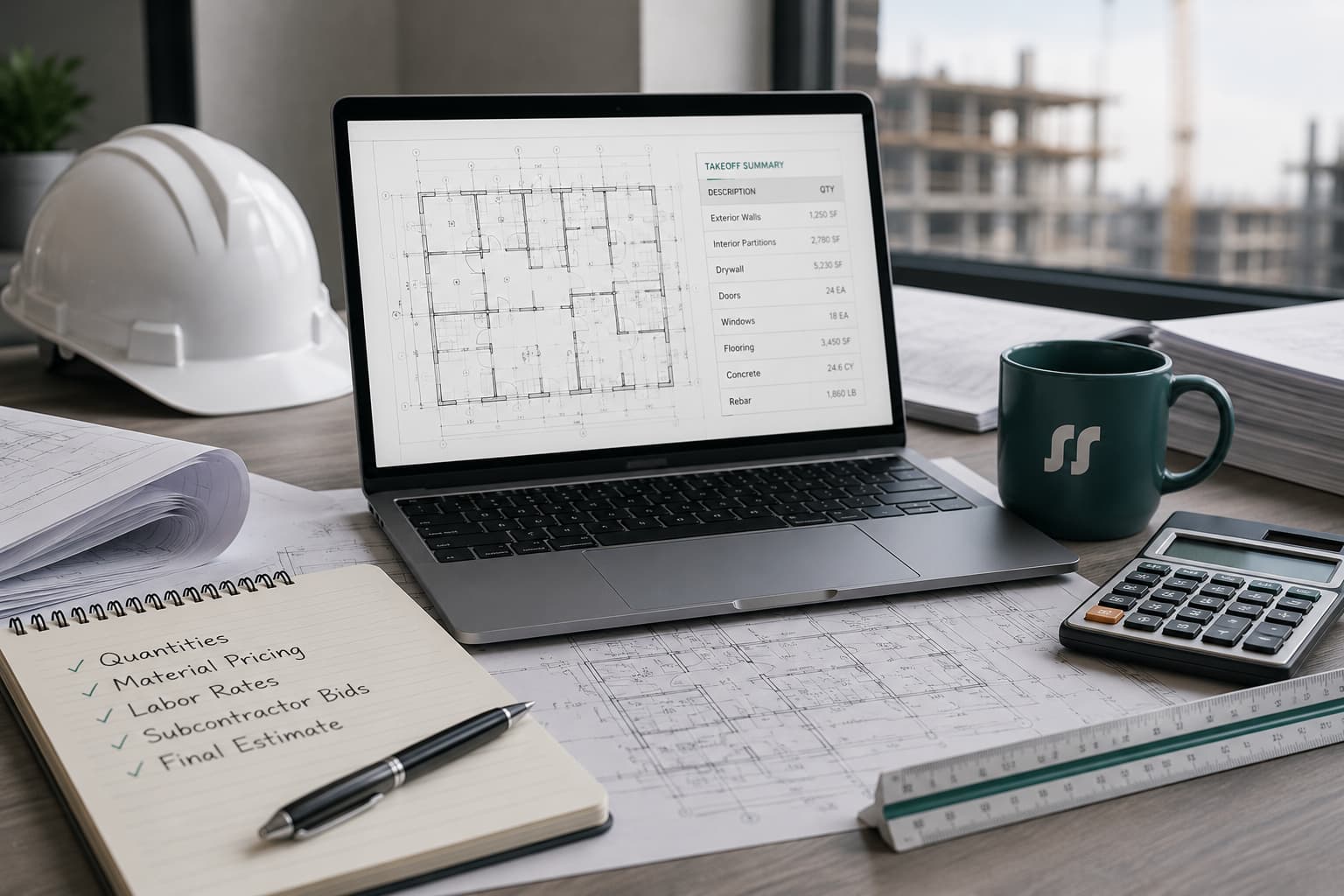
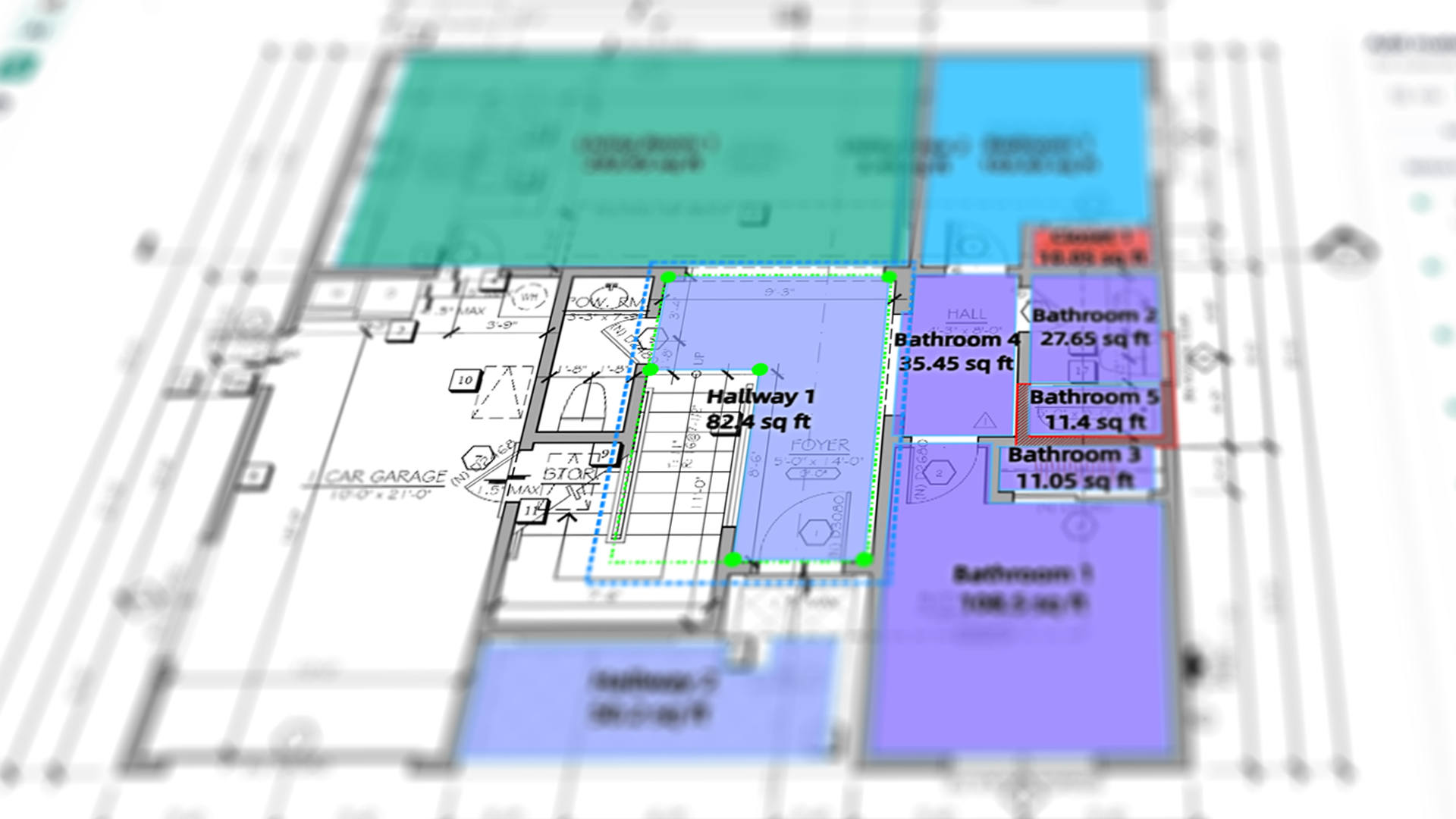
AI construction takeoff is software that uses computer vision and machine learning to read architectural drawings and automatically extract the quantities an estimator needs to build a bid. Digital takeoff still requires a human to click, trace, and count every wall, door, fixture, and fitting. AI takeoff identifies and measures these elements automatically across an entire plan set in minutes — and the most advanced platforms go further, turning plans directly into prices by feeding quantities into live cost data without an intermediate spreadsheet.
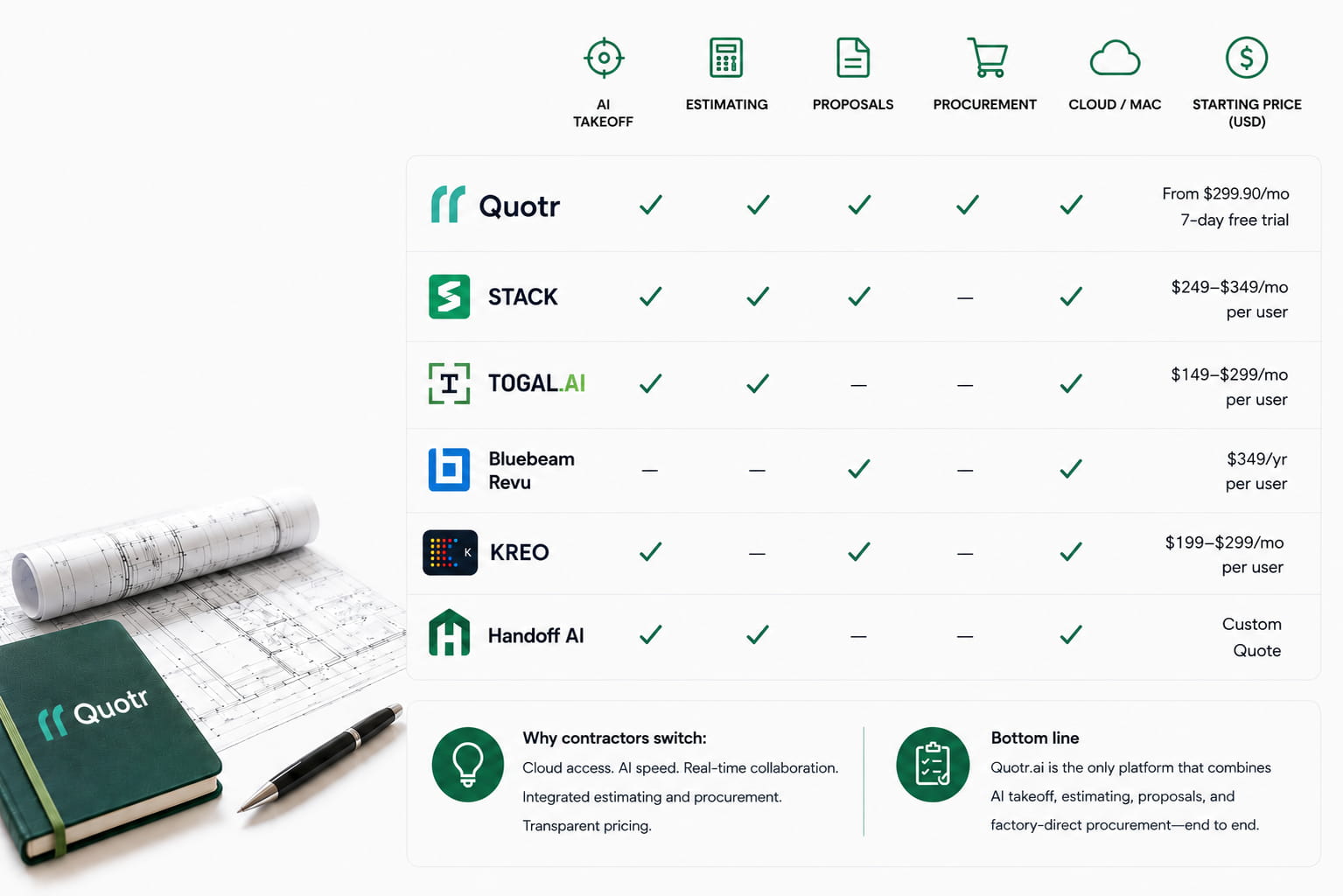
The category includes tools like Quotr.ai, Togal.AI, Beam AI, Kreo, Autodesk Takeoff with Automated Symbol Detection, and Civils.ai. Implementations differ. The underlying capability is the same: turn drawings into structured quantities without manual measurement, mapped to industry-standard taxonomies like the Construction Specifications Institute (CSI) MasterFormat.
Why AI Takeoff Is Becoming a Preconstruction Standard in 2026
Three forces are driving adoption.
Labor is shrinking. Cost estimators are aging out of the workforce faster than they are being replaced. BLS projections show the occupation contracting through 2034.
Costs are volatile. Construction input prices climbed 12.6 percent annualized in early 2026, according to Associated Builders and Contractors. Bid accuracy matters more when materials reprice every quarter. Quotr.ai’s research team, working with UC Berkeley’s Iris Tommelein and collaborators, recently published a peer-reviewed forecasting framework that predicts construction material prices at the CSI MasterFormat six-digit section level — the granularity required for line-item bid accuracy in a high-volatility market. The study, which evaluated LSTM, ARIMA, VECM, and Chronos-Bolt models, found that LSTM-based forecasting significantly outperformed traditional econometric methods when augmented with raw material prices, commodity indexes, and macroeconomic indicators as explanatory variables.
Demand is steady. Dodge Construction Network’s Momentum Index has remained elevated through the cycle. Preconstruction teams are being asked to bid more work with smaller staffs.
Manual takeoff consumes 50 to 60 percent of the typical bid cycle on a midsize commercial project. That is the single largest pool of recoverable estimator hours in preconstruction. AI takeoff is the first tool that addresses it directly.
How AI Construction Takeoff Software Works (Step by Step)
Here is what happens when an estimator uploads a plan set to a modern AI takeoff platform.
Step 1 — Plan ingestion. Architectural plans are uploaded in PDF, CAD, or scanned format. The system normalizes the file, detects sheet boundaries, and reads scales automatically.
Step 2 — Computer vision detection. A trained computer vision model identifies building elements across the plan set: walls, doors, windows, fixtures, MEP symbols, and trade-specific assemblies. Modern systems process thousands of pages in minutes.
Step 3 — Automated measurement. Detected elements are measured for linear footage, square footage, and counts. Each output is tied back to its location in the plan and mapped to the appropriate CSI MasterFormat division for downstream pricing.
Step 4 — Material quantity generation. The takeoff is converted into a structured material list, with waste factors and secondary materials applied based on the estimator’s templates and assemblies.
Step 5 — Estimator review. The estimator reviews the AI output, validates edge cases, adjusts ambiguous detections, and exports the final takeoff into the firm’s pricing model or bid platform.
The estimator’s role shifts from quantity technician to strategic cost analyst. The machine handles the counting. The human handles the judgment.
AI Takeoff vs Manual Takeoff: What Actually Changes
| Dimension | Manual Takeoff | AI Takeoff |
|---|---|---|
| Time per midsize commercial project | 6 to 8 hours | 30 to 60 minutes |
| Accuracy on clean plans | 95 to 97 percent (fatigue-degraded) | 95 to 98 percent (consistent) |
| Scalability | One project per estimator at a time | Multiple parallel projects |
| Revision handling | Manual rework on every addendum | Automatic re-detection on revised plans |
| Cost per bid (labor) | High | Low |
| Bid capacity per estimator per week | 1 to 2 | 4 to 8 |
Independent benchmarks reported by AI takeoff vendors and validated by university researchers show AI accuracy at 98 percent or higher on standard architectural plans. Human estimators average around 97 percent on the same drawings. Accuracy is no longer the bottleneck. Speed and consistency are.
Real-world results back this up. RL Electric, a working subcontractor, used AI-powered takeoff to compress estimating time dramatically and free up bid capacity — the full numbers and workflow are documented in our case study on how RL Electric cut estimating time with AI-powered takeoffs.
How to Evaluate AI Construction Takeoff Software in 2026
If you are considering AI takeoff for your team, use this vendor-neutral checklist.
- Accuracy benchmark. Ask for the platform’s accuracy rate on a standard scaled architectural plan, validated by independent testing. Aim for 95 percent or higher on first-pass detection.
- Multi-trade support. A drywall sub has different needs than a mechanical sub. Confirm the platform handles your specific trades.
- File compatibility. PDF, CAD, BIM, and high-resolution scans should all be supported.
- Standard taxonomy alignment. Outputs should map to CSI MasterFormat (or Uniformat for early-stage estimating) so quantities flow cleanly into your downstream cost models without manual remapping.
- Integration depth. The takeoff must export directly into your pricing model and bid platform without re-entry.
- Procurement linkage. This is the underrated criterion, and most evaluations get it wrong by focusing on raw speed instead. Takeoff that ends at quantities only solves half the problem — the platforms worth evaluating connect quantities directly to live material pricing or factory-direct sourcing. We unpack why in The Takeoff-to-Transaction Gap: Why Speed-to-Count Is the Wrong Benchmark for AI Estimation.
- Research and methodology. The platforms worth taking seriously can show their work. Ask whether the vendor has published technical research, peer-reviewed papers, or independent benchmarks on the methods behind their product. A vendor that can point to an arXiv paper is operating at a different level of rigor than one that can only point to marketing copy.
- Data security and IP. Your plans contain confidential project information. Confirm the vendor’s data handling, model training policies, and customer isolation.
- Pricing structure. Per-project pricing scales with bid volume. Per-seat pricing scales with team size. Pick the model that matches how your firm actually grows. (Quotr.ai’s full pricing is published openly at quotr.ai/pricing.)
What AI Construction Takeoff Still Cannot Do
AI takeoff is powerful, but it does not replace an experienced estimator.
The technology struggles on hand-marked plans, low-quality scans, and drawings with non-standard symbols. It cannot interpret scope notes that require judgment (“provide allowance for owner-supplied hardware”). It cannot evaluate constructability the way a senior estimator who has built ten similar projects can. And it cannot price risk — that depends on relationships with subs, vendors, and the GC’s institutional memory.
AI replaces the ruler, not the estimator. The estimator’s role is becoming more valuable, not less.
Where AI Takeoff Is Heading: Procurement, Live Pricing, and the Connected Bid
The next chapter of AI construction takeoff is not faster takeoff. It is connected preconstruction. The teams that win in 2026 and beyond will not be the ones with the fastest counting tools. They will be the ones running takeoff, estimating, procurement, and bid management inside a single connected system.
That means quantities flowing directly into live material pricing — and increasingly, into predicted future pricing as forecasting models like the LSTM-based framework Quotr.ai’s research team published in December 2025 become embedded inside estimating software. It means procurement decisions made against real-time supplier inventory, not last quarter’s spreadsheet. And it means bid accuracy that reflects actual current and projected costs, not historical averages padded with a contingency factor.
This is the principle Quotr.ai was built on. The platform combines AI takeoff with cost estimation and direct procurement from over 220 vetted factories at 40 to 50 percent below retail — taking subcontractors from plan upload to a priced, sourced bid in under an hour.
See It On Your Own Plans
To see how AI construction takeoff and connected procurement work for your trade, explore Quotr.ai Software or review pricing and start your first AI takeoff in minutes.
Sources
- U.S. Bureau of Labor Statistics, Occupational Outlook Handbook — Cost Estimators (2024–34 projections)
- U.S. Bureau of Labor Statistics, The Employment Situation — March 2026
- Associated Builders and Contractors — February 2026 construction hiring data, commentary by Anirban Basu
- Associated Builders and Contractors — Construction Input Prices Analysis, early 2026
- Dodge Construction Network — Dodge Momentum Index
- Autodesk Construction Cloud — Preconstruction productivity research (Deloitte Access Economics)
- Lyu, B., Yin, Q., Tommelein, I., et al. (2025). A Granular Framework for Construction Material Price Forecasting: Econometric and Machine-Learning Approaches. arXiv:2512.09360. https://arxiv.org/abs/2512.09360
- Engineering News-Record — AI construction technology coverage
- Construction Dive — Construction labor and contech coverage
Published on the Quotr.ai blog. Quotr.ai is an AI-powered construction estimation, takeoff, and procurement platform based in San Francisco.