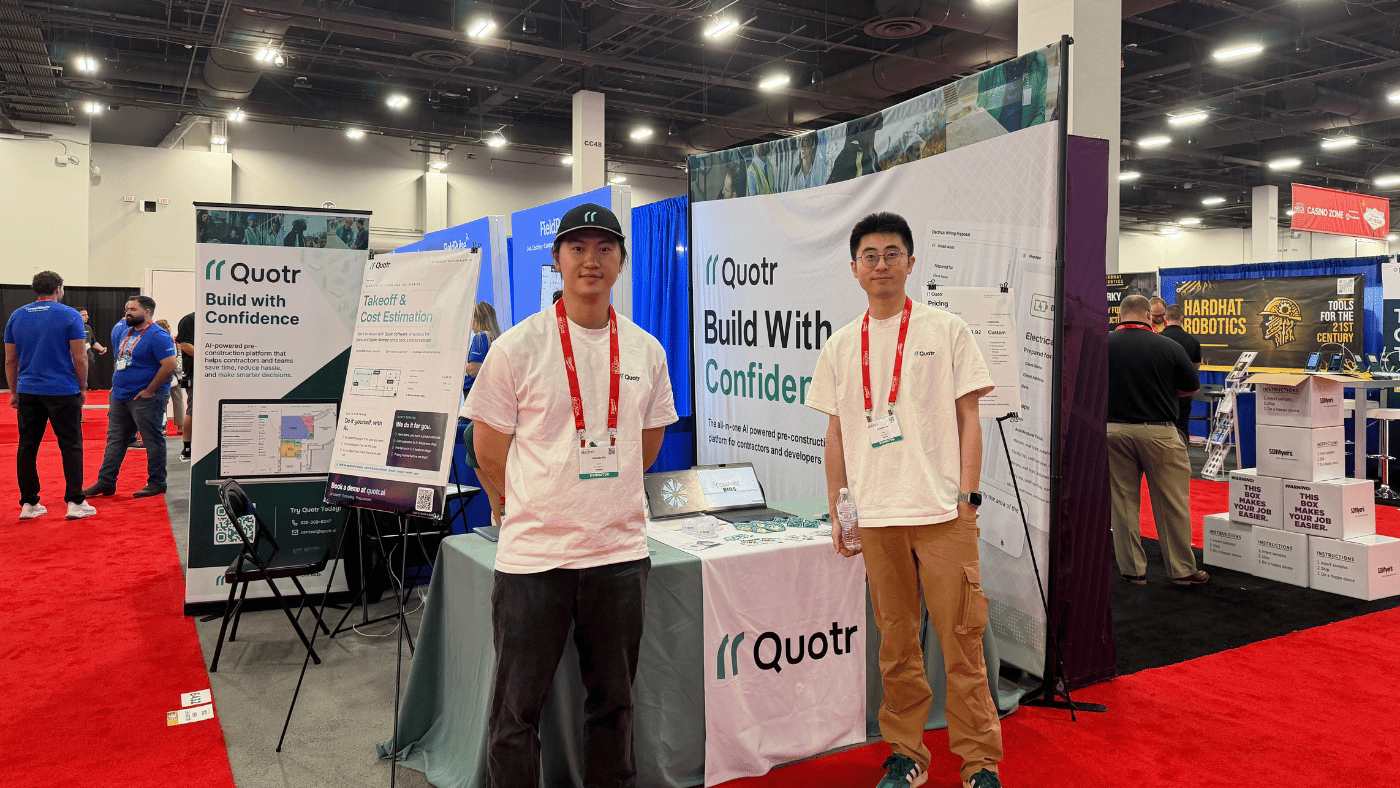
Chicago Build Expo 2026 Recap: What We Saw, and Why Estimators Stopped By
We’re back from Chicago, and it was a good one.
Last week, Quotr was on the floor at Chicago Build Expo 2026, October 28 and 29 at McCormick Place. It’s one of the largest construction, architecture, and design shows in the country, and the room reflected it: contractors, estimators, GCs, developers, and trades from across the Midwest and beyond, all in one place for two days.
Here’s what the event looked like, and what we were doing there. If you want the two-minute version, here’s our recap video from the floor.
Watch Quotr.ai @ Chicago Build 2026 on YouTube
What Chicago Build was
If you haven’t been, Chicago Build is where a big slice of the AEC industry shows up at once. Two days of exhibits, plus stages running talks on construction tech, sustainability, the workforce, and where the industry is heading. It’s a working crowd, people who spend their days bidding, building, and running projects, which is exactly the room we want to be in.
Hanyang Liu on the automation panel
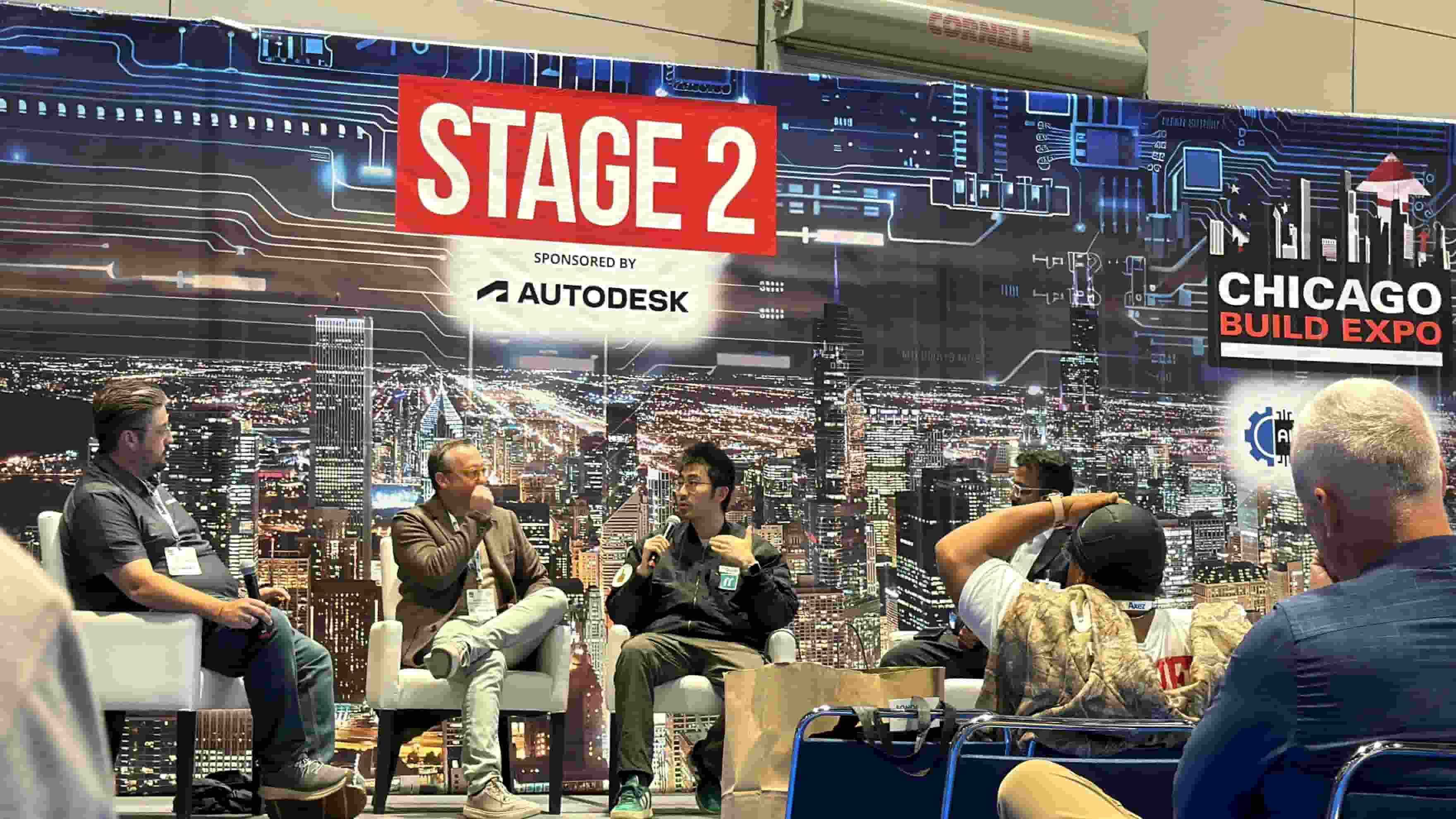
Our co-founder and CEO, Hanyang Liu, joined the panel “Robots, AI & Reality: The Pros and Cons of Construction Automation” on day two, on the AI & Digital Construction stage. It was a sharp group to think out loud with: chaired by Andrew Cooper (VDC Project Manager, AECOM Hunt Construction), alongside Lokesh Mani (Senior VDC Manager, RG Construction), Mayank Sharma (Director of Virtual Design and Construction, Mazzetti), and Andrew Wise (Design Phase Manager II, Mortenson).
“Pros and cons” is the right framing, and it’s exactly the conversation we want to be part of. The point Hanyang kept coming back to is the one we build around: the biggest win from AI in construction isn’t replacing people, it’s giving experienced estimators more leverage. Take the slow, repetitive reading and counting off their plate, and they get their time back for the parts that actually need judgment, scope, risk, and price. On a panel weighing where automation helps and where it doesn’t, that’s the line we think holds up.
At the booth: the takeoff and estimating draw
The best part of a show like this is the conversations, and we had a lot of them. More than 300 people stopped by Booth 450 to see what Quotr offers, and two things pulled them in over and over: AI takeoff and cost estimation.
But if you ask why they stopped, almost all of them came back to the same thing: they have more bids than they can get to. That is the story we heard again and again on the floor. An estimator has a stack of invitations to bid, a calendar full of deadlines, and only so many hours in the day to read drawings and count quantities by hand. Good work gets turned down, not because the team can’t win it, but because they can’t get the takeoff done in time to bid it. More than one person described the exact same squeeze: the work is there, the hours are not.
That is the problem Quotr is built to solve. The bottleneck in most shops is not judgment or pricing, it is the slow, repetitive first pass: paging through the set, measuring, and counting every symbol before you can put a number on the job. So that is what we kept showing at the booth. Upload a plan set, let the AI read it and take off the quantities, and carry those straight into a priced, bid-ready estimate, with every count traceable back to the sheet it came from. The payoff that landed with estimators was simple: get more bids out the door without adding more hours or more headcount. When your real constraint is capacity, a faster takeoff is not a nice-to-have, it is how you chase the work you’re currently leaving on the table.
We kept notes on what people actually asked, and the questions sorted themselves into a handful of themes. Here’s what was on estimators’ minds in Chicago.
An industry still deciding on technology
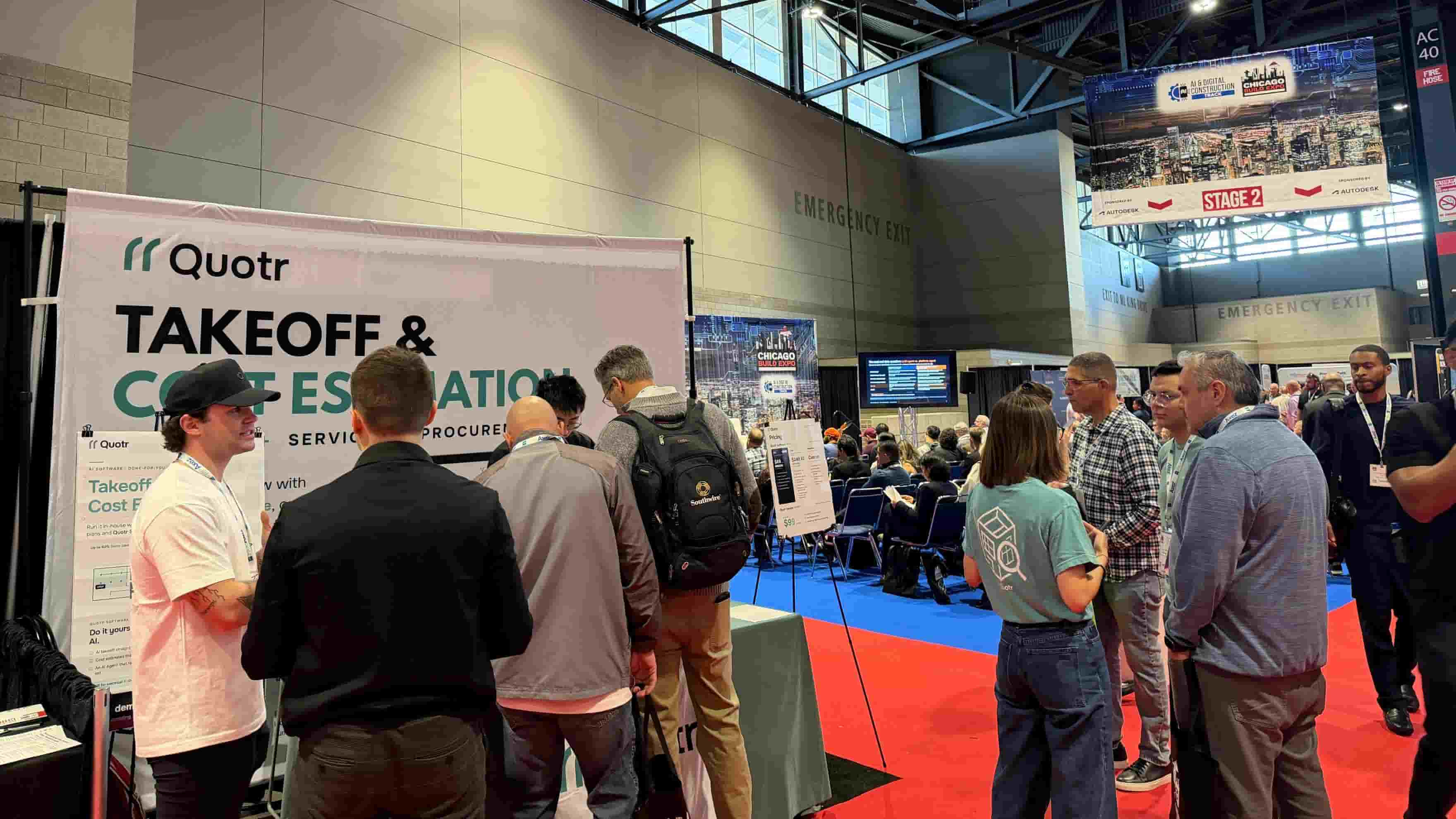
Construction is still one of the slowest industries to adopt new technology, and the floor reflected that. Plenty of the people we met had never used AI-assisted estimating, and many are still running takeoffs the way they always have: pen and paper, Bluebeam, Excel, and manual counts. That is not a knock on anyone. These tools work, and they are what the industry trusts. What changed the conversation was the live demo. Watching a real takeoff happen, seeing materials detected and priced on an actual sheet, is what produced the “ohhh” moment again and again. AI estimating is hard to picture in the abstract and obvious the second you see it run on a real drawing.
Trust, and the human in the loop
The sharpest questions came from the most experienced estimators, including people with more than twenty years in the trade. They wanted to know how reliable AI-generated results really are, and whether this is a tool that replaces estimators or supports them. Our answer did not change from one conversation to the next: AI does the slow first pass, the reading and the counting, and the estimator reviews and owns the final number. Industry experience isn’t going anywhere. The judgment about scope, risk, and price is the job, and that stays with the person. The AI is there to give that person back the hours they currently lose to manual takeoff.
Accuracy, above everything
For a bidding team, accuracy is the whole ballgame, and it was the top priority in Chicago too. One prospect put a number on it: he wanted 95% confidence in an estimate before bid day. Others pushed on the hard cases. Can the AI handle a large, complex plan set, find the pages that matter, and read the detailed specs? Can it check dimensions like wall and ceiling heights, or reason about a complicated layout? And can it reliably identify and count the components that drive a bid, the windows, doors, and materials across a set? These are exactly the right questions to ask, and they are the ones our research and our product are built around.
Capacity and the bid backlog
Underneath almost every conversation was the same squeeze: too many bids, not enough hours. Estimators have more invitations to bid than they can get to, and good work gets turned down because the takeoff can’t be finished in time. Late subcontractor bids make it worse, compressing the window to finalize an accurate number before the deadline. The question people kept arriving at was whether faster estimating could let them pursue more projects without hiring another estimator, and whether the time saved, the accuracy gained, and the extra bids out the door would add up to a return worth the investment. That ROI question is the right one, and it is the case we are built to make.
Pricing, materials, and the local market
Construction pricing is local, and estimators wanted to know how Quotr handles that: regional labor rates, material costs, and supplier pricing that shift from one city or state to the next. Teams working across multiple markets care about access to local suppliers and competitive regional pricing. Many also wanted to keep the cost data they already trust, importing an existing Excel pricing database rather than starting over. And there was real interest in discounted material procurement, especially for the things trades buy constantly: metal studs, beams, and drywall. That last point came up often enough to be a clear product signal. Expanding material procurement options, metal studs and beams in particular, is demand we heard loud and clear and are carrying back with us.
Fitting into how teams already work
The most practical questions were about workflow. Will this work alongside the estimating tools we already use, without forcing a full rip-and-replace? Can we keep manual control, reviewing quantities, adjusting waste percentages, updating pricing, and making corrections before anything is final? Can we export the way we already share work, in Excel and as marked-up PDF takeoffs? Companies with multiple offices wanted consistent estimating processes and better coordination between teams. And given the sensitivity of the documents involved, data security came up repeatedly: how are confidential drawings, project details, and NDA-protected files protected on an AI platform? Larger teams asked about dedicated enterprise support, custom features, flexible pricing, and help onboarding a team. Across the board, people wanted a hands-on trial with their own real drawings, and straightforward training, before committing. All reasonable, and all the right way to bring a new tool into a working estimating team.
Thank you
Thanks to the Chicago Build team for a well-run show, to everyone who stopped by Booth 450 to talk takeoff and estimating, and to the contractors who brought real projects and real questions. That’s still the best test there is.
If we talked in Chicago and you want to put Quotr on your own hardest plan set, that’s the standing invitation. Start a free trial or talk to our team. And if we missed you, we’ll be out at more shows through the season.
See you at the next one.
About Quotr.ai
Quotr.ai is an AI-powered construction estimation, takeoff, and procurement platform built for subcontractors, general contractors, and developers. Backed by Llama Ventures and based in San Francisco. Learn more at quotr.ai. The platform has three parts: Quotr Software (AI takeoff, estimating, and bidding, including the AI agent that reads your plans), Quotr Service (done-for-you cost estimates, takeoffs, and pro formas), and Quotr Procurement (factory-direct materials delivered door-to-door).