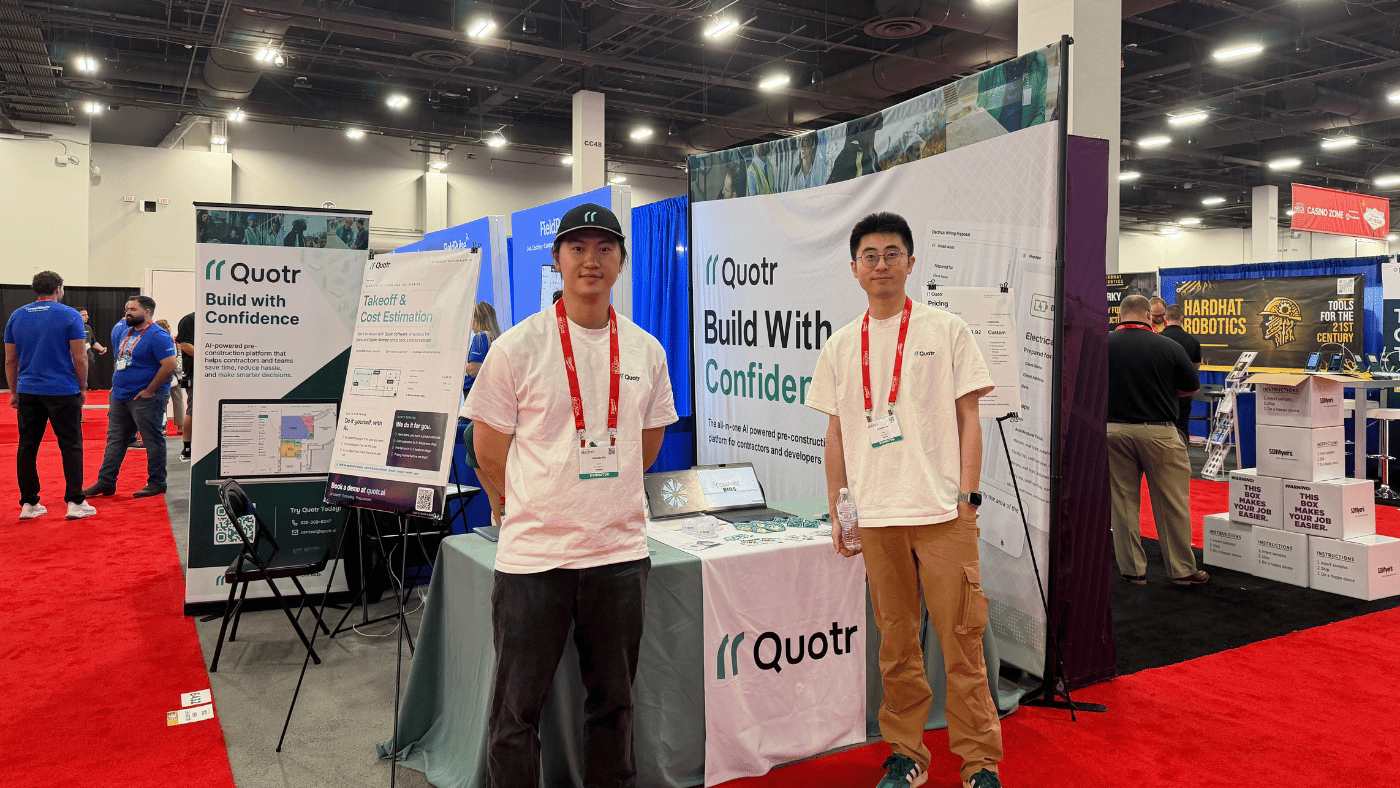
NECA 2026 Recap: What We Saw, and What We Brought to Booth #6432
We’re back from Las Vegas, and our voices are mostly recovered.
Last week, Quotr.ai was on the floor at the NECA 2026 Convention & Trade Show, the National Electrical Contractors Association’s big one, October 4 to 7 at the Mandalay Bay Convention Center. It was a milestone year. NECA turned 125, and the whole show leaned into it, from the “Built on the Past, Charged for the Future” theme to an opening reception at T-Mobile Arena and a closing party out on Mandalay Bay Beach.
Here’s what the week looked like, and what we were doing there.
What NECA 2026 was
If you’ve never been, NECA is where the electrical contracting industry shows up in one place. This year that meant 5,000-plus electrical contractors, suppliers, and pros, a trade floor with 300+ exhibitors, and a general-session lineup that pulled in Nick Saban to open, Andre Agassi mid-week, and Paralympian Melissa Stockwell to close it out.
The 125th-anniversary thread ran through everything: archival photos, milestone projects, and a lot of “here’s how far this trade has come” energy. Standing in a hall full of AI takeoff tools and new gear, it made for a nice contrast. An industry proud of its history, and clearly busy figuring out its next chapter.
Why we were there: Booth #6432
Electrical is one of the trades Quotr.ai knows best, so NECA is exactly the room we want to be in. We set up at Booth #6432 and did the thing we’re most comfortable doing: putting a real electrical plan set on the screen and letting people watch the AI take it off live. It counts the devices, fixtures, homeruns, and panel schedules, and traces every count back to the sheet it came from.
We didn’t keep a tally at the door, but a steady stream of estimators stopped to see what we were up to, and two reactions came up over and over. The first was the demo itself. “Can you show it to me?” usually turned into “that’s impressive” right about the time the AI finished reading a sheet. The second was the price. More than a few did a genuine double-take when they saw what the software costs. They were pleasantly shocked that AI takeoff at this level doesn’t come with an enterprise price tag. And the word we heard most for the product itself was intuitive, which, from people who’ve fought clunky estimating tools for years, we’ll happily take.
What we kept showing came down to two things electrical teams care about right now:
- AI takeoff that’s built for electrical. It counts devices by type, traces homeruns and conduit, and reads panel schedules, rather than being a generic tool pointed at an electrical sheet. (The buyer’s guide covers what to look for.)
- A done-for-you option for the weeks the bids pile up faster than the hours allow: outsourced electrical estimating, where our desk returns the takeoff and estimate for you.
What we heard on the floor
The best part of a show like this isn’t the pitch. It’s the conversations. A few themes came up again and again at the booth, and none of them will surprise anyone in the trade:
- Not enough estimators, too many bids. The capacity crunch is real. Teams want to chase more work but can’t take off fast enough to bid it all.
- The count is where jobs are won or lost. Everyone agreed the slab’s easy. It’s the device-by-device, homerun-by-homerun detail that eats the hours and hides the risk.
- Skepticism about AI accuracy, and fair skepticism at that. The question we got most was some version of “okay, but how accurate is it, really?” Our answer was the honest one: 95 to 99% on clean vector PDFs in our own benchmarking, lower on bad scans, with confidence scores so you know which counts to check. (We wrote the honest version here.) And the reaction that stuck with us: a lot of the estimators we walked through a live takeoff had the same response, some version of “okay, this is actually something I could use.” Not polite booth nodding. The kind where they pulled up a chair, asked how to run it on their own sets, and booked time to talk after the show. When people who do this work every day say they’d use it, that’s the only review that counts.
Thank you
Thanks to NECA for a well-run 125th, to everyone who stopped by #6432 to argue about takeoff accuracy and swap war stories, and to the contractors who brought real plan sets for us to run. That’s still the best test there is.
If we talked at the show and you want to put Quotr.ai on your own hardest electrical set, that’s the standing invitation. Start a free trial or talk to our team. And if we missed you in Vegas, we’ll be out at more shows through the fall and winter.
See you at the next one.
About Quotr.ai
Quotr.ai is an AI construction platform with three parts: Quotr.ai Software (AI takeoff, estimating, and bidding, including the AI agent that reads your plans), Quotr.ai Service (done-for-you cost estimates, takeoffs, and pro formas), and Quotr.ai Procurement (factory-direct materials delivered door-to-door). Multi-trade by design and built for subcontractors, general contractors, and developers. Based in San Francisco.
Published on the Quotr.ai blog. Quotr.ai is an AI-powered construction estimation, takeoff, and procurement platform based in San Francisco.