Electrical Estimating Software: 2026 Buyer's Guide
Electrical estimating has always been a numbers game — fixture counts, circuit runs, panel schedules, and labor hours that compound fast on anything larger than a small tenant improvement. Get the count wrong and you’re eating it. Get the count right but price the labor wrong and you’re still eating it.
The software market has caught up. AI-powered electrical estimating tools in 2026 are genuinely capable of reading plan sets and extracting quantities automatically — but not every tool is built for the complexity of electrical work specifically. A general construction AI tool and a tool trained on electrical symbology are not the same thing, and the difference shows up in real accuracy on real bid sheets.
This guide covers what electrical estimating software actually does, which features matter, where AI is accurate and where it still misses, and the questions to ask before you trust any tool with a live bid. If you already know what to look for and just want tools compared head-to-head, see the best electrical estimating software in 2026. If you’d rather hand the whole bid off, outsourced electrical estimating & takeoff services are the done-for-you route.
We build Quotr.ai, an AI construction estimating platform used by electrical contractors. We’ll be upfront about that and useful anyway.
1. What Electrical Estimating Software Actually Does
Electrical estimating software automates the three most labor-intensive parts of pricing a job: quantity takeoff, material pricing, and labor calculation.
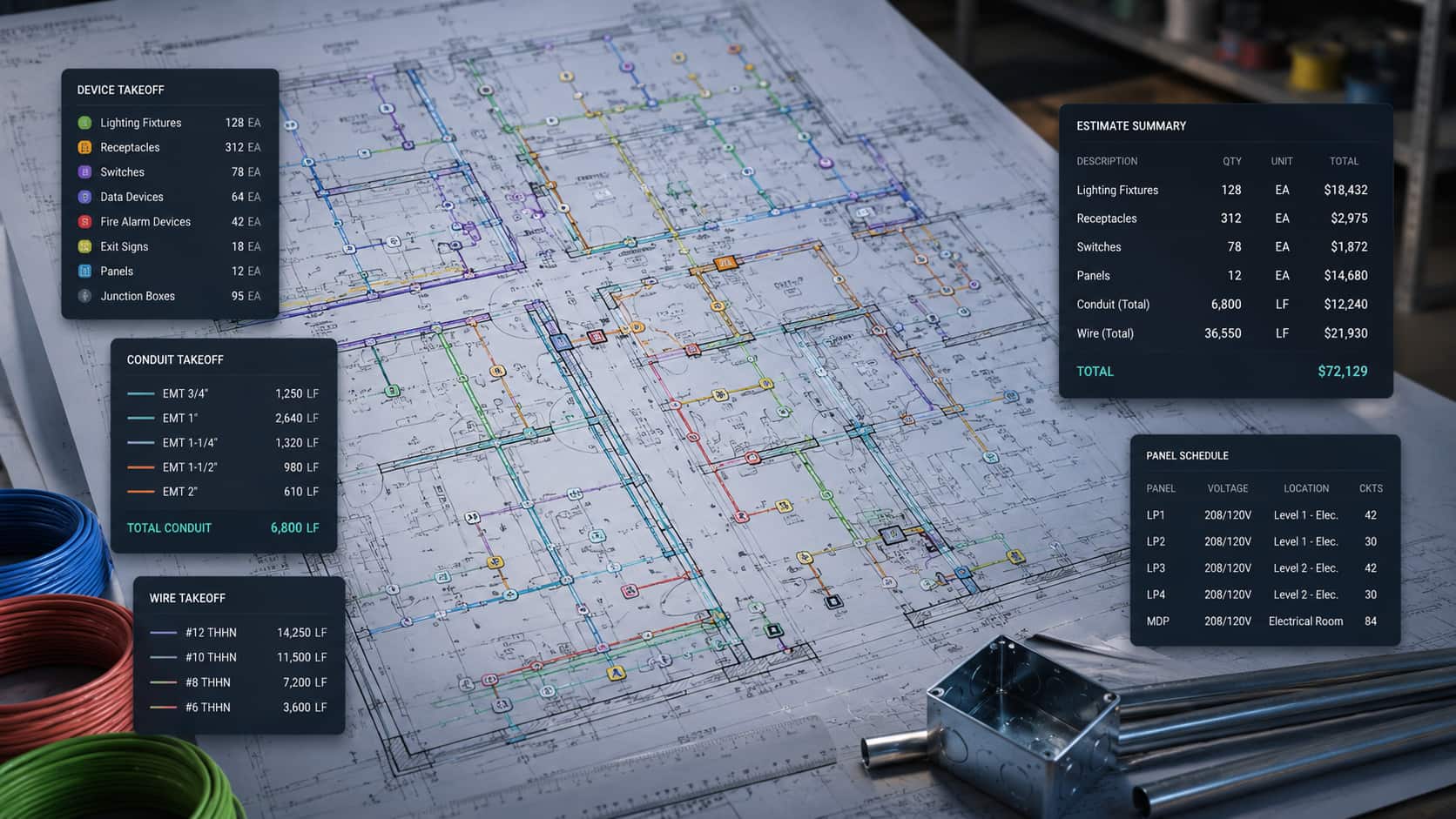
Quantity takeoff extracts counts and measurements from electrical drawings — receptacles, fixtures, panels, devices, conduit runs, wire lengths. On a commercial job with hundreds of symbols across dozens of sheets, this is where manual estimating eats the most time and introduces the most error. (We’ve broken down the full workflow in our guide to the commercial electrical takeoff, from drawings to proposal.)
Material pricing ties those quantities to current costs for wire, conduit, devices, fixtures, and gear. Electrical material pricing moves with copper markets and supply chain conditions — a pricing database that hasn’t been updated recently is quietly mis-pricing every bid you run through it.
Labor calculation applies unit labor hours and loaded rates to produce a fully burdened estimate. The accuracy here depends entirely on whether the tool lets you calibrate to your actual crew productivity — journeyman vs. apprentice mix, your local wage rates, your actual installation times on the work types you do most.
The best platforms connect all three so a quantity change flows automatically through to material and labor cost. The worst are digital spreadsheets with a fancier interface.
2. The Features That Matter
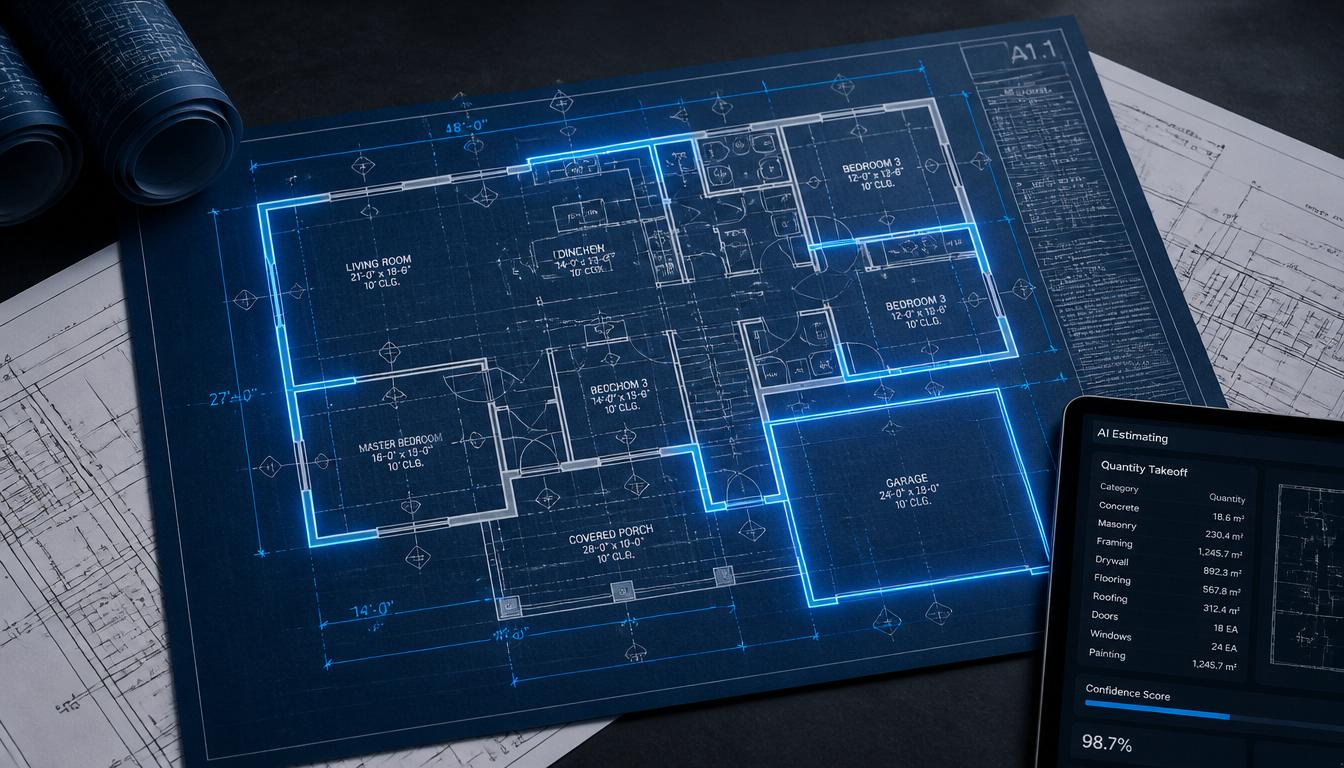
AI-powered quantity takeoff from PDF. On clean vector PDFs, AI tools now read electrical plan sets directly — identifying receptacles, fixtures, panels, devices, and conduit runs — and extract quantities automatically. Takeoff that used to take a full day compresses to a 20–30 minute review task. That time difference is the core ROI argument for electrical contractors doing high bid volumes.
Electrical-specific symbol libraries. This is where a lot of general construction AI tools fall short on electrical work. You need a model trained specifically on electrical symbology — single and duplex receptacles, GFCI and AFCI devices, lighting fixtures by type, panel and subpanel designations, switch types, emergency and exit fixtures, conduit type callouts. A generic tool trained on broad construction symbols will misread or miss electrical-specific symbols at a rate that compounds across a large plan set.
Per-item confidence scoring. Every AI-generated count should come with a signal of how certain the model is. Without confidence scores, you have no way to know which line items need human review before the bid goes out. On a large electrical set with hundreds of devices, this is the feature that determines whether the tool is usable on a real bid or just a demo.
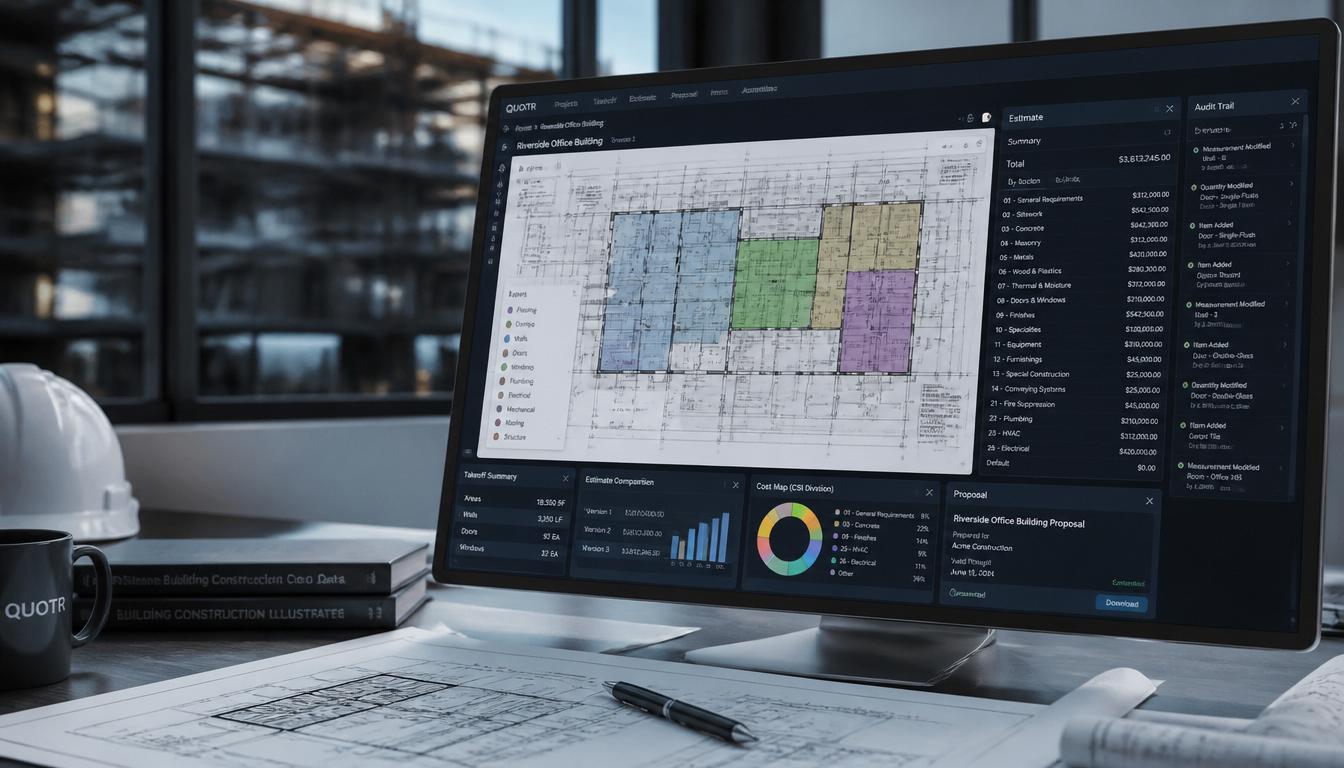
Full auditability. Every count should link back to the specific symbol on the specific sheet that produced it. If a number doesn’t look right, you need to be able to click into it and see exactly where it came from. This is also how you defend your quantities to a GC or owner if the bid gets scrutinized.
Live material pricing. Copper wire pricing moves with the market. Conduit and device pricing shifts with supply chain conditions. Look for tools with factory-direct pricing or verified supplier integrations — not a static database updated once a year.
Customizable labor units. NECA manual labor units are a starting point, not a finish line. Your actual installation times depend on your crew mix, your local market, and the work types you specialize in. A tool that won’t let you adjust labor units to match your operation will mis-price your jobs consistently.
3. Accuracy: What’s Real in 2026
On clean, vector-based PDFs with standard electrical symbology, modern AI takeoff tools hit 95–99% accuracy on device counts, fixture counts, and panel schedules — a range consistent with Quotr’s internal benchmarking across customer plan sets and with published vendor testing. This is the work that historically chewed through estimator hours — and it’s where AI has the clearest edge over manual counting, especially on large, repetitive plan sets. (For the full honest breakdown, see Is AI Takeoff Actually Accurate Yet?)
On scanned PDFs below 300 DPI, accuracy drops to 80–88% without human review in our testing. The same plan set can swing from 97% to 84% accuracy between a native PDF and a re-scanned version. Always feed the highest-quality source file available.
On conduit runs and wire lengths, accuracy depends heavily on whether the drawings are scaled correctly and consistently. Schematic riser diagrams — which show topology but not actual lengths — are a known challenge for AI tools. Make sure you understand how any tool handles schematic vs. scaled wiring diagrams before relying on it for feeder and home-run calculations.
The honest benchmark: manual electrical takeoff by an experienced estimator runs at roughly 92–96% accuracy under normal conditions in our observation, and lower under deadline pressure. AI plus a short human review of flagged items consistently outperforms solo manual takeoff on both speed and consistency for standard device and fixture work.
4. Electrical-Specific Considerations
Device and fixture classification accuracy. Counting receptacles is straightforward. Classifying them correctly — standard, GFCI, AFCI, 20A, 30A, dedicated circuit — is where AI tools diverge significantly in quality. A tool that counts total receptacles but can’t differentiate by type will produce a quantity list that requires significant manual cleanup. Ask specifically how any tool handles device classification, not just device counts.
Panel schedules and load calculations. Panel schedules are a different data extraction problem than symbol counting — they’re structured tables, not plan graphics. The best tools handle panel schedule extraction separately from takeoff and tie it to your load calculation workflow. Many tools don’t handle it at all. If panel schedules are a significant part of your estimating work, confirm this is a native capability.
Conduit fill and wire quantity calculations. Wire quantities derived from conduit runs involve conduit fill calculations, home-run lengths, and circuit counts that go beyond simple linear measurement. A tool that measures conduit length without accounting for fill and pull factors will under-price wire material on every job. Confirm how the tool handles wire quantity derivation from conduit drawings. (Our guide on how to estimate electrical work from drawings — conduit, devices, and labor covers the manual method these tools are automating.)
Service work and small jobs. If your business includes service calls, small tenant improvements, or change order work, your estimating inputs often aren’t full plan sets — they’re scope descriptions, field sketches, or a few pages of drawings. Confirm the tool is useful for this work type, not just engineered construction documents. And if the constraint is capacity rather than tooling — more bids than estimator-hours — outsourced electrical estimating & takeoff services can carry the overflow without a hire.
5. Questions to Ask Any Vendor
Bring your own plan set and ask these before you buy:
1. What’s your accuracy on electrical plan sets specifically? Generic construction accuracy data isn’t relevant to electrical symbology. Ask for electrical-specific numbers.
2. How does the tool handle device classification — not just device counts? Ask for a live demo on a sheet with mixed device types.
3. How does the tool handle panel schedule extraction? If it can’t extract panel schedules natively, that’s a gap you’ll fill manually.
4. How is material pricing sourced and how often is it updated? Get specifics on copper wire and conduit pricing specifically.
5. Can I customize labor units to my operation? Non-negotiable — default labor units will mis-price your jobs.
6. Do you surface per-item confidence scores? If no, you have no signal for which counts to review before the bid goes out.
6. Red Flags to Walk Away From
- No per-item confidence scoring — no way to know which counts to trust without reviewing everything manually
- Demo only runs on vendor plan sets — any serious tool lets you test your worst electrical sheet before you commit
- Generic symbol library without electrical-specific training — a broad construction model will underperform on electrical symbology
- Static material pricing with no clear update schedule — copper and conduit pricing moves; a stale database quietly mis-prices every bid
- No customizable labor units — default NECA units are a starting point, not your number
- No audit trail — if you can’t click into a count and see its source on the plan, you can’t defend the bid
7. What Quotr.ai Does Differently
Electrical-specific training. Our model is trained on electrical symbology — receptacles by type, fixture classifications, panel designations, conduit callouts, switch types, and emergency devices — not just generic construction symbols.
Per-item confidence scores on every takeoff. When the model isn’t certain, you see it before the bid leaves your desk. You know exactly which line items to review.
Factory-direct material pricing. Quantity accuracy converts directly to cost accuracy — including wire and conduit pricing tied to current market rates, not last year’s database.
Proven on real electrical work. This isn’t theoretical: see how RL Electric cut estimating time with AI-powered takeoffs — a working electrical contractor running this exact workflow on live bids.
Our trial is built for your real work — bring a completed electrical job with known actuals and run the audit before you commit.
Event · See it live
Meet Quotr at NECA 2026 — Booth #6432
We'll be at the NECA 2026 Convention & Trade Show — October 4–7 at the Mandalay Bay Convention Center, Las Vegas, for NECA's 125th anniversary. Come watch Quotr run a live AI electrical takeoff on a real plan set: devices, homeruns, and panel schedules counted in minutes, every quantity cited to the sheet. Stop by Booth #6432.
Book a time at the booth →8. Bottom Line
The right electrical estimating software produces accurate, auditable, confidence-scored quantities on your plan types — classifying devices correctly, handling panel schedules, and connecting quantity accuracy to live material pricing and calibrated labor units.
The electrical contractors pulling ahead in 2026 aren’t the ones who replaced their estimators. They’re the ones who freed their estimators from counting fixtures and measuring conduit runs — so they can spend their hours on labor strategy, scope review, and the bids worth chasing.
The takeoff isn’t the bid. The bid is what you do with the time the takeoff used to cost you.
Frequently Asked Questions
What is the best electrical estimating software in 2026?
The best electrical estimating software depends on your work mix, but the non-negotiables are the same: a model trained on electrical-specific symbology, per-item confidence scoring, a full audit trail back to the drawing, live material pricing, and customizable labor units. Quotr.ai was built around exactly those requirements for electrical contractors — and if you want the tools compared side by side, see the best electrical estimating software in 2026.
How accurate is AI electrical takeoff?
On clean vector PDFs with standard symbology, AI takeoff tools reach 95–99% accuracy on device, fixture, and panel counts in Quotr’s internal benchmarking. Accuracy drops to roughly 80–88% on low-resolution scans, which is why per-item confidence scoring and a short human review of flagged items matter.
Does electrical estimating software handle panel schedules?
Not always. Panel schedules are structured tables, not plan graphics, so they require a separate extraction capability from symbol takeoff. Many tools skip them entirely. If panel schedules are central to your estimating work, confirm native panel schedule extraction before buying.
Can AI calculate conduit runs and wire lengths?
AI can measure scaled conduit runs reliably, but wire quantities also depend on conduit fill, pull factors, home-run lengths, and circuit counts. Schematic riser diagrams that show topology rather than true lengths remain a known limitation — ask any vendor how their tool handles schematic versus scaled wiring diagrams.
How much time does AI takeoff save electrical estimators?
Takeoff that used to take a full day compresses to a 20–30 minute review task on typical commercial plan sets. RL Electric, an electrical contractor using Quotr.ai, cut its estimating time substantially while keeping every count traceable to the drawing — the time savings scale with bid volume.
Should I outsource electrical estimating instead of buying software?
If your constraint is capacity rather than tooling — more bid invitations than estimator-hours — outsourcing can be the better first move. Outsourced electrical estimating & takeoff services deliver a done-for-you takeoff, estimate, and bid-ready proposal, and every engagement still includes the software if you later bring it in-house.
Test It on the Hardest Set You’ve Got
Ready to test AI takeoff on your own electrical plan sets? Talk to the Quotr team and bring the hardest set you’ve got — the audit is the point. Want the tools compared first? See the best electrical estimating software in 2026. Prefer done-for-you? Start with outsourced electrical estimating services. And to see how contractors across trades run takeoff, estimating, and proposals in one workflow, visit Quotr.ai Software.
And if you’re heading to Las Vegas — come find us at NECA 2026, Booth #6432 (Oct 4–7, Mandalay Bay). Bring a sheet; we’ll take it off live.
Related Reading
- Best Electrical Estimating Software in 2026: Top Tools for Electricians
- Outsourced Electrical Estimating & Takeoff Services
- How RL Electric Cut Estimating Time with AI-Powered Takeoffs
- Commercial Electrical Takeoff: From Drawings to Proposal
- How to Estimate Electrical Work From Drawings: Conduit, Devices, Labor
- Is AI Takeoff Actually Accurate Yet? Honest 2026 Answer
- How AI Construction Takeoff Works in 2026
About Quotr.ai
Quotr is an AI construction platform with three parts: Quotr Software (AI takeoff, estimating, and bidding — including the AI agent that reads your plans), Quotr Service (done-for-you cost estimates, takeoffs, and pro formas), and Quotr Procurement (factory-direct materials delivered door-to-door). Multi-trade by design and built for subcontractors, general contractors, and developers. Based in San Francisco.
Published on the Quotr.ai blog. Quotr.ai is an AI-powered construction estimation, takeoff, and procurement platform based in San Francisco.