Outsourcing vs. Hiring an Estimator: The Real Math
The short answer: A senior construction estimator’s sticker salary is $125k–$180k — but the real cost to put one on your team is closer to $165k–$230k a year once you add payroll burden, benefits, recruiting, software, and ramp-up time. Hiring makes sense when your bid volume is high and steady enough to keep that person fully utilized. If your volume is spiky, or you’re passing on bids today because you’re at capacity, outsourcing converts that fixed cost into a per-project variable cost and adds capacity immediately — which is why most contractors land on a hybrid. Here’s the math so you can run it for your own shop. See Quotr.ai Service →
Every growing contractor hits the same wall: more bid invitations than estimator-hours to answer them. The obvious fix is to hire another estimator. But the “just hire someone” instinct hides most of the true cost — and it doesn’t solve the problem for months. Let’s put honest numbers on both options.
What a hire actually costs (not the salary you think)
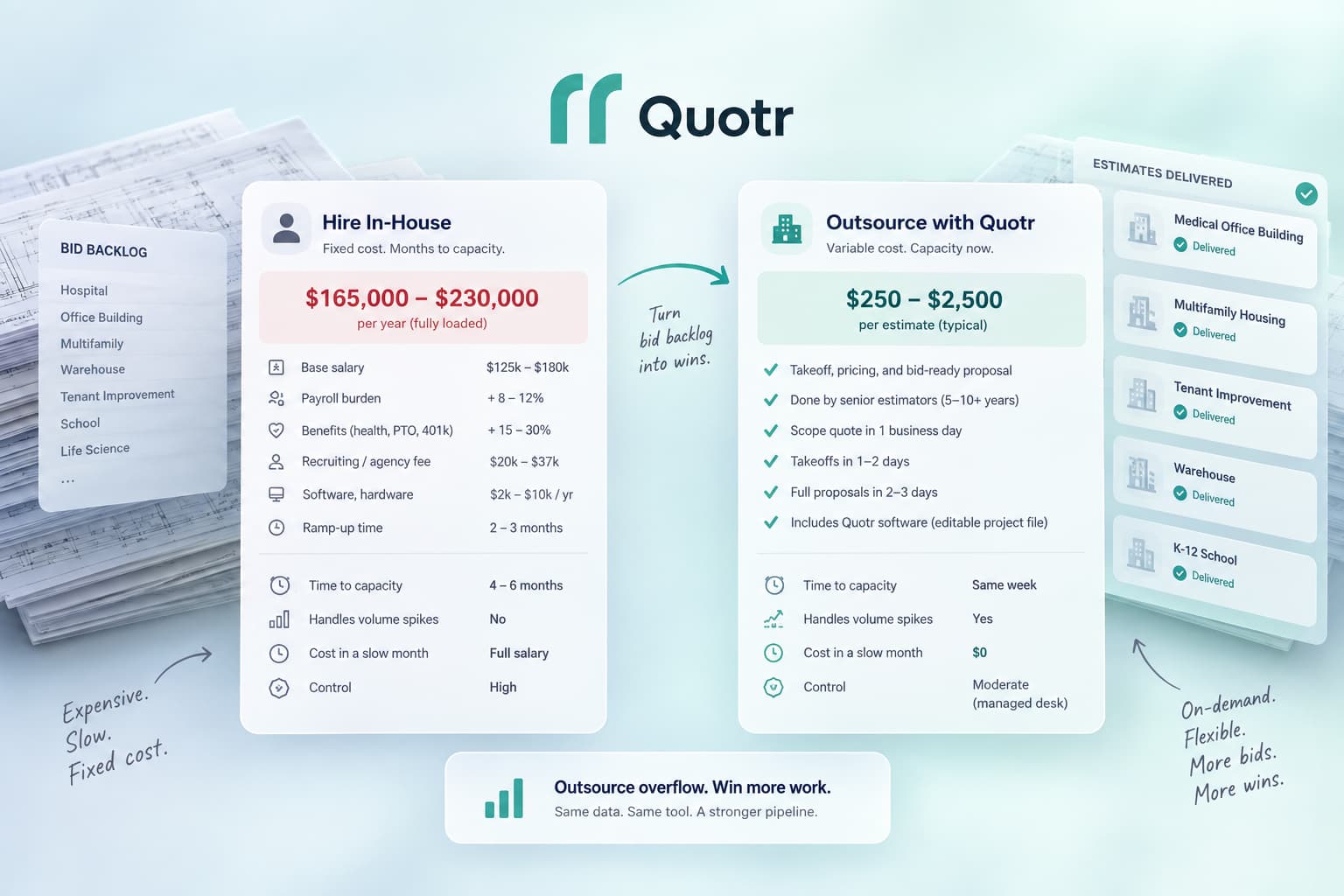
The salary line is only the beginning. Here’s what a senior estimator really costs in a high-cost US market:
| Cost component | Typical range (senior estimator) |
|---|---|
| Base salary | $125,000 – $180,000 |
| Payroll burden (FICA, unemployment, workers’ comp) | +8–12% of salary |
| Benefits (health, retirement match, PTO) | +15–30% of salary |
| Recruiting / agency fee (one-time, first year) | $20,000 – $37,000 |
| Software, hardware, licenses | $2,000 – $10,000 / yr |
| Ramp-up (2–3 months to full productivity) | ~15–25% of year-one output lost |
Once you apply a typical fully-burdened multiplier of 1.25×–1.45× to base salary — higher in California or New York — a $150,000 estimator costs roughly $190,000–$215,000 all-in in year one. Benefits alone run about 30% of total compensation for private-industry workers. None of that is optional, and none of it flexes down in a slow quarter.
The part the spreadsheet misses: capacity and timing
Two costs never show up on the offer letter:
Time-to-productive. A new senior estimator takes months to recruit and 2–3 months to ramp on your systems, pricing, and trade partners. The bids you’re losing this month stay lost.
The single-point-of-failure ceiling. One estimator can only process so many complete bids a week. When they’re on PTO, out sick, or slammed, your bid capacity drops to zero. And every invitation you decline doesn’t just cost the potential margin on that job — it costs standing with the GC or owner who invited you, and they invite you less next time.
What outsourcing changes
Outsourcing preconstruction flips a fixed cost into a variable one. Instead of carrying $200k+ a year whether the pipeline is full or empty, you pay per project — and only when you have work to bid. With an on-demand desk like Quotr.ai Service, you also get three things a single hire can’t give you:
- Immediate capacity — no 4–6 month recruiting cycle. You can send a drawing set today.
- Elastic throughput — one bid this week, fifteen next week; the desk absorbs the spike.
- No idle cost — a slow month costs you nothing, instead of $17k in salary you still have to pay. The tradeoff is that a pure outsourcing model gives you less minute-to-minute control than an estimator sitting down the hall — which is exactly why the answer for most shops is a blend.
The real math: a worked example
Say you’re currently passing on 6 bid invitations a month because you’re at capacity, and you win 1 in 5 of the bids you actually submit.
Option A — Hire. ~$200k all-in for the year, available in ~5 months, capped at one person’s throughput. Cost is fixed regardless of volume.
Option B — Outsource on demand. You pay per project only for the bids you pursue. Those 6 previously-passed invitations become 6 submitted bids a month. At a 1-in-5 win rate, that’s roughly one extra project won per month you weren’t capturing before — starting immediately, with zero fixed overhead in the months you’re quiet.
The break-even isn’t about which is “cheaper per bid.” It’s about utilization and timing: if you can keep a full-time estimator busy ~50 weeks a year, a hire amortizes well. If you can’t — or you need capacity now — outsourcing wins until your steady volume justifies the fixed seat.
In-house vs. outsourced, side by side
| Hire in-house | Outsource on demand | |
|---|---|---|
| Cost structure | Fixed (~$165k–$230k/yr) | Variable (per project) |
| Time to capacity | 4–6 months | Same week |
| Handles volume spikes | No (one-person ceiling) | Yes (elastic) |
| Cost in a slow month | Full salary | $0 |
| Control | High (in-house) | Moderate (managed desk) |
| Best when… | High, steady bid volume | Spiky volume, or at capacity now |
The answer most contractors land on: hybrid
You don’t have to pick a side. Keep your in-house estimator focused on your core, repeat work — and use Quotr.ai Service as overflow capacity for the bids you’d otherwise pass on. That’s the model the Precon on Demand walkthrough covers: send a drawing set, get a turnkey takeoff, a zip-code-accurate cost estimate, and a bid-ready proposal back in 1–3 business days.
And because every Quotr.ai Service engagement includes the Quotr.ai software, you’re not buying a black-box spreadsheet — you get the live, editable project file with an AI agent that checks the takeoff against the drawings. Your in-house estimator can pick up any project the desk produces and keep working in the same tool.
Run your own numbers, then send us a set. Get a custom quote on your next bid →
Frequently Asked Questions
How much does it really cost to hire a construction estimator? A senior estimator’s base salary is $125,000–$180,000, but the fully-loaded cost is closer to $165,000–$230,000 a year once you add payroll burden, benefits, recruiting fees, software, and ramp-up time — using a typical fully-burdened multiplier of 1.25×–1.45× (higher in California and New York). That cost is fixed whether your pipeline is full or empty.
Is it cheaper to outsource estimating or hire in-house? It depends on utilization. If you can keep a full-time estimator busy roughly 50 weeks a year, hiring amortizes well. If your bid volume is spiky, or you’re passing on bids today because you’re at capacity, outsourcing is more cost-effective because it turns a fixed ~$200k salary into a per-project variable cost with no idle-month expense. Many contractors use both.
How fast can outsourced estimating add capacity? Immediately. Hiring a senior estimator takes 4–6 months to recruit and 2–3 months to ramp. An on-demand desk like Quotr.ai Service can take a drawing set the same week and return a scope quote within one business day, with takeoffs in 1–2 days and full proposals in 2–3 days.
What’s the hidden cost of passing on a bid? Beyond the lost margin on that specific job, declining an invitation lowers your standing with the GC or owner — and they invite you to fewer future bids. Lost bid capacity compounds into a shrinking pipeline, which is why capacity, not price, is usually the real constraint.
Can I use outsourced estimating alongside my in-house team? Yes — that’s the most common setup. Keep your in-house estimator on core, repeat work and use Quotr.ai Service for overflow. Because the software is included, your team can open and edit any project the desk produces in the same tool, so nothing is siloed.
Related Reading
- Precon on Demand: Outsourcing Bid & Cost Estimation (CEO Walkthrough)
- Outsource Construction Estimating: In-House vs. On-Demand
- Construction Estimating Services (Hub)
- Preconstruction Services for General Contractors
About Quotr.ai
Quotr.ai is an AI construction platform with three parts: Quotr.ai Software (AI takeoff, estimating, and bidding — including the AI agent that reads your plans), Quotr.ai Service (done-for-you cost estimates, takeoffs, and pro formas), and Quotr.ai Procurement (factory-direct materials delivered door-to-door). Built for subcontractors, general contractors, developers, and lenders, and based in the San Francisco Bay Area.
Published on the Quotr.ai blog.