Best Plumbing Estimating Software in 2026: Top Tools for Plumbers
Plumbing estimating is unforgiving. Miss a few fixtures, under-count fittings on a riser, or price pipe off a stale cost book, and a bid that looked profitable turns into a loss the day you win it. The job is part counting (fixtures, valves, cleanouts), part measuring (pipe runs by material and size), and part judgment (labor productivity on the work types you actually do). The right plumbing estimating software handles the first two so your estimators can focus on the third — and price the bid faster than the competition.
The market in 2026 splits into two camps: the deep, pipe-specific desktop estimators plumbing and mechanical contractors have used for decades, and a newer wave of cloud-native, AI-assisted platforms that read plan sets and extract quantities automatically. This guide compares the best plumbing estimating software in 2026 — six tools worth your shortlist — with honest notes on who each fits, what it costs, and where it falls short.
For the broader evaluation framework, pair this list with our AI construction estimating software buyer’s guide and, if you also bid mechanical, the HVAC estimating software buyer’s guide. This article is the shortlist; those are the scorecards.
What plumbing estimating software does
Plumbing estimating software automates the three most labor-intensive parts of pricing a job: quantity takeoff (counting fixtures and measuring pipe runs, fittings, and valves off the drawings), material pricing (tying those quantities to current costs for pipe, fittings, fixtures, and gear), and labor calculation (applying unit labor hours and loaded rates to produce a fully burdened estimate). The best platforms connect all three so a quantity change flows straight through to material and labor cost. The weakest are spreadsheets with a nicer interface.
For plumbing specifically, two capabilities separate real tools from generic ones: handling pipe takeoff by material and size (copper, PEX, CPVC, cast iron, carbon steel — each with different fittings and labor), and the ability to calibrate to recognized labor standards like PHCC and MCAA units and then tune them to your own crews.
How we picked these tools
We weighted plumbing-specific takeoff (pipe and fixtures, not just generic counts), labor-unit flexibility, material pricing freshness, deployment model (cloud vs. desktop), procurement, and transparent pricing. We build Quotr.ai, an AI estimating platform used across the trades, so we’re upfront about that — and we’ve kept the comparisons fair regardless of which tool you choose.
The 6 best plumbing estimating software tools in 2026
1. Quotr.ai — Best for multi-trade AI-assisted takeoff and sourcing
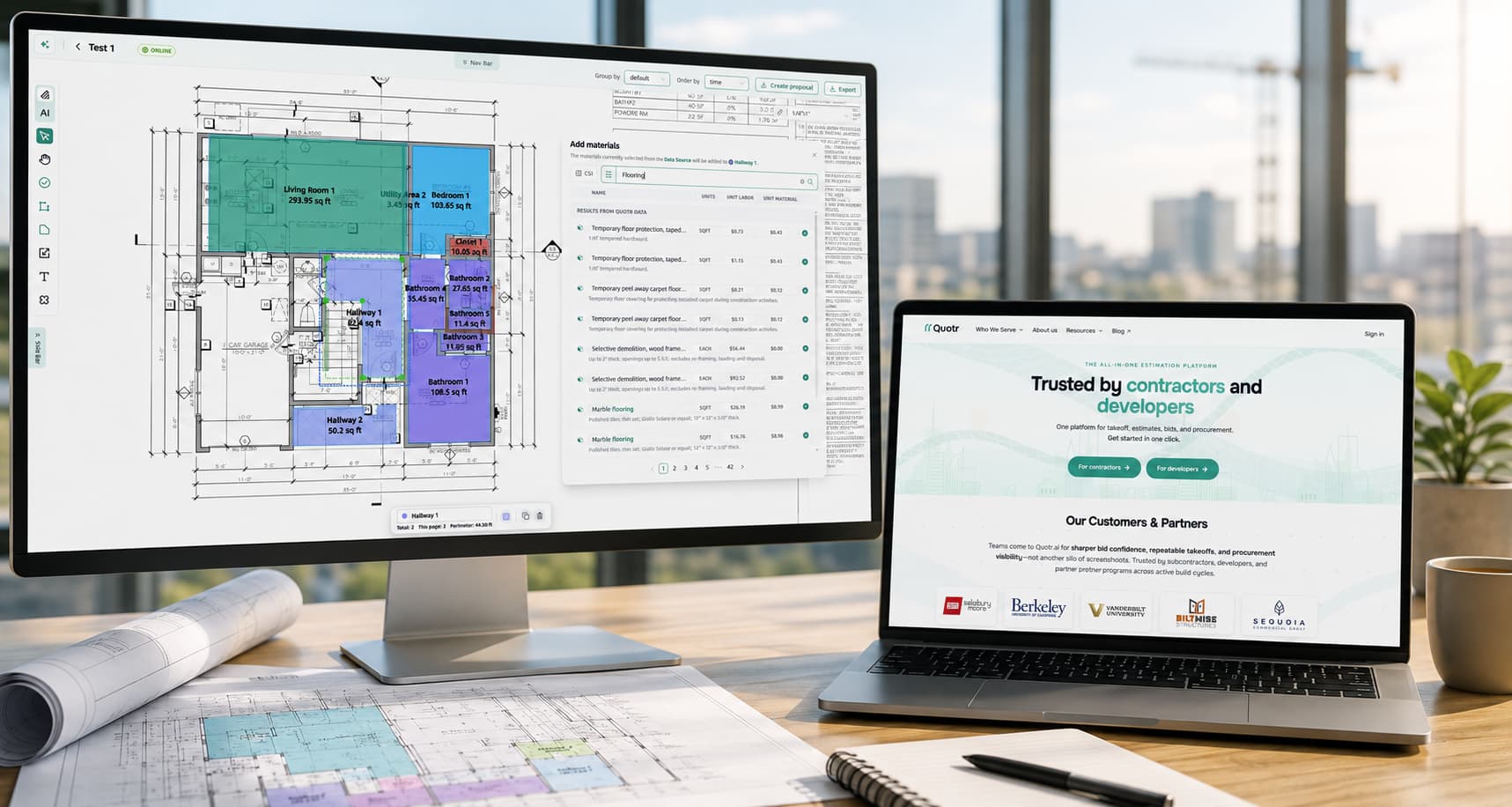
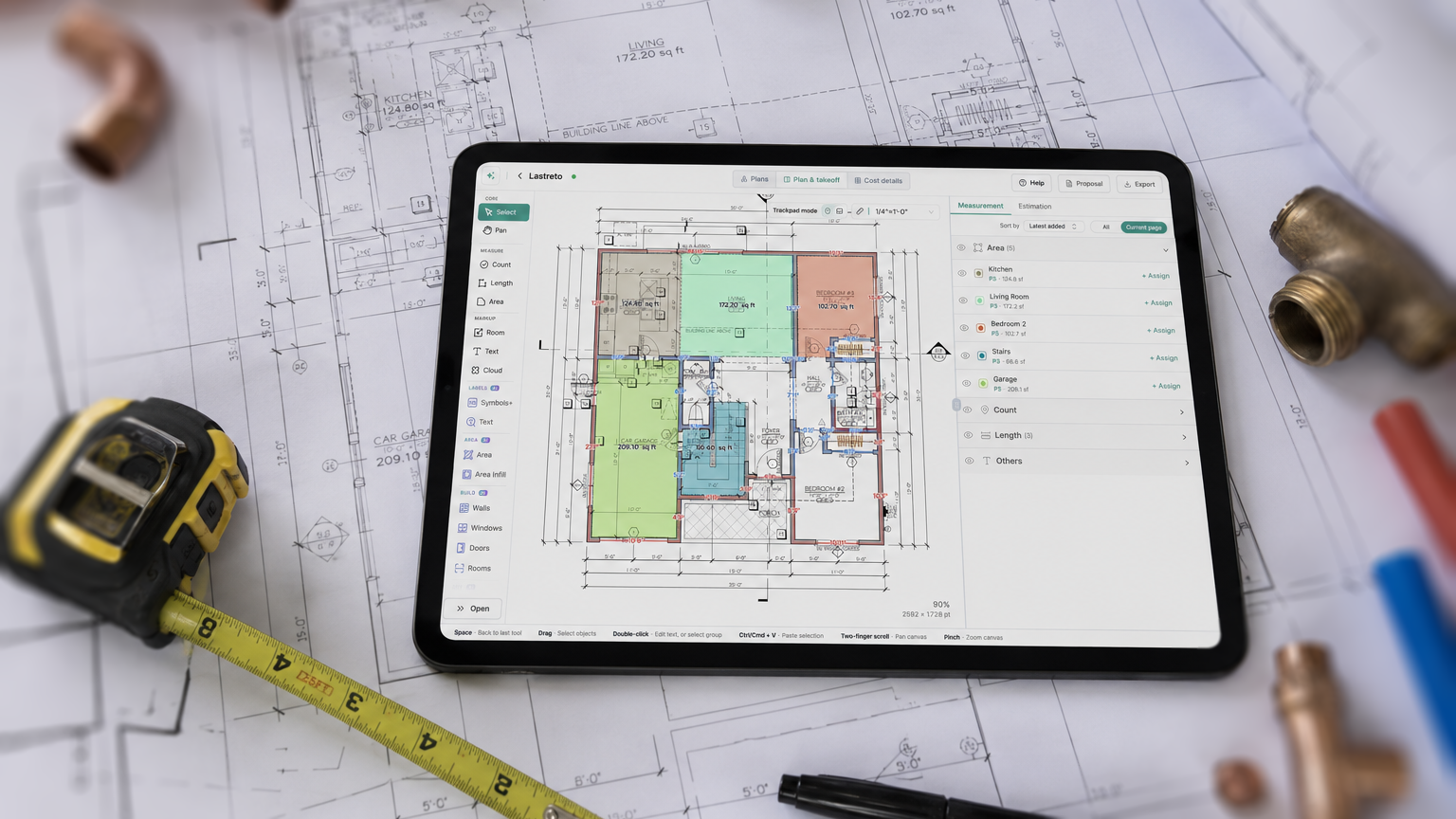
Quotr.ai is an all-in-one, cloud-native platform that runs the full subcontractor workflow — takeoff, estimates, a pricing database, bids, and procurement — in one product. Upload a PDF plan set and Quotr’s AI takeoff detects rooms, fixtures, and symbols, automatically counting every item with a per-item confidence score (via Smart Matching) and a full audit trail back to the drawing, so you know exactly which items to review before the bid goes out. On clean vector PDFs, Quotr’s AI takeoff runs at 95–99% accuracy on counts in internal benchmarking, with a short human review of flagged items closing the gap on lower-quality scans. There’s also a built-in AI Agent you can ask plain-English questions about the drawing — fixture counts, room dimensions, openings — without hunting through the sheets.
On the sourcing side, Quotr lets you add your own suppliers and compare their quotes inside the app, so existing trade relationships and deals carry in. When you want sharper material pricing, Quotr Procurement can act as a dedicated sourcing partner — factory-direct bath and plumbing fixtures delivered door-to-door to your jobsite, at an average 40–55% below dealer pricing. Either way, quantity accuracy becomes buyout accuracy in one workspace.
- Best for: plumbing and MEP subs who want AI takeoff speed plus integrated bidding and sourcing in one workspace.
- Pricing: published and transparent — Solo from $299.90/month, Team (2–6 seats) $499.90/month, and custom Enterprise pricing for 7+ users (SSO, custom contracts, dedicated support); 7-day free trial on every plan.
- Watch-out: newer than the legacy pipe estimators; for deep, fitting-by-fitting pipe assemblies and decades-old PHCC/MCAA labor libraries, the specialist desktop tools below still go deeper. Quotr is strongest on fixtures, quantities, speed, counting and sourcing.
2. FastEST (FastPIPE) — Best dedicated plumbing/mechanical estimator
FastEST’s FastPIPE is a long-standing favorite among plumbing and mechanical estimators, built specifically for pipe takeoff. It ships with a material and pricing database reported at 150,000+ items across major manufacturers, plus MCAA and PHCC labor standards, and on-screen digitizer takeoff. If pipe-by-material, fitting-heavy takeoff is the core of your work, FastPIPE is purpose-built for it.
- Best for: plumbing/mechanical contractors who want a dedicated, pipe-specific estimator with a deep material library.
- Pricing: reported at $4,995 one-time (or $225/month) for the first application, with additional apps (FastDUCT, FastWRAP) at $2,495 / $93 per month (Software Advice). Confirm with FastEST.
- Watch-out: desktop-rooted workflow; manual on-screen takeoff rather than automated AI detection.
3. Trimble AutoBid Mechanical — Best for large commercial and industrial
Part of Trimble’s Estimation MEP line, AutoBid Mechanical is built for larger plumbing and mechanical contractors bidding complex commercial and industrial work, with deep assemblies and integration into the broader Trimble construction ecosystem. It’s a category standard at the high end.
- Best for: larger plumbing/mechanical contractors on complex commercial and industrial projects.
- Pricing: quote-based; third-party aggregators report Trimble Estimation MEP / AccuBid Pro starting around $3,000/year per seat and scaling up. Confirm with Trimble.
- Watch-out: steeper learning curve and higher total cost of ownership; more than a small service shop needs.
4. QuoteSoft (Trimble) — Best for flexible pipe and ductwork takeoff
QuoteSoft Pipe, also a Trimble product, is a well-regarded plumbing and mechanical estimating tool known for flexible on-screen pipe and fitting takeoff and a maintainable item database. It’s a strong middle option for shops that want pipe-specific depth without the full AutoBid footprint.
- Best for: plumbing/mechanical contractors wanting flexible, pipe-specific takeoff.
- Pricing: quote-based; aggregators report QuoteSoft Pipe starting around $2,500+/year. Confirm with Trimble.
- Watch-out: desktop-lineage workflow; AI automation is limited compared with cloud-native platforms.
5. McCormick (Plumbing) — Best for service and small-to-mid commercial shops
McCormick Systems has long served plumbing contractors, especially service and small-to-mid commercial shops, with a comprehensive assembly library, PHCC labor units, and supplier price feeds from major plumbing distributors. Flexible labor costing is its hallmark.
- Best for: service plumbers and small-to-mid commercial shops that prioritize labor control.
- Pricing: quote-based; aggregators report McCormick Plumbing starting around $1,500/year (Software Connect). Confirm with McCormick.
- Watch-out: traditional desktop workflow; lighter on automated AI symbol detection.
6. Wendes Mechanical — Best for multi-trade mechanical/plumbing shops
Wendes is a mechanical estimating system used by HVAC and plumbing shops that bid across trades, with sheet-metal and piping takeoff and an established labor and material database. A practical fit for multi-trade mechanical contractors.
- Best for: multi-trade mechanical/plumbing contractors.
- Pricing: quote-based; aggregators report around $2,200/year for plumbing-mechanical shops. Confirm with Wendes.
- Watch-out: desktop-based; interface and workflow are more traditional than cloud platforms.
Plumbing estimating software comparison (2026)
| Tool | Best for | Deployment | AI takeoff | Sourcing built in | Pricing model |
|---|---|---|---|---|---|
| Quotr.ai | AI takeoff + bidding + sourcing | Cloud | Yes — AI detection + confidence scores | Bring-your-own suppliers + factory-direct | Published: from $299.90/mo |
| FastEST (FastPIPE) | Dedicated pipe takeoff | Desktop | On-screen (manual) | No | $4,995 one-time / $225/mo |
| Trimble AutoBid Mechanical | Large commercial/industrial | Desktop | Assembly-assisted | Limited | Quote (~$3,000/yr/seat) |
| QuoteSoft (Trimble) | Flexible pipe/duct takeoff | Desktop | On-screen (manual) | No | Quote (~$2,500+/yr) |
| McCormick (Plumbing) | Service & small-mid commercial | Desktop | Limited | No | Quote (~$1,500+/yr) |
| Wendes Mechanical | Multi-trade mechanical/plumbing | Desktop | Limited | No | Quote (~$2,200/yr) |
Pricing for the legacy vendors is largely quote-based or third-party-reported; confirm with each vendor. Quotr.ai pricing is published on the pricing page.
How to choose the right plumbing estimating software
Match the tool to your work mix, not the longest feature list. If your volume is fixture-and-fitting commercial work and you want to compress takeoff hours and connect estimating to buyout, prioritize a cloud platform with AI takeoff and built-in sourcing. If your work is pipe-heavy industrial with thousands of fittings per bid, the depth of a dedicated estimator like FastPIPE or AutoBid earns its cost. If you’re a service or small commercial shop focused on labor control, weigh McCormick.
Three checks decide most shortlists: Can you test it on your own worst plan set before buying? Does it handle pipe takeoff by material and size — not just fixture counts? And does material pricing stay current with the volatile cost of copper, PEX, and cast iron? A demo that only runs on the vendor’s clean sample sheet tells you nothing about your bids. Bring a completed job with known actuals and run the audit.
When you’re ready to pressure-test the shortlist, Is AI Takeoff Actually Accurate Yet? gives the honest accuracy breakdown, and What Is AI Construction Estimating Software? covers how the AI-assisted workflow fits the broader estimating process.
Frequently asked questions
What is the best plumbing estimating software in 2026?
The best plumbing estimating software depends on your work mix, but the non-negotiables are consistent: pipe takeoff by material and size, fixture and fitting handling, customizable PHCC/MCAA labor units, current material pricing, and a way to test it on your own plans. Quotr.ai leads on AI takeoff speed and integrated sourcing, while FastPIPE, Trimble AutoBid, and McCormick remain strong pipe-specific choices.
How much does plumbing estimating software cost?
Pricing ranges widely. Cloud platforms like Quotr.ai publish transparent rates starting at $299.90/month (with custom Enterprise pricing for larger teams), while dedicated desktop estimators run from roughly $1,500/year (McCormick) to $4,995 one-time (FastPIPE) and $3,000+/year per seat (Trimble). Always confirm current pricing directly with each vendor.
Can AI do plumbing takeoff?
Yes. AI takeoff reads plan sets and extracts fixtures, rooms, and symbols automatically, returning quantities with per-item confidence scores for review. On clean vector PDFs, tools like Quotr.ai reach 95–99% accuracy on counts in internal benchmarking. Pipe runs and fitting-level detail still benefit from estimator review, especially on schematic risers.
Does plumbing estimating software handle pipe takeoff by material?
The dedicated estimators (FastPIPE, AutoBid, QuoteSoft) are built around pipe-by-material-and-size takeoff with fitting assemblies and PHCC/MCAA labor units. If pipe-heavy industrial work is your core business, confirm depth of pipe and fitting handling before buying — it’s where these tools differentiate most.
What’s the difference between plumbing estimating and takeoff software?
Takeoff software extracts quantities — fixture counts and pipe measurements — from the drawings. Estimating software adds material pricing and labor calculation on top to produce a fully burdened bid. The best platforms combine both so a quantity change flows automatically through to material and labor cost.
The bottom line
The plumbing contractors pulling ahead in 2026 aren’t the ones who replaced their estimators — they’re the ones who freed their estimators from counting fixtures and measuring pipe so they can focus on labor strategy, scope, and the bids worth chasing. Any tool on this list can move you in that direction; the right one depends on your work mix, your deployment preference, and how much of the takeoff-to-buyout workflow you want in one product.
If you want AI takeoff, integrated bidding, and material sourcing under one roof — with pricing you can see before you talk to sales — start a free trial of Quotr.ai or talk to our team and bring the hardest plumbing plan set you’ve got. The audit is the point. Developers and owner-side teams who want costs handed off entirely can use Quotr.ai Service.
Related reading
- What Is AI Construction Estimating Software?
- AI Construction Estimating Software: Buyer’s Guide
- HVAC Estimating Software: 2026 Buyer’s Guide
- Electrical Estimating Software: 2026 Buyer’s Guide
- Is AI Takeoff Actually Accurate Yet?
References
- Plumbing-Heating-Cooling Contractors Association (PHCC) — labor unit standards. https://www.phccweb.org/
- Mechanical Contractors Association of America (MCAA) — labor estimating standards. https://www.mcaa.org/
- FastEST, Inc. — FastPIPE plumbing estimating software. https://www.fastest-inc.com/
- Software Advice — FastPIPE profile and pricing. https://www.softwareadvice.com/construction/fastpipe-profile/
- Software Connect — best plumbing estimating software roundup and pricing. https://softwareconnect.com/roundups/best-plumbing-estimating-software/
- Trimble — Estimation MEP / AutoBid / QuoteSoft. https://www.trimble.com/
- McCormick Systems — plumbing estimating. https://www.mccormicksys.com/
Published on the Quotr.ai blog. Quotr.ai is an AI-powered construction estimation, takeoff, and procurement platform based in Berkeley, California.