2026 Construction Cost Trends: Materials, Labor & What Builders Should Expect
If you’re a residential builder trying to hold your margins in 2026, you already know that construction costs are not behaving the way they used to. Material prices are swinging on a monthly basis. Skilled labor is increasingly hard to find and harder to keep. And the estimating processes most firms still rely on — spreadsheets, manual takeoffs, phone-based supplier quotes — were not designed for this level of volatility.
This post breaks down the most important construction cost trends in 2026, the structural forces driving them, and what separates firms that are protecting their margins from those that are watching bids go sideways before a single footing is poured.
The Bifurcation Nobody Is Talking About
The residential construction industry in 2026 is splitting into two camps.
The first group — firms that have modernized their preconstruction workflows with AI — are reporting stronger project margins even in volatile markets, with some industry observers citing ranges of 8–12% for AI-assisted firms relative to their manual counterparts. They’re adjusting estimates in real time, catching cost drift before it compounds, and submitting more bids without adding headcount.
The second group — firms still running manual workflows — are absorbing the full force of two simultaneous crises: a 500,000-worker shortage and annualized input price spikes running at 12.6% in key material categories. For these firms, the margin is not shrinking — it’s evaporating.
This is not a technology adoption story. It’s a survival story. Explore Quotr.ai’s automated takeoff features to understand what the transition looks like in practice.
2026 Material Cost Forecasts for Residential Construction
The table below reflects current and projected cost pressures across the materials most relevant to residential builds. These are baseline escalation ranges, not worst-case scenarios. Tariff-driven volatility can push the upper end significantly higher.
| Material | 2025 Avg. Price Change (YoY) | 2026 Forecast Trend | Primary Driver |
|---|---|---|---|
| Copper wire & conduit | +22–36% (wire & cable, YoY) | Continued pressure (+15–25%) | AI data center demand, global supply deficit |
| Framing lumber | +8–12% | Moderate (+5–8%) | Tariff risk on Canadian imports (USMCA renegotiation) |
| Structural steel | +14% | Elevated (+10–15%) | Section 232 tariffs, infrastructure competition |
| Concrete/cement | +6% | Stable (+4–6%) | Regional demand variation, energy cost pass-through |
| HVAC equipment | +10–18% | High (+12–20%) | Refrigerant transition (A2L), supply chain lead time |
| Electrical switchgear | Shortage-driven | Critical (2–4 yr lead times) | Data center buildout diverting domestic supply |
| Aluminum products | +30–33% (mill shapes, PPI) | Elevated (+15–20%) | Section 232 tariffs doubled to 50% in June 2025, reshoring constraints |
| Insulation (spray foam) | +5% | Stable (+3–6%) | Petrochemical pricing, modest improvement |
Sources: JLL Materials Report 2025, KPMG Construction Spending Analysis Feb 2026, Bloomberg Electrical Components Report April 2026, U.S. Bureau of Labor Statistics PPI
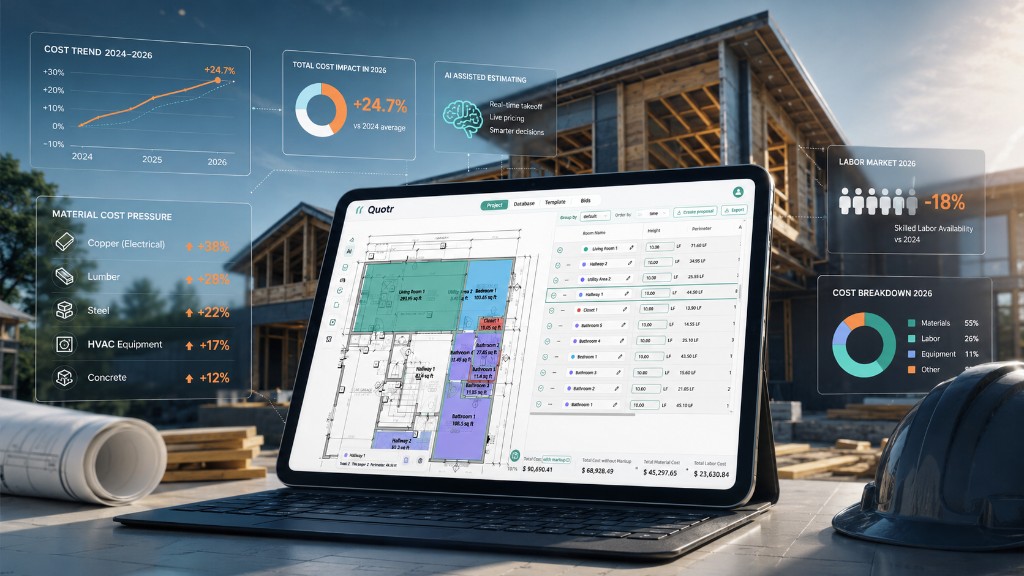
The standout risk for residential builders is copper and electrical switchgear. A single 1-GW AI data center now consumes up to 50,000 metric tons of copper — 3–4× more than a conventional facility. That demand is directly competing with residential electrical contractors for the same wire, panels, and gear. Lead times for switchgear in some markets have stretched to 2–4 years, and residential projects are not at the front of that queue.
The Labor Shortage Is Not a Temporary Problem
Understanding construction cost overrun causes and solutions in 2026 starts with the labor market. The Associated Builders and Contractors estimated the industry needs to attract 499,000 net new workers this year just to maintain equilibrium — and that’s before accounting for the 41% of the current workforce projected to retire by 2031.
The practical result on job sites:
- 92% of contractors report difficulty filling skilled trade positions (AGC-NCCER 2025 Workforce Survey)
- 45% of contractors experienced at least one project delay in the past year because of workforce gaps
- Electricians are in the most acute shortage — with roughly 1 in 5 over age 55 — precisely at the moment when data center construction is competing for the same talent
For residential builders, this translates directly into schedule extensions, overtime premiums, and subcontractor price increases that were not in the original estimate. Browse industry insights on the Quotr.ai blog to see how other firms are navigating workforce constraints without stalling bid volume.
Why Construction Estimating Errors Cost Overruns Are Accelerating
The data on budget performance is consistent and unforgiving. According to KPMG’s Global Construction Survey — a benchmark cited across the industry — only 31% of projects come within 10% of their original budget. The construction industry as a whole loses an estimated $273 billion annually to avoidable errors.
In 2026, three factors are making construction estimating errors and cost overruns worse:
- Stale pricing. A project estimated in October 2025 using static material prices from a spreadsheet is likely underpriced before it even breaks ground. Input costs have risen more than 43% since early 2020, with no return to pre-COVID baselines in sight.
- Scope drift under labor pressure. When crews are stretched thin, change orders pile up. Change orders cost the U.S. construction industry an estimated $44 billion per year in direct costs — with total rework and delay impact estimated far higher — and are responsible for a significant share of budget creep that firms fail to anticipate at bid time.
- Manual workflows can’t keep pace. When estimators are spending 3–5 days per project doing manual quantity takeoffs and calling suppliers for current pricing, they lack the bandwidth to update assumptions mid-project or catch cost drift early. By the time the variance is visible, the margin is already gone.
Review how Quotr.ai approaches this problem through Quotr.ai Software, built around real-time cost visibility.
How AI in Construction Industry 2026 Is Changing the Math
The use of AI in the construction industry in 2026 is no longer a forward-looking discussion — it’s happening on job sites and in preconstruction offices now. Here’s what the workflow shift looks like:
Manual workflow (status quo for most firms):
- Upload PDF plans → hand-count quantities → enter into spreadsheet → call suppliers for pricing → format estimate → submit bid → repeat from scratch next project
AI-assisted workflow:
- Upload plans → AI reads and quantifies → estimator reviews and adjusts → pricing updated in real time → bid submitted faster → historical data feeds the next estimate
The second workflow doesn’t replace estimators. It removes the most time-consuming, tedious parts of their job — the symbol counting, the data entry, the spreadsheet maintenance — and redirects that time toward scope strategy, pricing judgment, and winning more work.
Knowing how to automate quantity takeoffs is now a competitive differentiator, not an optional upgrade. Firms that have made the shift report:
- Faster estimate turnaround, enabling more bids with the same team
- More consistent line-item pricing across projects
- Better alignment between estimated and actual costs as real-time pricing replaces static assumptions
The most common pushback is that AI estimating tools are complex to adopt or expensive to justify. Neither holds up. Most modern platforms — including Quotr.ai — are designed for estimators who’ve never used AI before, and the cost is recovered in the first few bids.
For residential developers evaluating preconstruction tools, Quotr.ai Service is purpose-built for the project types and volume that characterize residential pipelines.
What Builders Should Do Before Q3 2026
The firms absorbing the least pain right now share a few common practices:
- Lock in material pricing earlier. Don’t wait until bid submission to confirm supplier costs. Use your estimate as the trigger for procurement conversations, not the final handoff.
- Add escalation clauses. Fixed-price contracts without tariff adjustment language expose your firm to input cost swings that fall entirely outside your control.
- Invest in estimating speed. In a volatile market, the ability to reprice a project quickly — or submit a revised bid within 24 hours — is a margin protection strategy.
- Track job-level cost in real time. The firms catching overruns early are the ones with systems that surface cost drift at the line-item level during construction, not after final billing.
The construction cost trends in 2026 are not going to normalize in Q2 or Q3. The structural forces — demographic labor shifts, data center-driven material demand, persistent tariff pressure — are multi-year in nature. The builders who protect their margins this year will be the ones who stopped treating estimating as a back-office function and started treating it as a competitive weapon.
Teams like RL Electric have already made this shift — going from fully manual takeoffs to AI-assisted estimates that hit deadlines with less stress. If you’re ready to see what that looks like for your projects, book a demo with Quotr.ai — most teams are up and running on their first takeoff the same day.
Frequently Asked Questions
Why are construction costs so high in 2026? Construction costs in 2026 are elevated due to three overlapping pressures: a 500,000-worker labor shortage driving up wages and overtime, tariff-driven material cost increases (copper wire and cable up 22–36% YoY, aluminum up 30–33%), and annualized input price spikes running at 12.6% through the first two months of the year. These are structural forces — not a temporary spike — and are unlikely to reverse in the near term.
How does AI help reduce construction cost overruns? AI estimating tools reduce cost overruns by replacing static, manually-entered pricing with real-time material cost data, automating quantity takeoffs from plan sets so estimators spend less time counting and more time refining scope, and flagging cost drift at the line-item level during a project — not after final billing. The result is faster, more consistent estimates that stay closer to actual costs throughout the project lifecycle.
What materials are most expensive for residential construction in 2026? The highest-risk materials for residential builders in 2026 are copper wire and conduit (up 22–36% YoY, driven by AI data center demand), aluminum products (up 30–33%, driven by Section 232 tariffs doubling to 50%), and HVAC equipment (up 10–18% due to the mandatory A2L refrigerant transition effective January 1, 2026). Electrical switchgear is in a separate category — it is facing supply shortages with lead times stretching 2–4 years in some markets.
Published on the Quotr.ai blog. Quotr.ai is an AI-powered construction estimation, takeoff, and procurement platform based in San Francisco.