How Do You Estimate Electrical Work From Drawings? A Step-by-Step Method for Conduit, Devices, and Labor
Electrical estimating from drawings is the discipline of translating a Division 26 plan set into priced quantities — every conduit run, device, fixture, panel, and labor hour required to install the work. It is the most error-sensitive task in preconstruction. According to industry benchmarks, even a one percent estimating error on a multimillion-dollar electrical project can produce tens of thousands of dollars in lost margin. Labor alone typically represents 40 to 60 percent of an electrical job’s total cost, which means the difference between a profitable bid and a losing one is usually decided at the takeoff table.
This guide walks through the exact step-by-step method experienced electrical estimators use to turn a drawing set into a defensible bid — covering scope review, conduit measurement, device counts, NECA labor units, and where AI-powered takeoff is changing the workflow in 2026. For the broader context on how AI is reshaping preconstruction, see our companion guide on how AI construction takeoff works in 2026.
What Is an Electrical Estimate From Drawings?
An electrical estimate from drawings is a structured quantification of every electrical component shown in a project’s construction documents, combined with the labor hours required to install them and the indirect costs needed to deliver the job. The estimate is built from three layers:
- Quantities — the count and measurement of every device, fixture, conduit run, wire pull, and panel shown in the electrical drawings.
- Costs — the unit material price for each item, sourced from supplier quotes or live pricing data.
- Labor — the man-hours required to install each item, usually derived from the National Electrical Contractors Association (NECA) Manual of Labor Units or an equivalent internal database.
Stack overhead, equipment, and target margin on top of those three layers and you have a bid. Miss any of the three and the bid is wrong before it reaches the GC.
For a foundational primer on the takeoff process across all trades, our construction takeoff guide covers the underlying mechanics that apply to electrical work as well as plumbing, mechanical, and structural.
Step 1 — Review the Scope and Division 26 Specifications
Before counting a single device, read the specifications. Division 26 of the project manual defines what is and is not in the electrical contractor’s scope. The drawings tell you what to install; the specs tell you which version of it and under what conditions.
A complete scope review answers a specific set of questions before takeoff begins:
- Does the scope include temporary power during construction?
- Who is responsible for utility coordination and service entrance work?
- Are light fixtures owner-furnished, owner-furnished/contractor-installed, or contractor-furnished and installed?
- What are the testing, commissioning, and closeout requirements?
- Are there allowances, alternates, or value-engineered items to track separately?
Compare the drawings against the spec sections line by line. If a panel schedule does not match the load calculations, or a riser diagram contradicts the one-line, issue a Request for Information (RFI) before you finalize the bid. A clarification before submission costs nothing. A scope gap discovered during construction costs everything.
This step is where most underbids are born. For a broader look at the failure modes, see our breakdown of common construction estimating mistakes to avoid.
Step 2 — Set Up Your Takeoff Template
A disciplined takeoff lives or dies on the structure of the template. Every electrical estimator’s template should contain, at minimum, the following columns:
| Column | Purpose |
|---|---|
| Item description | What is being counted (e.g., “20A duplex receptacle, NEMA 5-20R”) |
| Symbol / tag | The drawing symbol or schedule tag (e.g., “R1”) |
| Location | Sheet number, floor, room, or system |
| Quantity | Numeric count or linear measurement |
| Unit | EA, LF, C (per 100), or M (per 1,000) |
| Labor unit | NECA-based or internal man-hours per unit |
| Remarks | Conditions, alternates, RFI flags |
Break the scope into manageable sections by floor, zone, or system. On a three-story commercial building, count Floor 1 lighting, then Floor 1 power, then Floor 1 low-voltage, then move to Floor 2. Jumping between systems on the same sheet is how items get double-counted or missed entirely.
Step 3 — Count Devices, Fixtures, and Equipment Systematically
Counting symbols is the most basic — and most error-prone — step in electrical estimating. The accepted best practice, documented by EC&M and used by experienced estimators for decades, is to use colored pencils or pens to mark every symbol as it is counted, and to follow a consistent counting sequence across every project.
A reliable counting order looks like this:
- Lighting fixtures, by type designation (A1, B2, etc.) — match each symbol to the fixture schedule legend.
- Switches, single-pole through four-way, occupancy sensors, dimmers.
- Receptacles, by NEMA configuration and amperage.
- Special-purpose outlets — data, telecom, AV, dedicated equipment circuits.
- Panelboards, transformers, disconnects, and other distribution equipment.
- Fire alarm, security, and low-voltage devices.
Trace every counted symbol with a consistent color so you can verify your count against the plan visually. If the project owner forbids markup on the original drawings, work from a 100 percent scale copy or overlay clear film.
Critical caveat: symbols that appear in legends, details, or schedules should not be counted as installed quantities. This is one of the most common sources of double-counting in manual takeoffs and one of the first things experienced reviewers check.
Step 4 — Measure Branch Circuits and Conduit Runs
Conduit and wire represent the single largest material cost on most electrical projects, which makes accurate measurement non-negotiable.
The standard sequence for measuring branch circuit wiring, as documented by EC&M’s long-running estimating guidance, is to take off 2-wire circuits first, then 3-wire circuits, then 4-wire circuits. Trace each measured circuit with a distinct color — yellow for 2-wire, blue for 3-wire, and so on. Consistency is what makes the takeoff reviewable later.
For conduit specifically, the run length is not just the straight-line distance between two points. The full calculation is:
Conduit length = (Point A to Point B horizontal distance)
               + (Vertical rises)
               + (Horizontal offsets)
               + (Bend allowances — approx. 5–6 inches per 90° EMT bend)
               + (Waste factor)
Measure horizontally from the drawings using a scaled measuring tape, an architectural rule, or an electronic scale wheel. Verify the scale on every sheet — title block scales can change between drawings, and an unverified scale can throw a measurement off by 100 percent.
A common rule of thumb: for every 100 feet of conduit, expect to need additional couplings, box connectors, straps, and other fittings. Build these accessories into your assemblies so they are not forgotten at the bid stage.
Step 5 — Cross-Check Against Schedules and Riser Diagrams
After the takeoff is complete, verify every count against the panel schedule, fixture schedule, device schedule, and one-line diagram. If your fixture takeoff says 87 Type-A fixtures but the schedule shows 92, something is wrong — and it is almost always the takeoff, not the schedule.
A complete cross-check covers:
- Panel schedules — confirm circuit counts and breaker sizes match your branch circuit takeoff.
- Fixture schedules — confirm fixture counts by type match your lighting takeoff.
- Riser diagrams — confirm feeder sizes, lengths, and equipment locations match your distribution takeoff.
- Key notes and general notes — these often contain scope additions that are not shown on the plans (e.g., “provide and install all required fire-stopping at penetrations”).
This is also the stage where you should be looking for inconsistencies that warrant a final RFI — missing details, conflicting information between drawings and specs, or load calculations that do not match the panel schedules.
Step 6 — Apply Labor Units to Build the Labor Estimate
This is where most electrical bids are won or lost. Labor units convert your material quantities into man-hours, and man-hours convert into dollars at your loaded labor rate.
The industry standard reference is the NECA Manual of Labor Units (MLU), which has been the estimating resource of choice for electrical contractors since 1923. NECA’s labor units include normal material handling, drawing study, measurement and layout, material installation, and normal non-productive labor — but explicitly exclude supervision, which must be estimated separately.
The MLU provides three labor unit columns for every item:
- Normal installation conditions — when site conditions permit maximum productivity.
- Difficult installation conditions — when one or more factors reduce productivity.
- Very difficult installation conditions — when conditions substantially reduce productivity.
NECA labor units are stated in man-hours per unit, where the unit may be EA (each), C (per 100), M (per 1,000), or LF (per linear foot). The Manual is updated periodically to reflect newer technologies — recent editions added units for electric vehicle supply equipment, cable lashing, pre-cut and field-cut strut, access control, and enclosed magnetic motor starters.
Adjust the base labor units for project-specific conditions: overtime productivity loss, height of work, congestion, phasing, union versus open shop, and project schedule compression. The judgment of an experienced estimator is what separates a labor estimate that holds in the field from one that produces overruns.
Step 7 — Add Material Costs, Overhead, Equipment, and Margin
The final stack on a complete electrical estimate:
- Direct material cost — quantities × current unit prices, with a waste factor applied.
- Direct labor cost — labor hours × loaded labor rate (wages + burden).
- Equipment and tool costs — lifts, scissor lifts, benders, testing equipment.
- Subcontracted work — fire alarm certification, testing, specialty trades.
- Indirect costs — overhead, mobilization, project management.
- Profit margin — typically 10 to 20 percent on electrical work, depending on job type and competitive landscape.
Material prices for copper, steel conduit, and LED lighting can move weekly. Build relationships with at least two local suppliers and refresh quotes on every bid. For fixture packages, send the fixture schedule directly to your lighting rep for a lump-sum quote.
For a wider view on how to structure pricing and proposals, see our guide on how to price a construction job.
How AI Construction Takeoff Changes the Electrical Estimating Workflow
The manual method described above is the proven foundation. It is also, on a midsize commercial project, a process that can consume 40 to 60 hours of senior estimator time — most of it spent counting symbols and measuring runs.
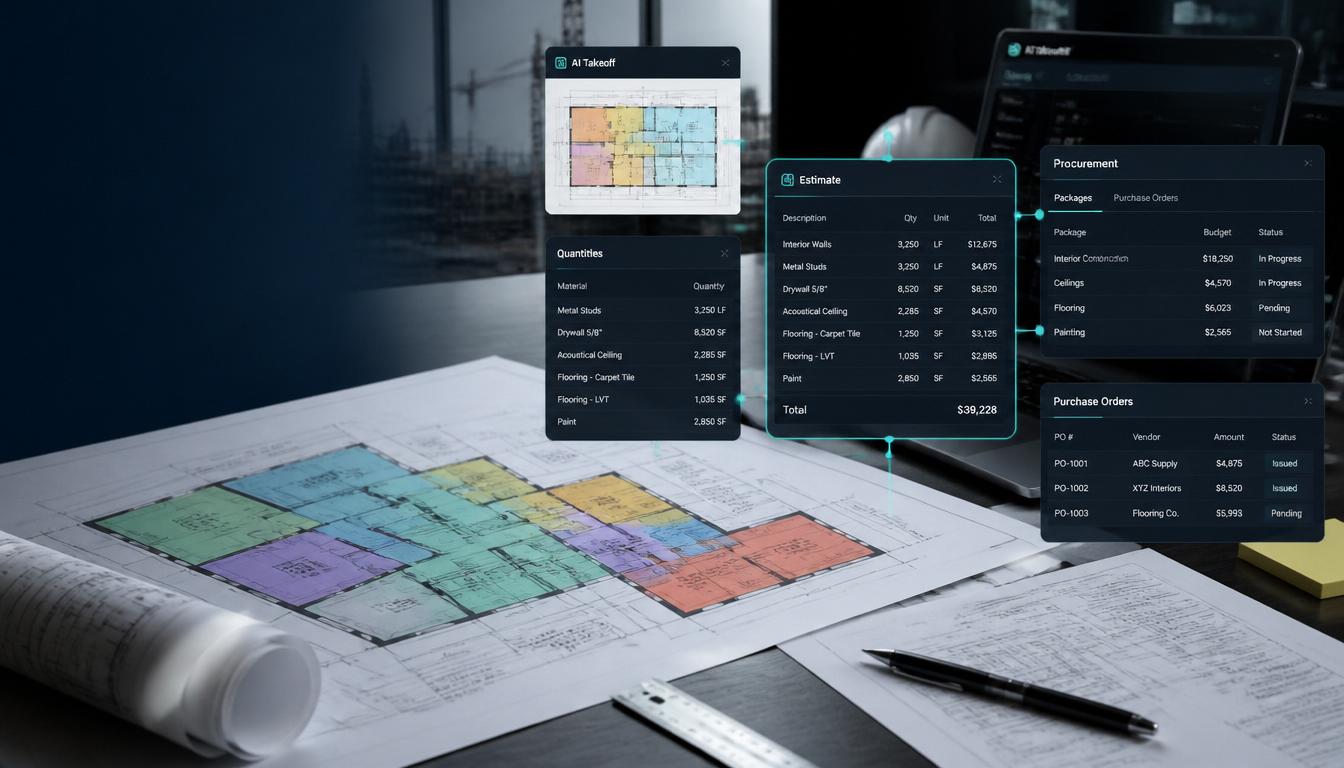
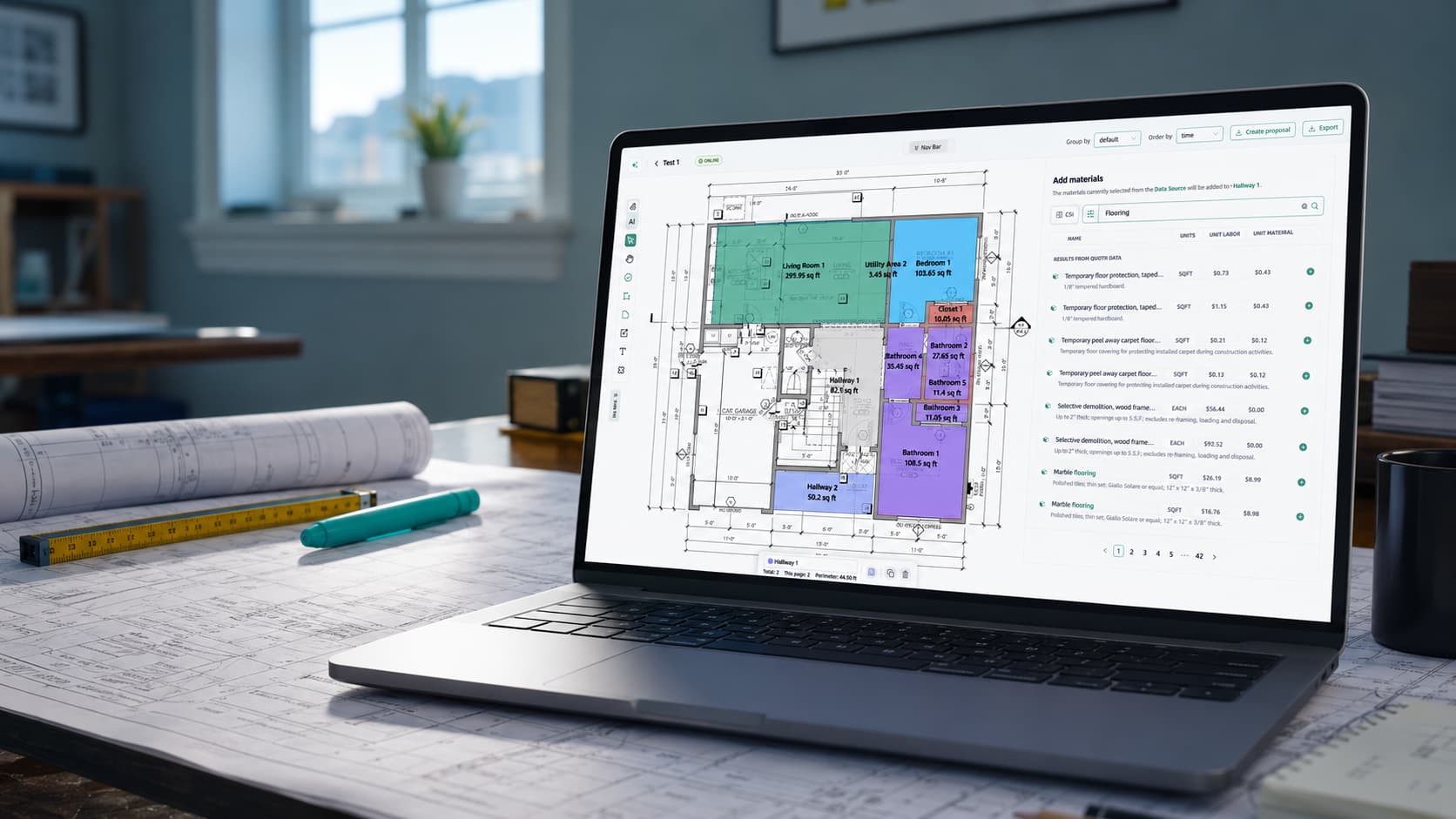
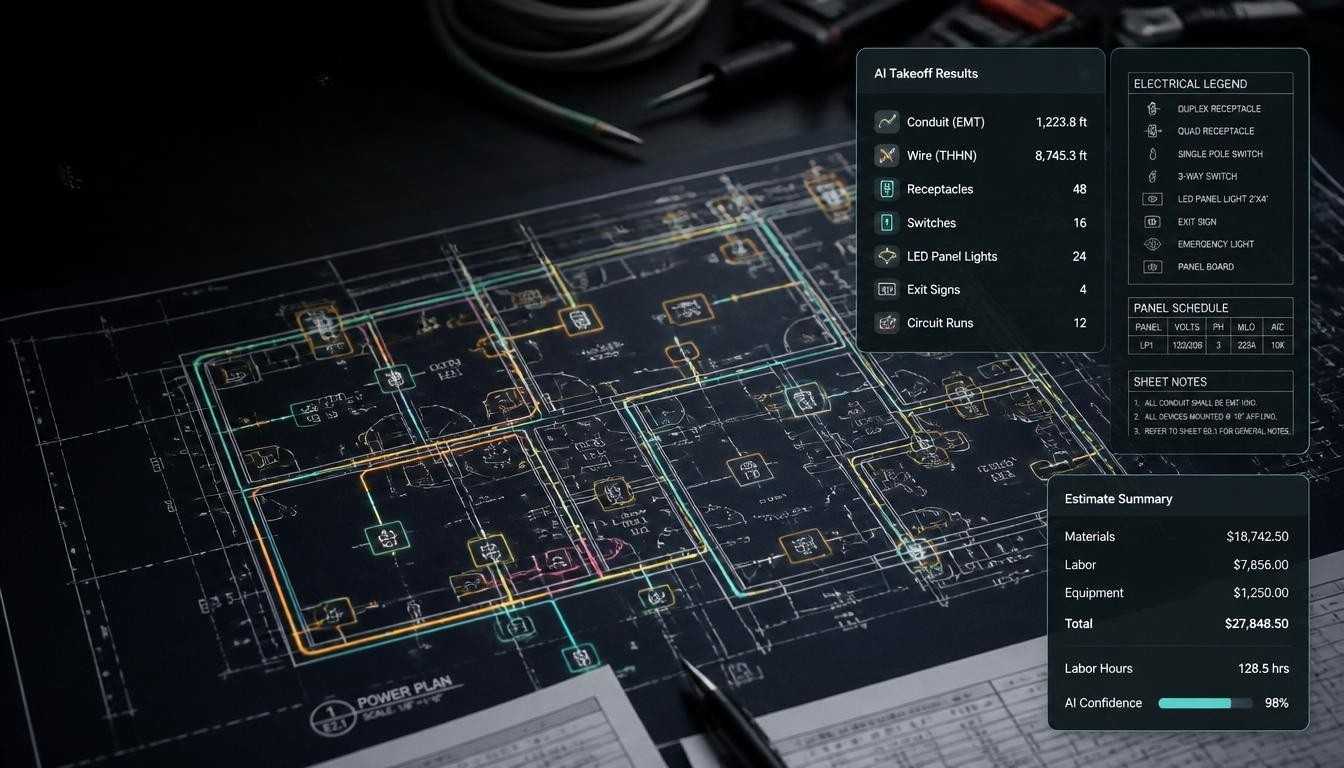
This is exactly the work that AI-powered takeoff is built to compress. Modern AI takeoff platforms detect electrical symbols across an entire plan set automatically — once an estimator identifies a fixture symbol or device tag, the system finds and counts every instance across every sheet in the project. Conduit and feeder runs can be measured digitally with linear measurement tools that follow the path of the run on screen rather than requiring a physical scale wheel.
In practice, this typically compresses the device-counting and measurement portion of an electrical takeoff from days to under an hour, while raising consistency. The estimator’s role shifts from quantity technician to scope reviewer and judgment expert — validating ambiguous detections, interpreting scope notes, and pricing risk. For a documented case study on how this plays out in a real subcontractor’s workflow, see how RL Electric cut estimating time with AI-powered takeoffs.
A realistic AI takeoff workflow for an electrical estimator looks like this:
- Upload the plan set. PDF, CAD, or scanned plans are ingested and normalized.
- AI symbol detection. The system identifies fixtures, devices, and equipment across all sheets.
- Estimator validation. The estimator reviews detected counts, fixes edge cases, and accepts the takeoff.
- Linear measurement. Conduit and feeder runs are measured digitally with on-screen tools.
- Labor unit application. Quantities are mapped to NECA labor units (or the firm’s internal database).
- Pricing and proposal. The takeoff flows into the firm’s pricing model and bid platform without re-entry.
For estimators wondering how accurate the AI portion of this workflow actually is in practice, our deep dive on whether AI takeoff is actually accurate yet covers the benchmarks honestly.
What AI Takeoff Still Cannot Do for Electrical Work
AI takeoff replaces the ruler and the counter. It does not replace the estimator’s judgment. On electrical work specifically, AI still struggles with:
- Hand-marked plans and low-quality scans — symbol detection accuracy degrades on poor-quality source files.
- Non-standard symbols — every architect and engineer uses slightly different symbol conventions, and AI models do best on standardized symbol libraries.
- Scope interpretation — clauses like “provide allowance for owner-supplied control wiring” require human reading of specs.
- Constructability judgment — a senior estimator who has built ten similar projects knows where the drawing will hit reality and the bid will not.
- Risk pricing — relationships with suppliers, knowledge of local labor markets, and institutional memory of past projects do not live in software.
The estimators who win in 2026 are not the ones who refuse to adopt AI takeoff. They are also not the ones who rubber-stamp AI output. They are the ones who use AI to compress the mechanical work so they can spend more time on the judgment work that actually drives bid quality.
A Defensible Electrical Estimate: The Bottom Line
A good electrical estimate from drawings is built in the same order every time:
- Review scope and specs.
- Set up a structured takeoff template.
- Count devices and fixtures systematically with consistent markup.
- Measure conduit and branch circuits, accounting for bends, drops, and waste.
- Cross-check counts against schedules and risers.
- Apply NECA labor units, adjusted for project conditions.
- Stack material, labor, equipment, overhead, and margin.
Skip a step and the bid is exposed. Follow them in order — with or without AI assistance — and the bid will hold in the field.
For electrical contractors who want to compress takeoff time without losing the discipline above, see Quotr.ai Software and start your first AI-powered electrical takeoff in minutes.
Sources
- National Electrical Contractors Association — NECA Manual of Labor Units
- EC&M Magazine — “Estimating Basics: The Takeoff”
- Construction Specifications Institute — MasterFormat Division 26 (Electrical)
- Industry benchmarks on electrical estimating accuracy and labor cost share (Beam AI, MSB Estimating, Universe Estimating, 2025–2026 industry reporting)
- Quotr internal research and case studies, 2026