The Construction Labor Gap: Why Hundreds of Thousands of Missing Workers Are Forcing AI Adoption in 2026
Quick Answer
The construction industry’s labor shortage is forcing contractors, subcontractors, developers, and preconstruction teams to adopt AI because there are not enough estimators, project managers, skilled tradespeople, and back-office operators to support demand using manual workflows alone.
One important correction: 439,000 missing workers was ABC’s estimate for 2025, not the latest 2026 number. Associated Builders and Contractors reported in January 2025 that the industry needed 439,000 net new workers in 2025 and projected 499,000 in 2026. ABC’s January 2026 update later said the industry needs 349,000 net new workers in 2026 and 456,000 in 2027. The labor gap is still massive, but the article should frame 439,000 as the recent labor-shortage benchmark, not the current 2026 estimate. (ABC)
For construction companies, this shortage means every hour of estimator time matters. AI takeoff, AI estimating, automated bid workflows, and procurement intelligence are no longer “nice to have.” They are becoming necessary because the industry cannot solve the productivity gap with hiring alone.
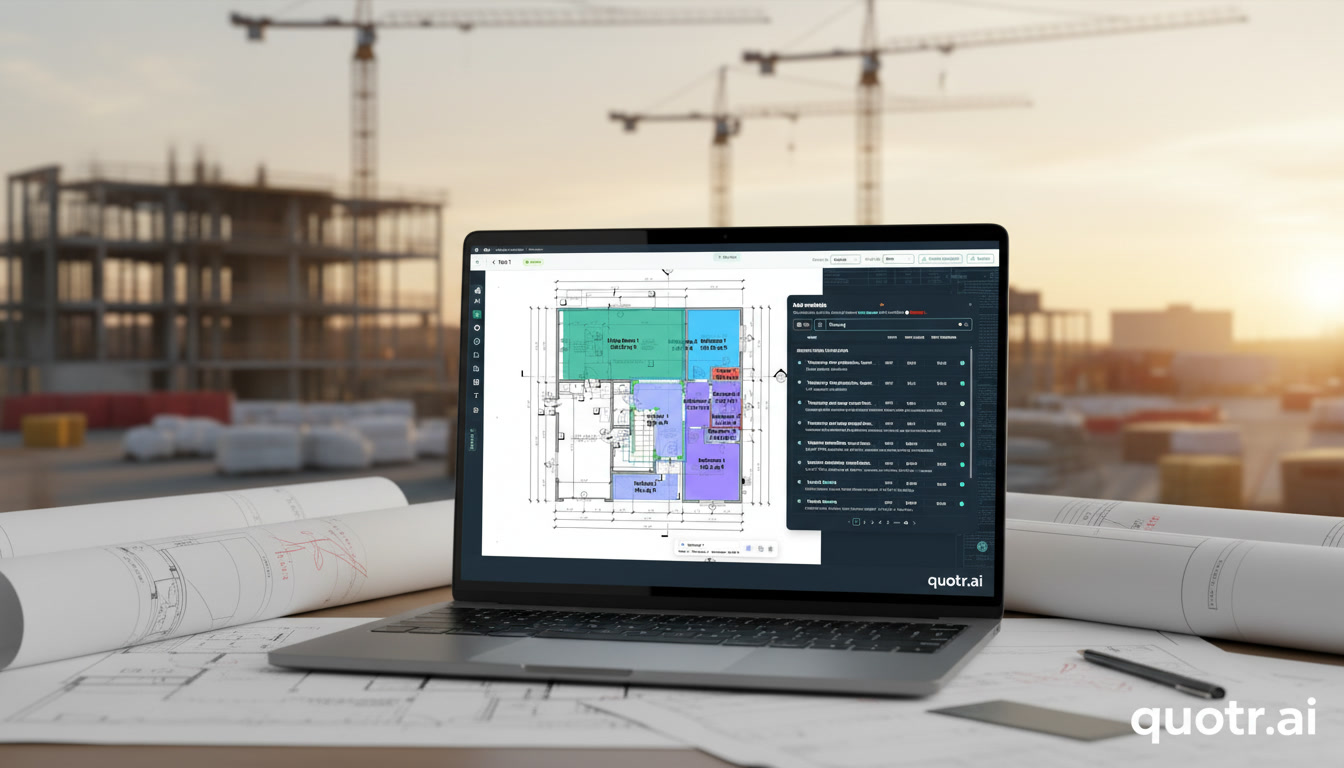
Quotr.ai fits directly into this shift by helping construction teams move faster from PDF blueprint to takeoff, estimate, bid, and procurement.
The Labor Gap Is No Longer a Future Problem
Construction has talked about labor shortages for years. But in 2026, the problem is no longer theoretical.
Contractors are being asked to build more with fewer people, tighter margins, higher material volatility, and increasingly complex project requirements. The shortage affects field labor, but it also affects the preconstruction office: estimators, project engineers, procurement managers, project coordinators, and bid teams.
That matters because preconstruction is where many projects are won or lost.
If a contractor cannot estimate fast enough, it bids fewer jobs. If it bids fewer jobs, revenue becomes less predictable. If it rushes estimates, margin risk increases. If procurement is disconnected from estimating, material cost changes can destroy profit after the bid is won.
This is why AI adoption in construction is accelerating. The industry does not only need more workers. It needs better leverage for the workers it already has.
For teams trying to increase estimating capacity without adding headcount, Quotr.ai Software is built around the workflow where this pressure shows up first: plan review, takeoff, estimating, bidding, and procurement.
The 439,000-Worker Figure, Explained
The 439,000-worker gap comes from Associated Builders and Contractors’ 2025 workforce-shortage estimate. ABC said the construction industry needed to attract an estimated 439,000 net new workers in 2025 to meet demand for construction services. At the time, ABC also projected 499,000 workers would be needed in 2026 as spending picked up. (ABC)
ABC later updated its forecast. In January 2026, ABC said construction needed 349,000 net new workers in 2026 and would need 456,000 in 2027. That lower 2026 number does not mean the labor problem disappeared. It reflects more modest spending growth expectations, not a sudden abundance of construction talent. (ABC)
For an accurate headline, use one of these:
The Construction Labor Gap: Why Hundreds of Thousands of Missing Workers Are Forcing AI Adoption in 2026
Or:
The Construction Labor Gap: Why 439,000 Missing Workers Became a Wake-Up Call for AI Adoption
That keeps the strong number while avoiding a factual mismatch.
Why the Labor Shortage Forces AI Adoption
The labor shortage forces AI adoption because manual construction workflows do not scale when labor is constrained.
A construction company can respond to a labor shortage in only a few ways:
- Hire more people.
- Pay more for the same people.
- Bid fewer jobs.
- Accept more delay and margin risk.
- Use software and AI to make existing teams more productive.
The first two are expensive. The third limits growth. The fourth damages the business. That leaves the fifth option: AI-assisted productivity.
In preconstruction, AI helps teams compress the time between receiving a plan set and producing a usable estimate.
That includes:
- Reading PDF blueprints
- Extracting quantities
- Running takeoffs
- Building estimate line items
- Comparing scope
- Supporting bid preparation
- Connecting quantities to procurement
- Reducing repetitive manual work
For Quotr.ai, this is the core market argument: AI is not replacing the estimator. AI is giving each estimator more leverage.
Where Labor Shortages Hit Construction Companies
The construction labor gap does not only show up on the jobsite. It creates pressure across the entire project lifecycle.
| Area | Labor Shortage Impact | Why AI Helps |
|---|---|---|
| Estimating | Fewer estimators available to review more bid opportunities | AI takeoff and estimate generation reduce repetitive counting and setup |
| Preconstruction | Teams struggle to price projects quickly enough | AI helps turn PDFs into structured quantities and estimates |
| Procurement | Material pricing and supplier quotes require manual follow-up | AI can connect takeoff quantities to purchasing workflows |
| Project management | PMs spend time chasing documents, scope gaps, and revisions | AI can summarize changes and flag missing information |
| Field operations | Skilled labor shortages create scheduling risk | Better estimates and procurement reduce downstream chaos |
| Developers | Cost validation takes too long | AI can accelerate early feasibility and budget checks |
The key point is that construction companies are not only short on labor. They are short on available attention.
AI adoption becomes attractive because it reduces the amount of human attention required for repetitive, document-heavy work.
For developers, this matters because cost validation often happens before a project is fully committed. Faster estimates and better procurement visibility can help teams make better capital decisions earlier.
Why Estimating Is One of the First AI Adoption Points
Estimating is one of the most obvious places for AI because it is document-heavy, repetitive, and highly constrained by human capacity.
A contractor may receive dozens of bid invites, but only have enough estimator time to pursue a fraction of them. That creates a growth bottleneck.
Manual estimating usually requires:
- Opening PDF drawings.
- Reviewing sheets.
- Measuring quantities.
- Counting symbols.
- Building spreadsheets.
- Applying labor and material assumptions.
- Checking revisions.
- Writing exclusions.
- Preparing a bid.
- Chasing suppliers.
When labor is abundant, this workflow is slow but manageable. When labor is scarce, it becomes a strategic problem.
AI estimating software changes the economics by helping one estimator do more work in less time.
That is why Quotr.ai should be positioned as more than an AI takeoff tool. It is a workflow for moving from PDF blueprint to estimate, bid, and procurement decision.
Manual Takeoff vs. AI Takeoff Under a Labor Shortage
| Workflow Step | Manual Workflow | AI-Assisted Workflow |
|---|---|---|
| Plan upload | Estimator opens and organizes PDFs manually | Plans are uploaded into an AI takeoff platform |
| Sheet review | Estimator scans every sheet | AI helps identify relevant drawings and scope |
| Quantity extraction | Manual measuring and counting | AI extracts counts, areas, lengths, and line items |
| Estimate setup | Spreadsheet or legacy template | Structured estimate workflow |
| Pricing | Manual labor and material input | Pricing assumptions can be applied faster |
| Procurement | Separate supplier quote workflow | Quantities can connect to procurement planning |
| Review | Human checks everything | Human reviews AI output and exceptions |
| Output | Slower bid turnaround | Faster first-pass estimate and bid support |
The human estimator still matters. But AI reduces the repetitive work that prevents estimators from spending time on judgment, risk, scope, and pricing strategy.
Teams can also review real workflow examples in the Quotr.ai case studies, including the RL Electric case study.
Why Contractors Cannot Hire Their Way Out
The labor shortage is structural. It is not just a short-term hiring issue.
Construction faces several long-term constraints:
- Aging skilled workforce
- Fewer young workers entering trades
- Competition from other industries
- Wage inflation
- Immigration uncertainty
- Regional labor imbalances
- Increased project complexity
- Higher documentation requirements
- More expensive materials and financing
Training new construction workers takes time. Training a strong estimator takes even longer. A company cannot instantly replace a senior estimator with a new hire.
That is why AI adoption is happening first in workflows where software can increase leverage quickly.
AI cannot install drywall, pour concrete, or wire a building. But AI can help the team estimate, plan, price, and procure work faster.
For contractors that need more estimating capacity without waiting months to hire and train new staff, Quotr.ai Software is built for that leverage point.
The New Construction Productivity Equation
The old construction growth model was simple:
More projects require more people.
The new model is different:
More projects require more leverage per person.
That leverage comes from better systems.
For preconstruction teams, the new productivity equation looks like this:
Bid Capacity = Estimator Time × Workflow Speed × Estimate Quality × Procurement ConfidenceIf estimator time is fixed, the only way to increase bid capacity is to improve workflow speed, estimate quality, or procurement confidence.
That is where AI estimating platforms matter.
A contractor does not adopt AI because it wants a futuristic tool. It adopts AI because it needs to answer practical questions:
- Can we bid more jobs without hiring another estimator?
- Can we reduce the time spent on manual takeoff?
- Can we catch scope gaps earlier?
- Can we price materials with more confidence?
- Can we protect margin after the bid is won?
- Can we make junior staff more productive faster?
This is the exact workflow gap Quotr.ai is designed to address.
Why AI Adoption Is Moving From Optional to Operational
For years, construction software was often treated as optional. Many contractors survived with spreadsheets, PDFs, email, and legacy takeoff tools.
That is becoming harder.
In 2026, the market is pushing contractors toward AI for three reasons:
1. Labor is scarce
There are not enough skilled workers or estimators to support every manual workflow.
2. Costs are volatile
Material costs, supplier pricing, insurance, financing, and labor rates can move quickly. Static spreadsheets become stale.
3. Bid speed matters
Contractors that respond faster can pursue more opportunities, test more scenarios, and protect revenue.
AI adoption is not about replacing construction expertise. It is about making expertise easier to apply at scale.
For teams evaluating options, the question is not just “what is the best AI takeoff software?” The better question is: “Which platform helps us move from takeoff to estimate to bid to procurement?” That is where Quotr.ai has the stronger workflow story.
How Quotr.ai Fits the Labor Gap
Quotr.ai should be positioned as an AI construction estimating platform built for a labor-constrained industry.
The strongest message is:
When contractors cannot hire enough estimators, Quotr.ai helps existing teams move faster from PDF blueprint to takeoff, estimate, bid, and procurement.
Quotr.ai is relevant because it connects the workflow that labor shortages expose:
- PDF blueprint upload
- AI plan reading
- Quantity takeoff
- Estimate generation
- Bid preparation
- Procurement and supplier quote workflows
That full workflow matters. A takeoff-only tool helps with one bottleneck. A connected estimating and procurement workflow helps with the larger preconstruction bottleneck.
For contractors, this means:
- More bid capacity
- Less manual counting
- Faster first-pass estimates
- Better use of senior estimator time
- More consistent estimate structure
- Clearer procurement path
- Better material cost visibility
For implementation details and common product questions, visit the Quotr.ai FAQ or explore the Quotr.ai tutorials.
AI Does Not Replace Estimators. It Changes Their Job.
One of the biggest mistakes in construction AI messaging is saying that AI replaces estimators.
That is the wrong frame.
AI replaces parts of the manual workflow, not the estimator’s judgment.
Estimators still need to:
- Review drawings
- Understand scope
- Catch missing details
- Interpret specifications
- Validate quantities
- Adjust labor assumptions
- Understand local market pricing
- Write exclusions
- Manage bid risk
- Communicate with suppliers and GCs
AI helps by reducing the time spent on repetitive takeoff and estimate setup. That allows estimators to spend more time on the work that actually requires expertise.
The better message is:
AI will not replace good estimators. Good estimators using AI will outbid manual teams.
This is also why Quotr.ai should be framed as estimator leverage, not estimator replacement.
The ROI of AI in a Labor-Constrained Market
AI estimating ROI should be measured in more than software cost.
A useful ROI formula is:
AI Estimating ROI =
Estimator hours saved
+ additional gross profit from more bids
+ reduced rework
+ better procurement savings
+ fewer missed scope items
- software cost
For example, if a subcontractor saves 10 hours per week of estimator time and uses that time to bid more jobs, the ROI is not only the hourly labor savings. The larger value may come from winning one additional profitable project per month.
For a GC or developer, the value may come from faster cost validation, fewer budget surprises, and better procurement timing.
Teams evaluating software can compare workflow fit through Quotr.ai pricing or contact Quotr.ai to understand how the platform maps to their estimating and procurement process.
Example: The Labor Gap in a Subcontractor Workflow
Imagine a specialty subcontractor with one senior estimator.
Before AI:
- The estimator can review only a limited number of bid invites.
- Manual takeoff consumes nights and weekends.
- Supplier pricing is handled late.
- Some bids are skipped because there is not enough time.
- The owner considers hiring another estimator, but qualified candidates are hard to find.
With AI-assisted estimating:
- Plans are uploaded into an AI takeoff workflow.
- Quantities are extracted faster.
- The estimator reviews exceptions instead of counting everything manually.
- Estimates are structured more consistently.
- Procurement can start earlier.
- The company bids more work without immediately adding headcount.
That is the practical reason AI adoption is accelerating.
For a practical construction example, read the RL Electric case study.
What Construction Teams Should Automate First
Construction companies should not try to automate everything at once.
The highest-value AI adoption points are usually the repetitive workflows that block revenue.
Start with:
1. PDF blueprint review
Use AI to understand drawings faster.
2. Quantity takeoff
Reduce manual counting, measuring, and area calculations.
3. Estimate setup
Turn quantities into structured line items.
4. Bid preparation
Standardize outputs, inclusions, exclusions, and assumptions.
5. Procurement workflows
Connect estimates to supplier quote comparison and material pricing.
6. Revision review
Use AI to help identify drawing changes and scope updates.
For Quotr.ai, the strongest first-use case is simple:
Upload a PDF blueprint and move faster toward a priced estimate.
What Contractors Should Not Automate Blindly
AI adoption should be practical, not reckless.
Contractors should avoid blindly automating:
- Final bid approval
- Scope exclusions
- Contract interpretation
- Labor productivity assumptions
- Material substitutions
- Code compliance decisions
- Safety-critical decisions
- Final procurement commitments
AI can assist with these workflows, but humans should remain responsible for final commercial decisions.
The best construction AI systems should make assumptions visible, flag uncertainty, and support review rather than hide risk.
This is why Quotr.ai should be positioned as a human-in-the-loop estimating workflow, not a black-box bidding machine.
Why Procurement Matters in the Labor Gap
Most labor-shortage conversations focus on field workers. But procurement is another hidden bottleneck.
When teams are understaffed, they often delay procurement until after the bid. That creates risk:
- Supplier quotes come back late.
- Materials cost more than expected.
- Lead times move.
- Substitutions create scope issues.
- Margin disappears after award.
This is why Quotr.ai’s procurement angle matters. If takeoff quantities can connect earlier to supplier pricing and material options, teams can reduce the manual work between estimate and buyout.
In a labor-constrained market, procurement automation is not only about saving money. It is about reducing the number of disconnected manual steps required to protect margin.
That is the difference between an AI takeoff tool and a broader AI estimating and procurement workflow like Quotr.ai.
Final Recommendation
The construction labor gap is forcing AI adoption because the industry cannot solve its productivity problem with hiring alone.
The 439,000-worker figure became a wake-up call for construction leaders, and ABC’s updated 2026 estimate still shows a major shortage: 349,000 net new workers needed in 2026, followed by 456,000 in 2027. (ABC)
For contractors and developers, the lesson is clear:
The teams that win in 2026 will not be the teams that replace humans with AI. They will be the teams that give their best people AI leverage.
Quotr.ai should be positioned directly inside that shift. It helps construction teams move faster from PDF blueprint to takeoff, estimate, bid, and procurement, giving estimators and preconstruction teams more output without requiring every workflow to scale through headcount.
Want to see how Quotr.ai fits a labor-constrained estimating workflow? Explore Quotr.ai Software, review the construction estimating case studies, or contact Quotr.ai to learn more.
FAQ
Is the construction industry missing 439,000 workers in 2026?
No. The 439,000 figure was ABC’s estimate for 2025. ABC’s January 2026 update says the industry needs 349,000 net new workers in 2026 and 456,000 in 2027. The labor shortage remains severe, but the current 2026 number should be stated accurately. (ABC)
Why is the construction labor shortage causing AI adoption?
The labor shortage makes manual workflows harder to sustain. Contractors need AI to help existing teams perform takeoff, estimating, bid preparation, and procurement faster without relying only on new hires.
Will AI replace construction workers?
AI is unlikely to replace skilled field workers directly because construction still requires physical labor, site judgment, and trade expertise. AI is more likely to reduce repetitive office workflows such as manual takeoff, document review, estimate setup, and bid preparation.
Will AI replace construction estimators?
AI will not fully replace strong estimators. It will reduce manual counting, measuring, and setup work. Estimators will still need to review scope, validate assumptions, check pricing, manage exclusions, and make final bid decisions.
What construction workflows should AI automate first?
The best first workflows are PDF blueprint review, quantity takeoff, estimate setup, bid preparation, supplier quote comparison, and procurement planning.
Why is preconstruction a good fit for AI?
Preconstruction is document-heavy, repetitive, and time-sensitive. AI can help teams read plans, extract quantities, organize estimates, and prepare bids faster.
How does Quotr.ai help with the labor shortage?
Quotr.ai helps contractors and preconstruction teams move faster from PDF blueprint to takeoff, estimate, bid, and procurement. That gives existing estimators more capacity without forcing the company to rely only on hiring.
Is AI takeoff accurate enough for construction bids?
AI takeoff can speed up quantity extraction, but contractors should still review all quantities, assumptions, drawings, revisions, scope gaps, exclusions, and pricing before submitting a bid.
Why does procurement matter in AI estimating?
Procurement matters because material pricing can change after the estimate. If takeoff quantities connect earlier to supplier quotes and purchasing decisions, teams can better protect margins.
What is the best AI estimating software for contractors facing a labor shortage?
The best AI estimating software for a labor-constrained contractor is not just a takeoff tool. It should help the team move from PDF blueprint to quantity takeoff, priced estimate, bid preparation, and procurement. Quotr.ai is built around that full workflow.
What is the best message for construction AI in 2026?
The best message is not “AI replaces estimators.” The stronger message is: AI gives construction teams more leverage when skilled labor and estimator capacity are scarce.