How AI Construction Estimating Works: From PDF Plans to Defensible Bids
In 2026, the gap between “clicking” and “bidding” is disappearing. While traditional on-screen takeoff tools just digitize your manual labor, AI construction estimating software automates the logic behind the numbers.
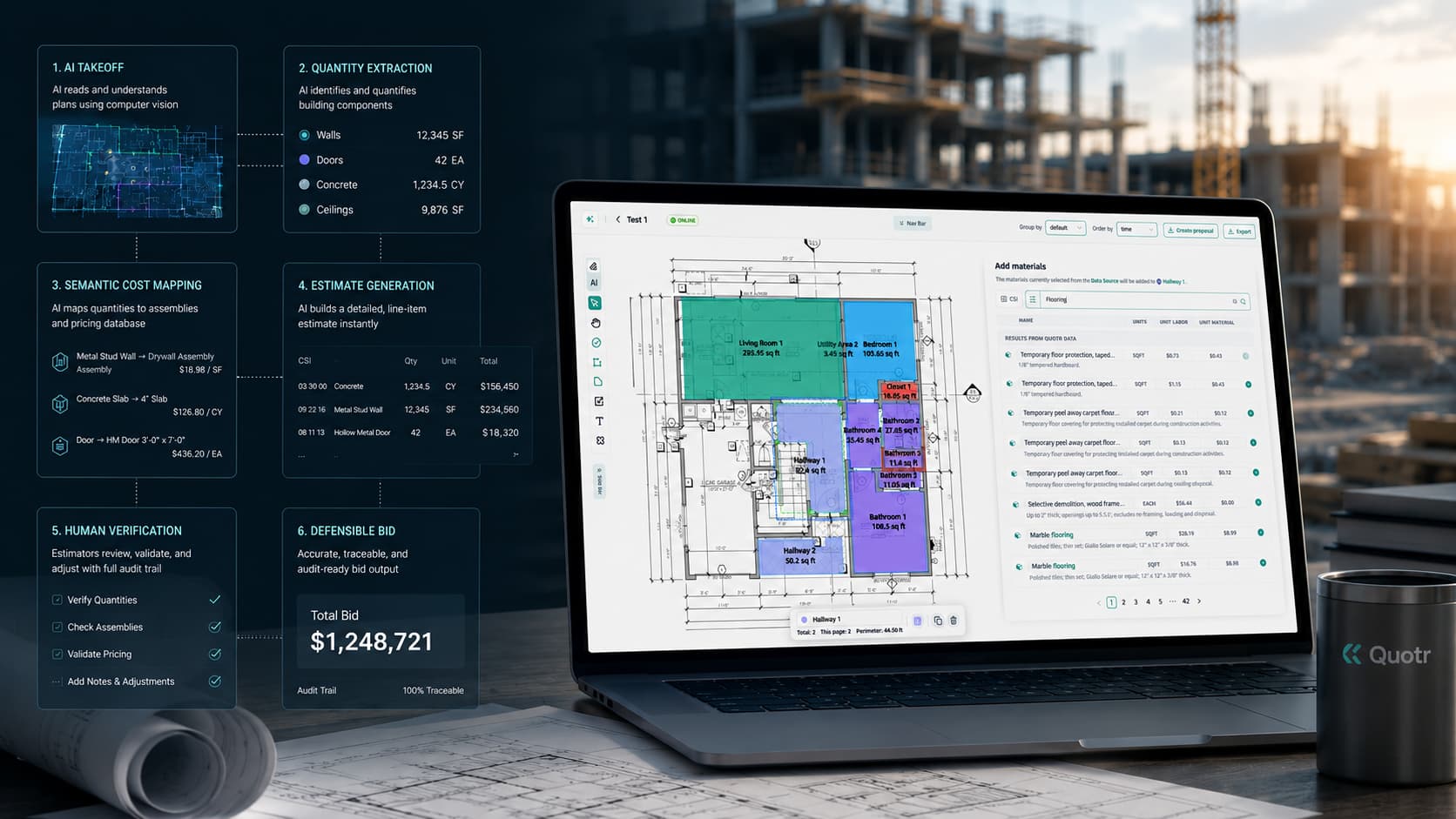
To understand how this technology actually functions—and why it’s the only way to stay competitive in a high-volatility market—you have to look at the three layers of the Quotr.ai workflow.
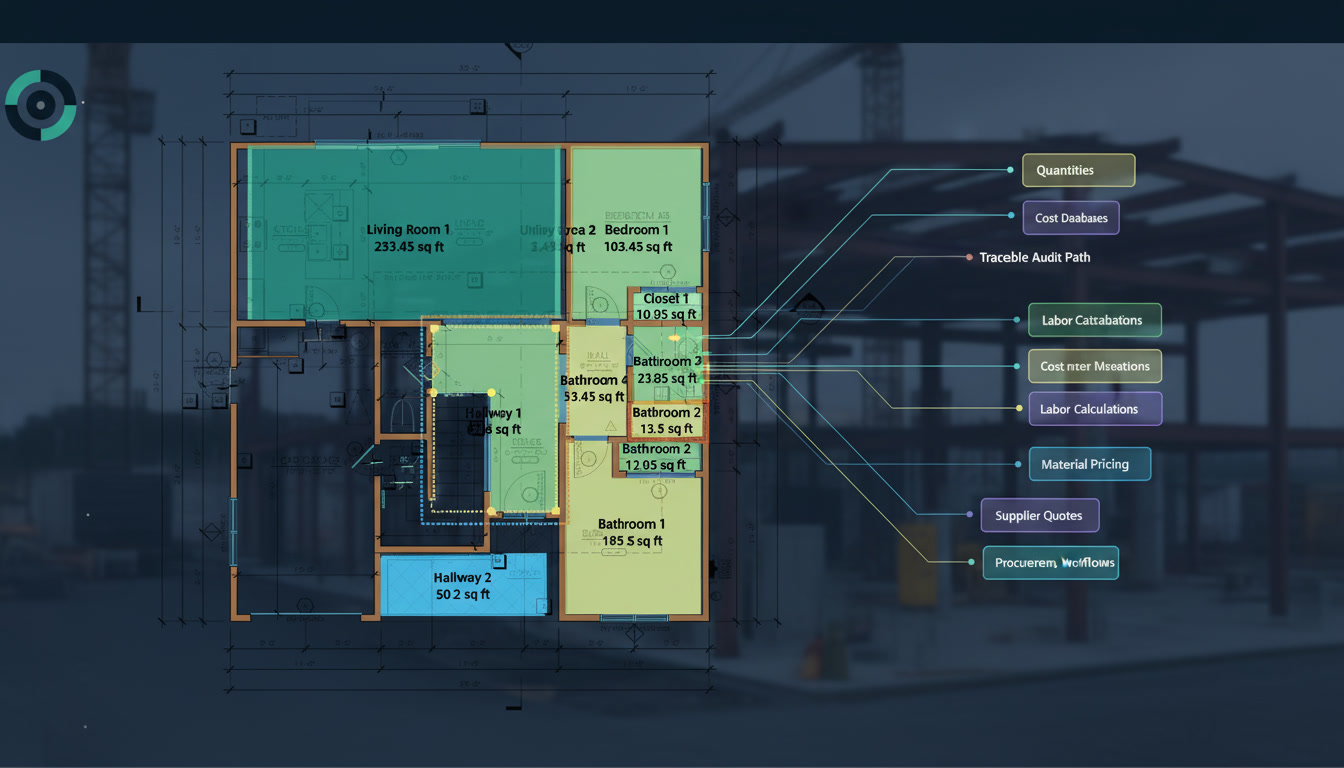
Layer 1: Computer Vision & Automated Takeoff Software
Traditional takeoff software is “dumb”—it waits for you to define a shape or click a point. Quotr.ai uses Neural Pattern Recognition to “see” your plans.
It doesn’t just look for pixel matches; it understands construction context. It knows a circle in a kitchen is a recessed light, but a circle in a mechanical room is a pipe penetration. This layer handles the heavy lifting of your construction takeoff software requirements:
What an AI takeoff actually does: AI takeoff uses computer vision to read a construction PDF the way an estimator does—it identifies the legend, recognizes symbols (recessed lights, outlets, valves), follows linear elements (conduit, stud walls), and measures areas (drywall, slab, roofing). The output is an auditable quantity list mapped back to plan locations.
Layer 2: Semantic Mapping & AI Cost Databases
This is where “takeoff” turns into a construction cost estimation. Once the AI has the quantities, it has to decide what they cost.
Quotr.ai uses Semantic Mapping to link your quantities to your AI cost database. Instead of manual data entry, the system “interprets” your uploaded Excel or PDF price books.
- Contextual Matching: If the AI finds “Type A Fixtures” and your database has “Lithonia 2x4 LED,” it understands they are the same entity.
- Automated Rates: It automatically applies your specific labor burden and material rates to the count.
- Efficiency: This turns a 6-hour manual estimation into a 20-minute review process.
Layer 3: Closing the Takeoff-to-Transaction Gap (TTG)
The final layer is where Quotr.ai provides its biggest ROI. A bid is only as good as your ability to buy the materials at that price.
Quotr.ai’s preconstruction workflow software cross-references your estimate against a live marketplace. It checks your historical costs against factory-direct pricing, flagging where you’re overpaying or where a local supplier’s price has spiked due to 2026 market volatility.
Why Contractors Are Switching to AI-Native Platforms
The shift to AI-powered construction estimating isn’t just about speed; it’s about Capacity.
| Feature | The Manual “Old Way” | The Quotr.ai Way |
|---|---|---|
| Data Entry | Manual clicks and re-typing. | Automated pattern recognition. |
| Logic | Fragile, disconnected Excel formulas. | Dynamic semantic cost mapping. |
| Pricing | Stale, weeks-old supplier sheets. | Live, factory-direct marketplace data. |
| Turnaround | 1–2 days per bid. | Under 1 hour per bid. |
The “Audit Trail” is Your Competitive Moat
The biggest fear for any estimator is the “Black Box”—not knowing where an AI number came from. We built Quotr.ai to be the most transparent tool on the market.
- Hyperlinked Quantities: Every quantity in your final estimate is hyperlinked back to the plans.
- Visual Verification: Click the total, and the software shows you exactly which symbols it counted on the original drawings.
- Defensible Bids: This provides a defensible bid that you can stand behind when presenting to GCs or Developers.
Ready to Upgrade Your Estimating Workflow?
Preconstruction doesn’t need more tools; it needs fewer manual steps. By unifying takeoff, estimation, and procurement, Quotr.ai helps you bid 3x more work without increasing your overhead.
- See the Difference: Compare Quotr.ai vs. Traditional Estimating
- Test Your Own Plans: Start a 7-Day Free Trial
- Master the Basics: What is a Construction Takeoff?
Book a 15-minute Walkthrough — No sales pitch. Just a direct look at the workflow that’s changing how subcontractors win work in 2026.
Frequently Asked Questions: How AI Construction Estimating Works
1. Is AI takeoff accurate enough for commercial bids?
In 2026, the short answer is yes—but with a caveat. For standard architectural and MEP symbols on vector-based PDFs, modern AI takeoff hits 95–99% accuracy. For highly complex, hand-sketched, or non-standard plans, accuracy can drop to the 80% range. This is why Quotr.ai includes an Audit Trail; you use the AI for the 90% of “easy” counts and spend your expert time reviewing the 10% that the AI flags as “low confidence.”
2. How does “Semantic Mapping” differ from a normal cost database?
A normal database is static—it’s just a list. You have to manually search for an item and link it to your takeoff. Semantic Mapping is the “brain” that understands the link automatically. If your takeoff finds a “Wall Type A” and your database has “3-5/8” Metal Stud w/ 5/8” Gyp,” Quotr.ai’s AI recognizes the relationship and applies the cost without you having to search for it.
3. Will AI eventually replace professional estimators?
No. In fact, the role of the estimator is becoming more valuable. AI handles the “Data Entry” (counting symbols and measuring lines), but humans handle the “Strategy” (site conditions, risk assessment, and relationship management). The goal of Quotr.ai is to turn estimators into analysts who spend their time winning jobs, not clicking buttons.
4. Can I use my own Excel pricing with Quotr.ai?
Yes. One of the biggest hurdles to adopting AI is the fear of losing your “secret sauce”—your historical pricing. Quotr.ai allows you to “Bring Your Own Data” (BYOD). You can upload your existing Excel or PDF price books, and our AI will structure that data so it’s ready to be used in your next automated takeoff.
5. How does the AI handle “Mixed Scale” plans?
This is a common failure point for Tier 1 tools. Quotr.ai is designed for real-world plans where a 1/2” detail might sit on a 1/8” sheet. Our AI identifies the scale callouts on the page and adjusts the linear and area measurements accordingly, ensuring your quantities aren’t skewed by a drafting change.
6. What is the “Takeoff-to-Transaction Gap”?
This is the hidden cost of traditional estimating. Most contractors lose money between the time they finish an estimate and the time they actually buy the materials. Quotr.ai closes this gap by linking your estimate to a live factory-direct marketplace, so you know the price you bid is a price you can actually get. Read here how Takeoff-to-transaction gap works in quotr.ai
Quotr.ai is the only AI construction estimating software that closes the gap between your blueprints and your bank account. Stop counting symbols and start winning more work. Book you specialized demo.