How to Estimate Plumbing From Drawings: Pipe, Fixtures, and Labor
Plumbing is a takeoff where the fixtures are the easy part. Anyone can count toilets off a fixture schedule. The money — and the mistakes — live in the pipe: linear feet by material and size, the fittings and valves that don’t show up as neat symbols, the hangers and sleeves nobody drew, and the labor that climbs with every floor above the fourth. Get the fixtures right and the pipe wrong, and you’ve bid a job you’ll lose money finishing.
This is a step-by-step guide to estimating plumbing from drawings — what to pull off the plans, how to measure pipe and count fittings, how to price labor, and where plumbing takeoffs go wrong. If you’re shopping tools rather than method, see our best plumbing estimating software roundup; this guide is the method those tools automate.
What is a plumbing takeoff?
A plumbing takeoff is the process of reviewing the drawings and specifications to identify, measure, and list every plumbing component a job requires — fixtures, pipe, fittings, valves, and specialties — so you can price material and labor into a bid. It’s the foundation of the estimate: get the quantities wrong and no amount of clean pricing saves the number.
Plumbing spans several systems that get taken off separately: domestic water (hot and cold), sanitary and vent (DWV), storm, and often gas and specialty systems. Each has its own materials, sizes, and labor.
Step-by-step: estimating plumbing from drawings
1. Gather the full set, not just the plumbing sheets
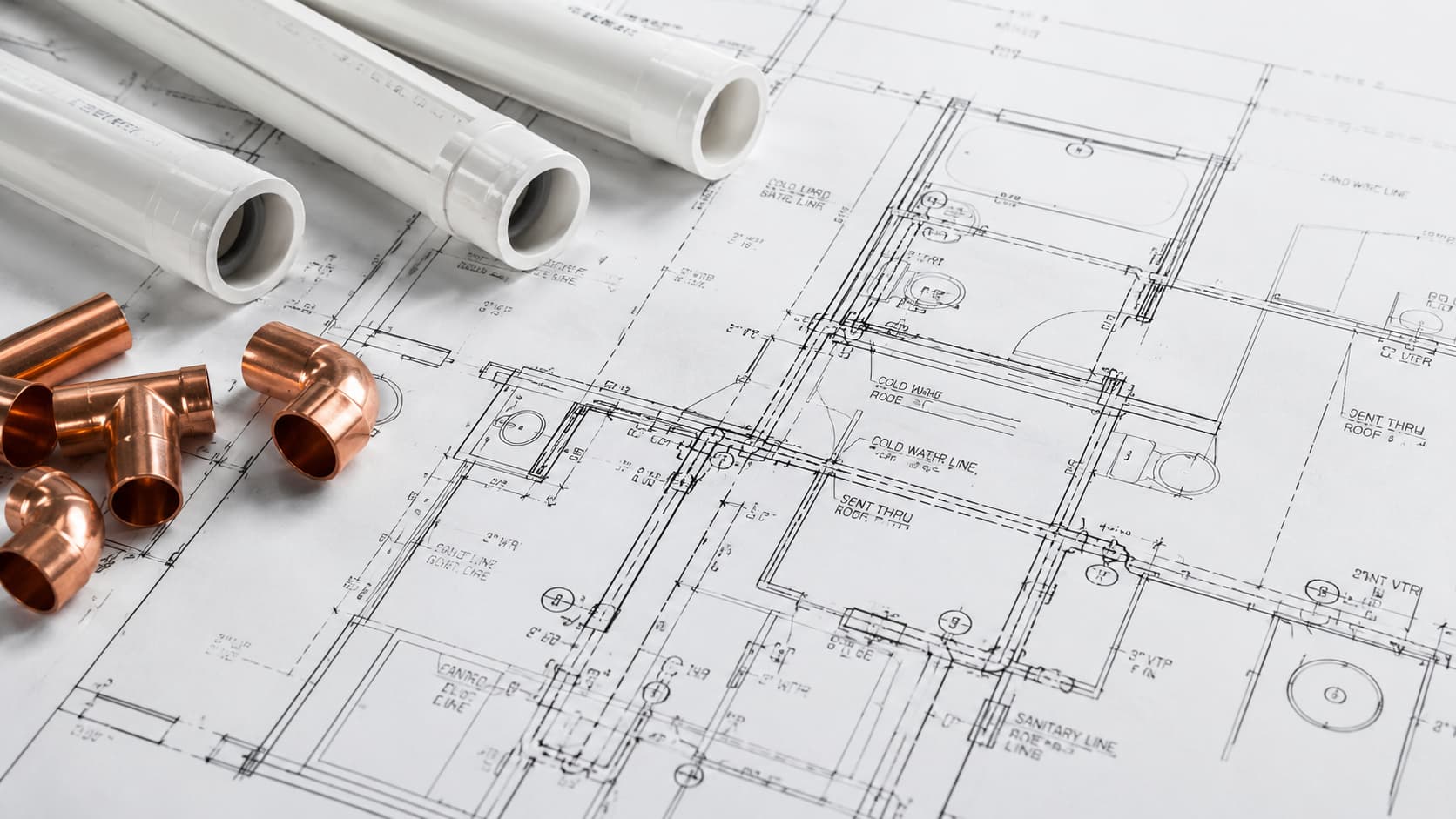
Start with the P-series (plumbing plans, riser diagrams, and the fixture schedule), but don’t stop there. Fixture counts and rough-in also live on architectural plans, and gas, equipment connections, and specialties can sit on mechanical or kitchen/equipment sheets. Confirm the drawing version and any addenda before you measure — a stale set means a stale bid.
2. Count and classify the fixtures
Work from the fixture schedule first, then verify counts against the floor plans (schedules and plans don’t always agree). Classify by type — water closets, lavatories, sinks, urinals, floor drains, hose bibbs, water heaters — because each carries its own rough-in, trim, and labor. A count of “40 fixtures” is useless; “12 WCs, 14 lavs, 6 sinks, 4 urinals, 4 floor drains” is a takeoff.
3. Measure pipe by system, material, and size
This is where the estimate is won or lost. Measure pipe runs — horizontal and vertical — for each system, broken out by material and diameter (copper, PEX, CPVC, cast iron, carbon steel, PVC), because price and labor change with both. Risers come off the riser diagram; horizontal runs come off the floor plans to scale. Watch the scale and confirm whether riser diagrams are schematic (topology only) or dimensioned.
4. Tally fittings, valves, and hangers
Fittings are the quiet margin killer. Elbows, tees, couplings, reducers, and transitions rarely appear as countable symbols, so estimators apply a fitting factor to pipe footage or count them per assembly. Add valves (gate, ball, check, backflow), plus supports, hangers, sleeves, and firestopping. A pipe number without fittings and hangers under-buys the job.
5. Take off specialties and equipment
Water heaters, pumps, backflow preventers, mixing valves, cleanouts, floor drains, grease interceptors, and gas equipment each need their own line — many are long-lead and high-dollar, so flag them for pricing and procurement timing.
6. Apply labor by installation condition
Plumbing labor is not one rate. Use recognized unit-labor standards (PHCC and MCAA) as a starting point, then adjust to your crew and the job: material and joining method (soldered copper vs. PEX vs. no-hub cast iron), overhead vs. accessible runs, occupied or phased work, and the well-known escalation of roughly 1–2% more labor for every floor above the fourth in a high-rise. Distinguish underground/below-slab from above-ground rough-in — they’re different production rates.
7. Price material, add waste, and set markup
Tie quantities to current pricing — copper and other metals move with the market, so a stale cost book quietly mis-prices the bid. Add waste by material, then layer overhead and margin as an intentional decision, not whatever’s left after you priced to win.
8. QC the takeoff and write clean exclusions
Cross-check schedule vs. plan counts, confirm every system was measured, and state exclusions plainly (e.g., trenching/excavation, fire sprinkler, gas beyond the meter, insulation) so the bid is compared on equal scope.
Where plumbing takeoffs go wrong
- Counting fixtures but under-measuring pipe. The pipe, fittings, and hangers are most of the labor. Fixtures are the visible part; pipe is the cost.
- Forgetting fittings and hangers. A pipe length without a fitting factor and supports under-buys every run.
- Trusting schematic risers as scaled. Riser diagrams show topology, not true lengths — get vertical runs from dimensioned info, not by scaling a schematic.
- One flat labor rate. No-hub cast iron overhead is a different production rate than PEX in an accessible wall. Flat-rating labor mis-prices the hard work.
- Stale material pricing. Copper and metal pipe move; price from current numbers, not last quarter’s book.
- Silent scope. If trenching, sprinkler, or gas is by others, say so — don’t eat it through an unstated assumption.
How software speeds up a plumbing takeoff
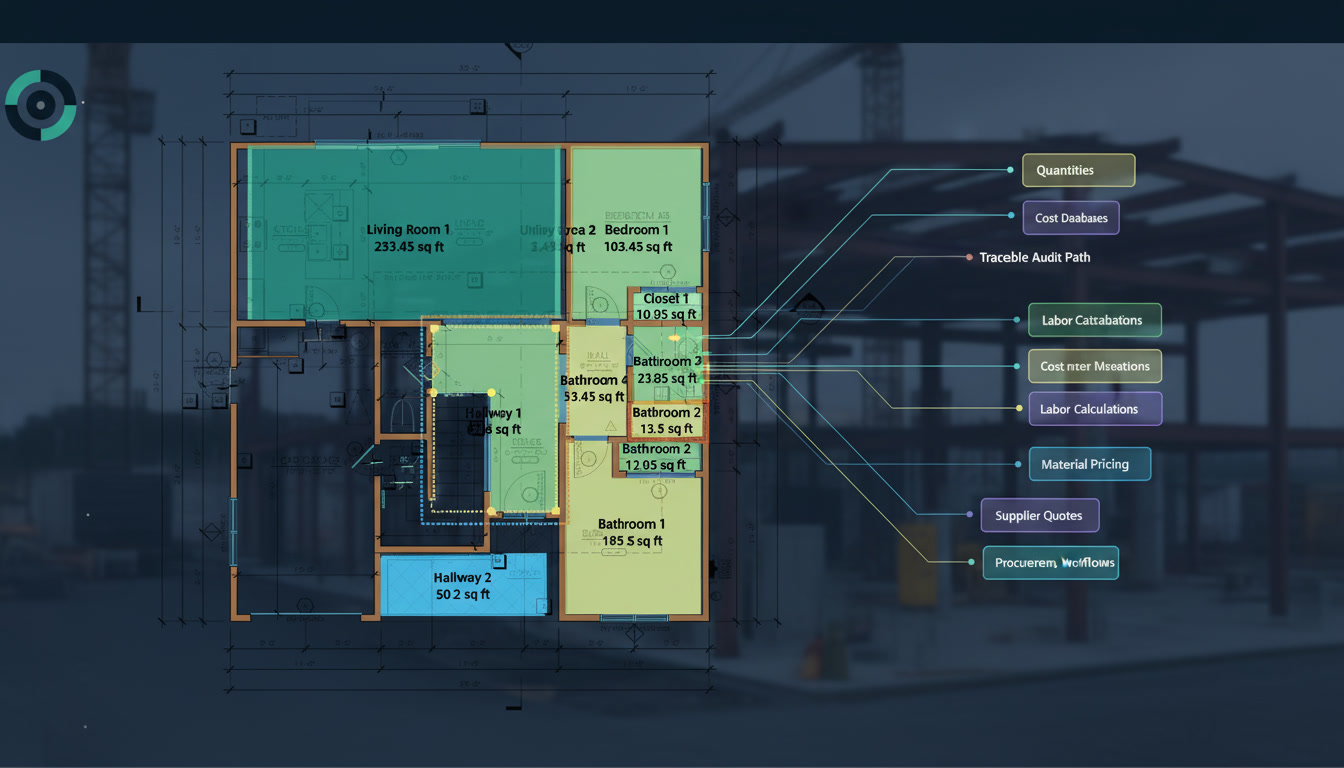
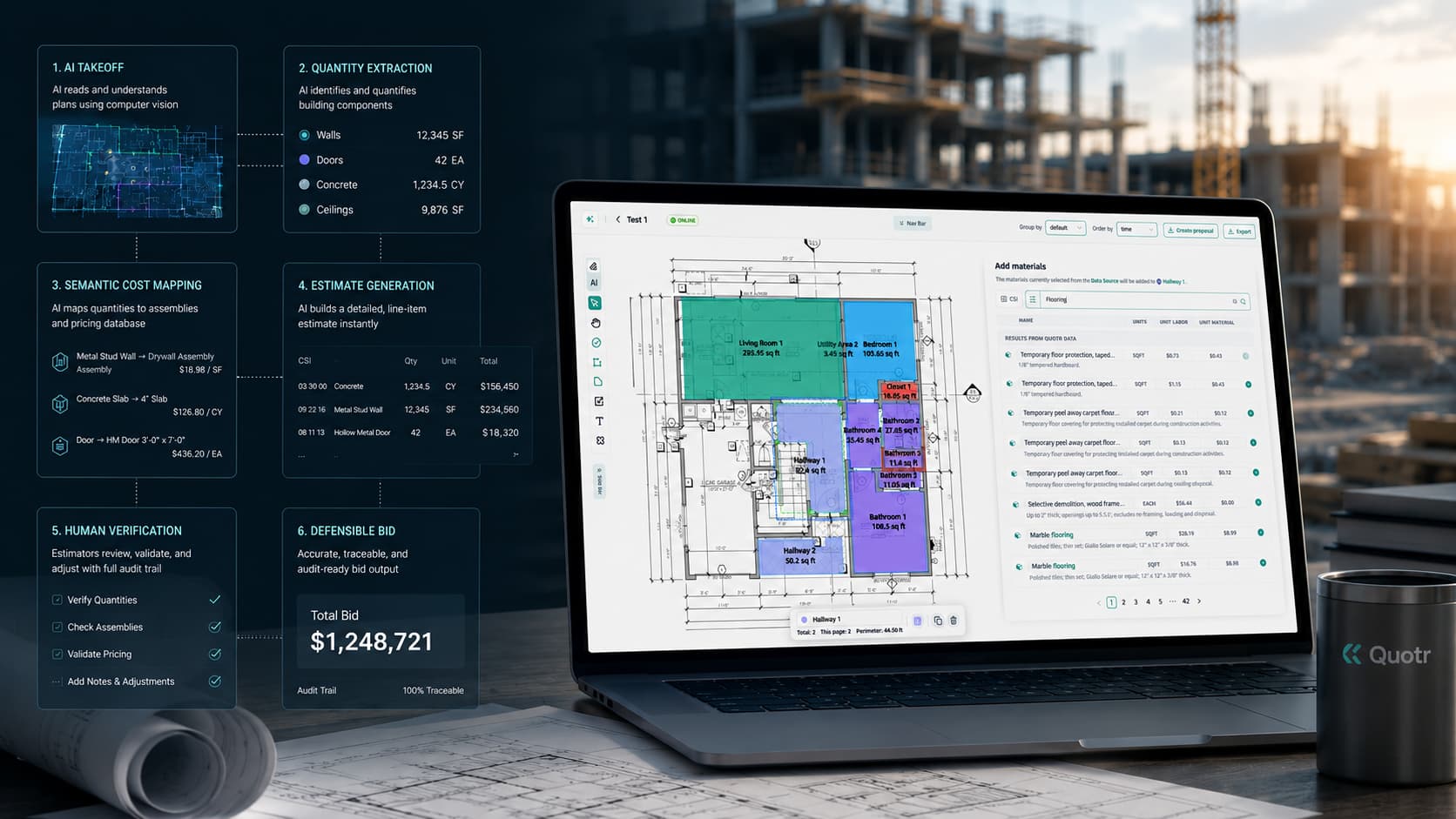
AI-assisted estimating platforms compress the front half of this workflow: they read plan sets, help identify fixtures and rooms, organize quantities, and carry them into a structured estimate and proposal without re-keying. The counting and measuring that used to take a day compresses to a focused review.
Quotr.ai is a multi-trade AI estimating platform — proven today across electrical, concrete, flooring, and drywall, and expanding into plumbing and MEP. Plumbers use the same takeoff-to-bid workflow: mark up and quantify fixtures, pipe runs, and areas on the PDF, apply your own pricing and labor, and export a proposal. As with any AI takeoff, pipe runs and fitting-level detail — especially on schematic risers — still get a quick estimator review, which is exactly how a good workflow should run: AI reads, you decide.
Frequently asked questions
How do you estimate plumbing from drawings?
Pull the full drawing set, count and classify fixtures from the fixture schedule, measure pipe runs by system, material, and size, tally fittings/valves/hangers, take off specialties and equipment, apply labor by installation condition (PHCC/MCAA units plus floor escalation), then price material with waste and markup. QC schedule-vs-plan counts and state exclusions clearly.
What’s included in a plumbing takeoff?
Fixtures (WCs, lavs, sinks, urinals, drains), pipe by material and diameter across domestic water, sanitary/vent, storm, and gas, plus fittings, valves, hangers, sleeves, firestopping, and specialties like water heaters, pumps, and backflow preventers.
How is plumbing labor estimated?
Start from recognized unit-labor standards (PHCC and MCAA), then adjust to your crew and conditions — joining method, overhead vs. accessible runs, underground vs. above-ground, occupied/phased work, and roughly 1–2% more labor per floor above the fourth in high-rise work.
Can AI do a plumbing takeoff?
AI can read plan sets and help identify fixtures, rooms, and quantities, then carry them into an estimate — compressing manual counting. Pipe runs and fitting-level detail, especially on schematic risers, still need estimator review. Confidence scoring and a human check keep the number defensible.
What’s the difference between a plumbing takeoff and a plumbing estimate?
A takeoff is the quantities — fixtures, pipe, fittings — pulled from the drawings. An estimate adds material pricing and labor on top to produce a fully burdened bid. The takeoff is the foundation; the estimate is what you submit.
The bottom line
A good plumbing estimate isn’t a fixture count — it’s an honest read of pipe, fittings, specialties, and the labor to install them under real job conditions. Nail the pipe and the labor, price from current numbers, and write clean exclusions, and your bid holds through buyout instead of bleeding margin on the fittings nobody counted.
When you’re ready to run this workflow faster, see the best plumbing estimating software, or start a free Quotr.ai trial and run a real plumbing plan set through it. Questions about your workflow? Talk to our team.
Related reading
- Best Plumbing Estimating Software in 2026
- How to Estimate HVAC and Sheet Metal From a Mechanical Plan
- How to Estimate Electrical Work From Drawings
- What Is AI Construction Estimating Software?
- Is AI Takeoff Actually Accurate Yet?
References
- Plumbing-Heating-Cooling Contractors Association (PHCC) — labor unit standards. https://www.phccweb.org/
- Mechanical Contractors Association of America (MCAA) — labor estimating standards. https://www.mcaa.org/
- Quotr.ai Software — AI Takeoff and Estimating. https://quotr.ai/software
Published on the Quotr.ai blog. Quotr.ai is an AI-powered construction estimation, takeoff, and procurement platform based in San Francisco.