How to Estimate HVAC and Sheet Metal From a Mechanical Plan
Direct Answer
To estimate HVAC and sheet metal from a mechanical plan, review the drawing set, measure ductwork linear feet, count air devices and equipment, quantify fittings, dampers, insulation, and accessories, apply labor units, price materials and equipment, then add overhead, profit, tax, and contingency.
The basic workflow is:
Mechanical plans → duct takeoff → equipment counts → labor hours → priced estimate → bid
Quotr helps HVAC contractors move from mechanical drawings to quantities, estimates, bids, and procurement decisions faster. For the broader workflow, read How AI Construction Estimating Works and From Takeoff to Buyout: Why Estimating Without Procurement Is Half a Tool.
HVAC Estimating Workflow
| Step | What to do | Key output |
|---|---|---|
| 1 | Review mechanical drawings | Scope clarity |
| 2 | Identify system type | Estimating assumptions |
| 3 | Measure ductwork | Linear feet by size/type |
| 4 | Count fittings and dampers | Accessory quantities |
| 5 | Count air devices | Diffusers, grilles, registers |
| 6 | Count equipment | RTUs, AHUs, VAVs, fans |
| 7 | Quantify insulation | Square feet or linear feet |
| 8 | Apply labor units | Labor hours |
| 9 | Price materials/equipment | Direct cost |
| 10 | Add markup and risk | Bid price |
For a broader construction takeoff foundation, read Construction Takeoff Guide and How to Do Construction Takeoff from a PDF Blueprint.
1. Review the Mechanical Drawing Set
Start with the full mechanical package:
- Mechanical plans
- Roof plans
- Equipment schedules
- Diffuser schedules
- Duct details
- Control diagrams
- Specifications
- Addenda and revisions
Before measuring, answer:
- Is this new construction or renovation?
- Are existing systems reused?
- Is demolition included?
- Is duct insulation required?
- Are controls included?
- Is testing and balancing included?
- Are fire or smoke dampers required?
- Are roof curbs, access doors, and hangers included?
Many HVAC estimates miss money because the estimator measures ductwork but misses notes, schedules, controls, insulation, access doors, or addenda.
For takeoff accuracy issues, Construction Estimating Mistakes to Avoid.
2. Identify the HVAC System Type
The system type affects ductwork, equipment, labor, controls, and procurement.
Common systems include:
| System | Estimating impact |
|---|---|
| Rooftop unit | Curbs, crane, duct drops, economizers |
| VAV | VAV boxes, controls, reheat, balancing |
| VRF | Indoor units, refrigerant piping, controls |
| Exhaust | Fans, louvers, dampers, roof penetrations |
| Chilled water | Pumps, piping, coils, valves, insulation |
Do not estimate every mechanical plan the same way. System type controls the labor and material logic.
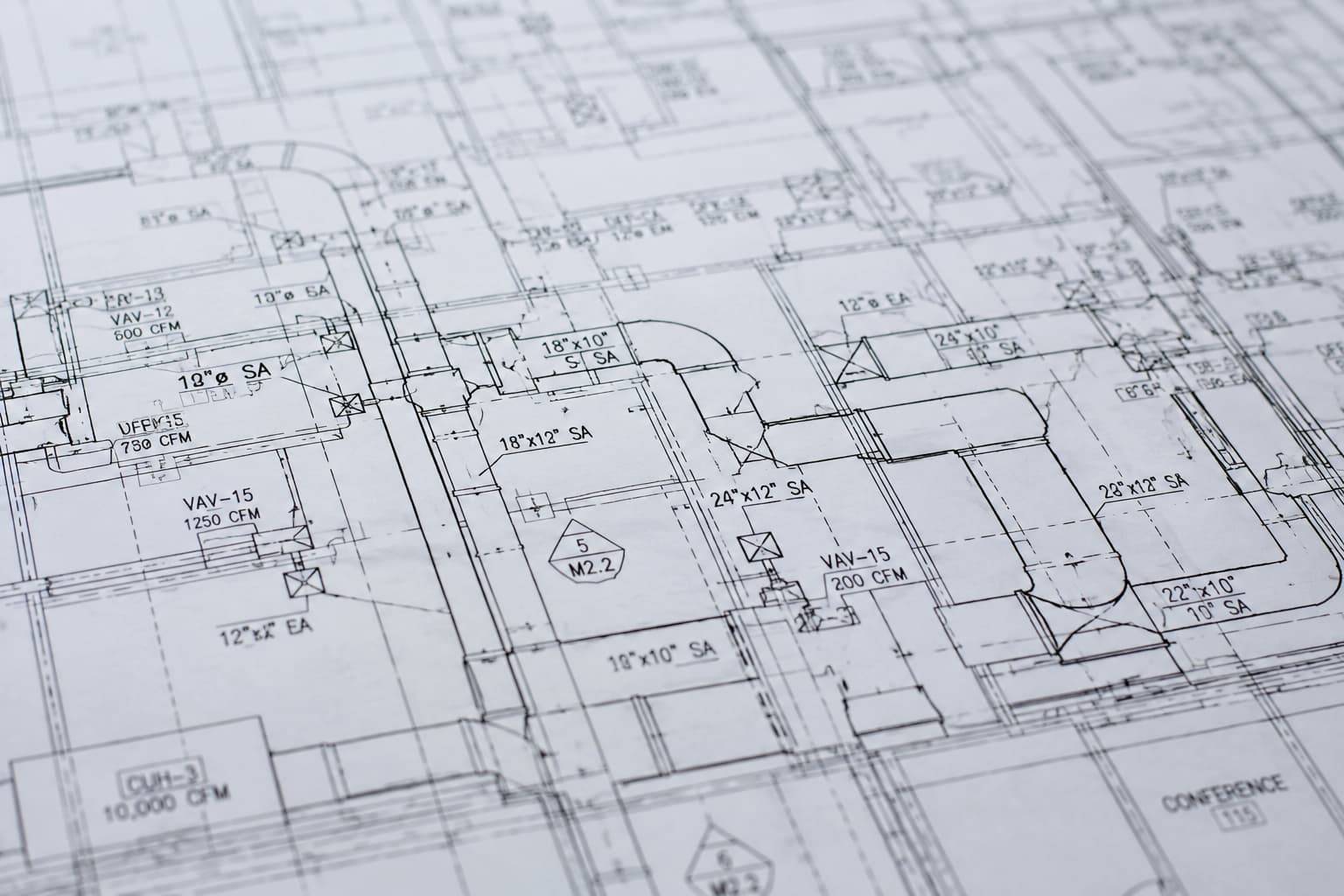
3. Measure Ductwork Linear Feet
Measure ductwork by size, type, and system.
Separate:
- Supply air
- Return air
- Exhaust air
- Outside air
- Rectangular duct
- Round duct
- Spiral duct
- Flexible duct
- Lined duct
- Insulated duct
Formula:
Duct linear feet = measured duct run length by size and type
Example:
| Duct type | Size | Quantity |
|---|---|---|
| Supply duct | 24” x 12” | 120 LF |
| Supply duct | 18” x 10” | 85 LF |
| Return duct | 30” x 14” | 60 LF |
| Exhaust duct | 12” round | 95 LF |
| Flexible duct | 8” round | 240 LF |
Do not combine all duct into one quantity. A 12” round exhaust duct and a 36” x 18” rectangular supply duct have different material and labor costs.
For similar trade-specific takeoff workflows, read How to Estimate Electrical Work from Drawings: Conduit, Devices, and Labor and Commercial Electrical Takeoff: From Drawings to Proposal.
4. Convert Ductwork to Sheet Metal Quantity
Sheet metal may be estimated by linear feet, surface area, weight, or size category.
Rectangular duct surface area:
Surface area = 2 × (width + height) × length
Example:
24” x 12” duct, 100 LF:
- Width = 2 ft
- Height = 1 ft
- Length = 100 ft
Calculation:
2 × (2 + 1) × 100 = 600 SF
Round duct surface area:
Surface area = π × diameter × length
Example:
12” round duct, 100 LF:
3.14 × 1 × 100 = 314 SF
Use company standards, SMACNA requirements, gauge tables, fabrication method, and waste factors when converting duct quantities into material cost.
5. Count Fittings, Dampers, and Accessories
Duct linear feet are not enough. Fittings and accessories drive labor.
Count:
- Elbows
- Transitions
- Offsets
- Tees
- Wyes
- Reducers
- Tap-ins
- Volume dampers
- Fire dampers
- Smoke dampers
- Access doors
- Flexible connectors
- Hangers and supports
- Roof penetrations
Example:
| Item | Quantity | Estimating note |
|---|---|---|
| Elbows | 24 | Add fabrication/install labor |
| Transitions | 12 | Review size changes |
| Volume dampers | 36 | Include access and balancing |
| Fire dampers | 8 | Include sleeves/access doors |
| Access doors | 10 | Often missed |
This is where AI-assisted drawing review can help estimators catch missed symbols and repetitive counts. For a broader explanation, read How AI Construction Takeoff Works in 2026 and Is AI Takeoff Actually Accurate Yet?.
6. Count Air Devices
Count air devices from mechanical plans, reflected ceiling plans, and schedules.
Include:
- Supply diffusers
- Return grilles
- Exhaust grilles
- Registers
- Louvers
- Linear slot diffusers
- Transfer grilles
Check each device for:
- Neck size
- Face size
- CFM
- Finish
- Mounting type
- Damper requirement
- Plenum requirement
Example:
| Air device | Quantity |
|---|---|
| Supply diffusers | 48 |
| Return grilles | 32 |
| Exhaust grilles | 18 |
| Linear slot diffusers | 120 LF |
If the plan and schedule disagree, flag it before bid submission.
7. Count HVAC Equipment
Count equipment from plans, roof plans, schedules, and specifications.
Include:
- RTUs
- AHUs
- Fan coil units
- Exhaust fans
- Make-up air units
- VAV boxes
- Reheat coils
- Unit heaters
- Condensing units
- Chillers
- Pumps
Track:
- Tag
- Quantity
- Capacity
- Voltage
- Accessories
- Controls
- Curbs/supports
- Startup
- Freight
- Lead time
- Installation labor
Example:
| Equipment | Quantity | Notes |
|---|---|---|
| RTU | 2 | Include curb, crane, startup |
| VAV boxes | 24 | Include controls coordination |
| Exhaust fans | 3 | Include curb/backdraft damper |
| Unit heaters | 6 | Confirm gas/electric scope |
Equipment often creates procurement risk. That is why HVAC estimates should connect to buyout and procurement, not stop at takeoff. Read From Takeoff to Buyout and Tariff-Aware Estimating: How Quotr Bakes Material Escalation Into Every Bid.
8. Quantify Insulation and Liner
Check specifications for:
- External duct insulation
- Internal duct liner
- Acoustic liner
- Vapor barrier
- Insulation thickness
- Supply/return/exhaust requirements
- Roof duct insulation
- Exposed duct requirements
Simple formula:
Insulation quantity = duct surface area requiring insulation
With waste:
Insulation quantity with waste = insulation SF × waste factor
Example:
600 SF × 1.10 = 660 SF
Insulation labor depends on ceiling height, congestion, access, roof work, and phasing.
9. Estimate Labor Hours
HVAC labor hours are calculated by multiplying quantity by labor unit.
Formula:
Labor hours = quantity × labor unit
Example:
| Scope | Quantity | Labor unit | Labor hours |
|---|---|---|---|
| Rectangular duct | 500 LF | 0.45 hr/LF | 225 |
| Round duct | 300 LF | 0.30 hr/LF | 90 |
| Flexible duct | 200 LF | 0.12 hr/LF | 24 |
| Diffusers | 50 EA | 0.50 hr/EA | 25 |
| VAV boxes | 20 EA | 2.50 hr/EA | 50 |
| Fire dampers | 8 EA | 1.50 hr/EA | 12 |
Total:
225 + 90 + 24 + 25 + 50 + 12 = 426 labor hours
Adjust labor for:
- Ceiling height
- Access limits
- Congestion
- Renovation work
- Phasing
- Night work
- Roof work
- Union rules
- Material handling
- Commissioning support
Do not use one labor factor for every duct type.
For broader labor and productivity context, read Construction Labor Shortage and AI Adoption in 2026.
10. Price Materials, Equipment, and Markup
A complete HVAC estimate should include:
- Sheet metal
- Fittings
- Dampers
- Diffusers
- Grilles
- Registers
- Hangers
- Insulation
- Equipment
- Controls
- Crane or rigging
- Freight
- Tax
- Startup
- Testing and balancing
- Waste
- Escalation
- Overhead
- Profit
Basic structure:
| Cost category | Includes |
|---|---|
| Materials | Duct, fittings, dampers, diffusers, insulation |
| Equipment | RTUs, VAV boxes, fans, coils |
| Labor | Shop labor, field labor, supervision |
| Subcontractors | Controls, balancing, crane, firestopping |
| Other | Freight, tax, permits, startup, warranty |
| Markup | Overhead and profit |
A priced estimate should support bid review and procurement. That is why Quotr connects estimating workflows beyond takeoff. For tool selection, read AI Construction Estimating Software Buyer’s Guide and Best AI Construction Estimating Software 2026.
HVAC Takeoff Example
Example project:
| Item | Quantity |
|---|---|
| Rectangular duct | 500 LF |
| Round duct | 300 LF |
| Flexible duct | 200 LF |
| Supply diffusers | 50 EA |
| Return grilles | 30 EA |
| VAV boxes | 20 EA |
| Fire dampers | 8 EA |
| Insulation | 1,800 SF |
Labor calculation:
| Item | Quantity | Labor unit | Hours |
|---|---|---|---|
| Rectangular duct | 500 LF | 0.45 | 225 |
| Round duct | 300 LF | 0.30 | 90 |
| Flexible duct | 200 LF | 0.12 | 24 |
| Supply diffusers | 50 EA | 0.50 | 25 |
| Return grilles | 30 EA | 0.35 | 10.5 |
| VAV boxes | 20 EA | 2.50 | 50 |
| Fire dampers | 8 EA | 1.50 | 12 |
| Insulation | 1,800 SF | 0.04 | 72 |
Total labor:
508.5 labor hours
At $85/hour:
508.5 × $85 = $43,222.50 labor cost
Use company labor history and project conditions to adjust this number.
For more examples of converting plan quantities into bid-ready estimates, read Blueprint to Priced Estimate Workflow and How to Price a Construction Job.
Common HVAC Estimating Mistakes
Avoid these misses:
- Missing fittings
- Missing dampers
- Missing access doors
- Missing insulation
- Missing acoustic liner
- Missing fire/smoke dampers
- Missing VAV controls
- Missing testing and balancing
- Missing curbs
- Missing crane or rigging
- Missing freight
- Missing startup
- Missing warranty
- Ignoring addenda
- Applying one labor factor to all ductwork
- Not reconciling plans with schedules
- Not checking procurement risk
For a wider checklist of bid misses, read Construction Estimating Mistakes to Avoid.
How AI Helps HVAC Estimating
AI helps HVAC estimating by detecting mechanical plan elements and reducing manual takeoff time.
AI can help identify:
- Duct runs
- Duct sizes
- Equipment tags
- Diffusers
- Grilles
- Registers
- VAV boxes
- Dampers
- Fans
- Mechanical symbols
- Drawing notes
- Equipment schedules
- Scope gaps
AI does not replace the estimator. It helps estimators extract quantities faster, review more scope, catch misses, and improve bid turnaround.
For more, read How AI Construction Estimating Works, AI That Reads Construction Drawings: Chat With Blueprints, and AI Construction Estimating Software That Turns Plans Into Prices in Minutes.
Where Quotr Fits
Quotr helps HVAC and sheet metal contractors move from mechanical drawings to estimate-ready quantities and procurement-aware bids.
Quotr can support:
- Mechanical plan review
- Ductwork takeoff
- Equipment counts
- Diffuser and grille counts
- VAV box counts
- Damper counts
- Scope review
- Bid turnaround
- Estimate organization
- Procurement-aware estimating
The value is not only faster takeoff. The value is connecting:
Mechanical drawings → quantities → labor hours → estimate → bid → buyout → procurement
For a full workflow explanation, read From Takeoff to Buyout and AI Construction Estimating Software Buyer’s Guide.
For product-level navigation, visit Quotr.ai Software, Quotr Pricing, or the Quotr AI Software Demo.
HVAC Estimating Checklist
Use this checklist before submitting a bid.
| Category | Check |
|---|---|
| Drawings | Plans, schedules, specs, addenda reviewed |
| Ductwork | Supply, return, exhaust, outside air measured |
| Accessories | Fittings, dampers, access doors, hangers counted |
| Air devices | Diffusers, grilles, registers, louvers counted |
| Equipment | RTUs, AHUs, VAVs, fans, pumps counted |
| Insulation | External insulation, liner, vapor barrier included |
| Labor | Labor units adjusted for project conditions |
| Pricing | Materials, equipment, freight, tax, escalation included |
| Subs | Controls, balancing, crane, firestopping reviewed |
| Risk | Procurement, lead times, addenda, exclusions checked |
Final Takeaway
HVAC and sheet metal estimating starts with the mechanical plan and ends with a bid-ready cost model.
The key steps are:
Review drawings → measure ductwork → count equipment → quantify accessories → apply labor hours → price materials → add markup → review procurement risk
Quotr helps HVAC contractors move faster from mechanical drawings to quantities, estimates, bids, buyout, and procurement.
To continue building the estimating workflow, read How AI Construction Estimating Works, AI Construction Estimating Software Buyer’s Guide, and From Takeoff to Buyout.
FAQ
How do you estimate HVAC from mechanical plans?
Estimate HVAC from mechanical plans by reviewing drawings, measuring ductwork linear feet, counting equipment and air devices, quantifying fittings and insulation, applying labor units, pricing materials and equipment, and adding markup, tax, and contingency.
How do you estimate sheet metal ductwork?
Estimate sheet metal ductwork by measuring duct linear feet by size and type, counting fittings and accessories, calculating surface area or weight if needed, adding waste, and applying labor units.
How do you calculate ductwork linear feet?
Calculate ductwork linear feet by measuring each duct run along the centerline of the duct on the mechanical plan. Separate quantities by duct size, duct type, and system type.
How do you calculate HVAC labor hours?
Calculate HVAC labor hours with this formula: labor hours = quantity × labor unit. For example, 500 LF of rectangular duct at 0.45 hr/LF equals 225 labor hours.
What should be included in an HVAC takeoff?
An HVAC takeoff should include ductwork, fittings, dampers, diffusers, grilles, registers, VAV boxes, fans, RTUs, AHUs, insulation, access doors, hangers, supports, controls, startup, testing and balancing, and equipment schedules.
How can AI help HVAC estimating?
AI can help HVAC estimating by detecting duct runs, equipment tags, air devices, dampers, VAV boxes, mechanical symbols, notes, and schedules. It reduces manual takeoff time and improves bid turnaround.
What is the best HVAC estimating software?
The best HVAC estimating software helps contractors review mechanical plans, measure ductwork, count equipment, apply labor units, organize bids, compare pricing, and connect estimating to procurement. Quotr supports AI-assisted HVAC takeoff and estimating workflows.