Quantity Takeoff Services: Costs and When to Outsource (2026)
Every estimator knows the takeoff is the grind. Before you can price a single line, someone has to sit with the drawings and measure the whole job — count every fixture, scale every run of pipe, tally every square foot of finish. It’s the most time-consuming part of estimating and the easiest place to lose an evening (or three). It’s also the part you can hand off without giving up an ounce of what makes your bids yours.
A quantity takeoff service measures the work from your drawings and returns the quantities — counts, lengths, areas, and volumes, organized by trade — so your team can price them with your own rates instead of spending the hours doing the measuring. You send the plan set; you get back a clean quantity takeoff (often as a bill of quantities) you can drop straight into your estimate. This guide covers exactly what these services deliver, what they cost, and when outsourcing just the takeoff — not the whole estimate — is the right call.
Takeoff vs. estimate: why you might want only the quantities
This is the distinction that trips people up. A quantity takeoff is the measuring — the “what and how much.” A full estimate is the takeoff plus pricing: unit costs, labor rates, and markup applied to those quantities. Two different jobs.
Plenty of contractors deliberately outsource only the first. Their pricing — their labor rates, their assemblies, the numbers they’ve refined over years of jobs — is their edge, and they want to keep it in-house. What they don’t want is to burn senior-estimator hours scaling drawings. A quantity takeoff service scratches exactly that itch: it hands back accurate, defensible quantities and leaves the pricing to you. (If you’d rather have the whole thing priced, that’s a cost estimating service — different scope, different deliverable.)
What a quantity takeoff service delivers
The output is the measured scope, organized so it plugs into how you bid: counts (fixtures, devices, openings), linear measurements (pipe, conduit, trim), areas (drywall, flooring, roofing), and volumes (concrete, earthwork) — broken out by trade or CSI division. A good service also distinguishes a quantity takeoff from a material takeoff: quantities are the measured work; a material takeoff extends that into the specific materials and counts you’ll buy. Know which one you’re asking for.
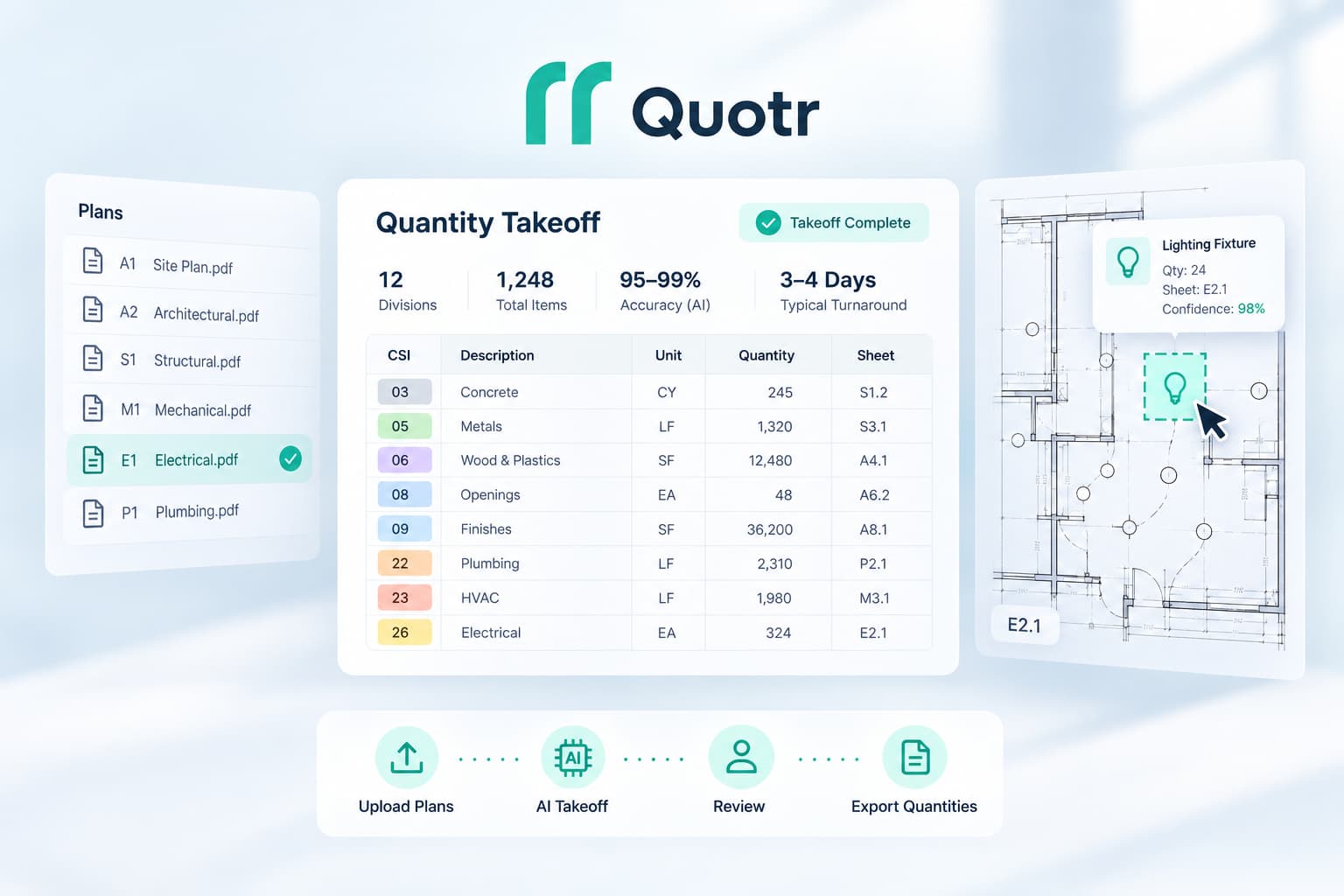
The thing that separates a takeoff you can trust from a spreadsheet you have to re-check is traceability — every quantity tied back to the sheet and symbol it came from, so when a number gets questioned, you can defend it instead of re-measuring.
When to outsource your takeoff
Outsourcing the takeoff makes sense in a few specific situations, and it’s worth being honest about which one you’re in:
- You’re at capacity in bid season. The takeoff is the bottleneck between you and more bids. Offloading it lets you pursue jobs you’d otherwise no-bid.
- You want to protect your pricing IP. Keep your rates and assemblies in-house; send out only the measuring.
- The volume doesn’t justify a hire. A full-time takeoff person is a salary you carry year-round; a service is per-project.
- You need speed on a specific bid. Many services turn a takeoff around in days — faster than pulling someone off another job to do it. If your bottleneck is actually pricing accuracy or scope review rather than the measuring, a takeoff-only service won’t fix it — you want a fuller estimating service. Match the service to the actual gap.
What quantity takeoff services cost
Takeoff pricing scales with scope and complexity. Across the market, a professional takeoff runs roughly $150 for a minor single-trade residential review up to $5,000+ for a multi-story, multi-division commercial set, with single-trade takeoffs commonly starting around $250 and full multi-trade commercial in the $1,200–$2,500 range. Rush jobs (24–48 hours) usually carry a 20–50% premium. (Takeoff Monkey, Edge Estimates)
Quotr.ai Service prices per square foot instead — $0.25/sq ft under 50,000 sq ft, $0.10/sq ft above — scoped and approved before work begins, so you know the number up front rather than negotiating per sheet.
How Quotr.ai does quantity takeoff
Most takeoff services are people measuring by hand — which is why they bill by the sheet and why a rush costs more. Quotr.ai runs your plan set through its own AI takeoff engine first: the computer-vision model reads the drawings and extracts counts, lengths, and areas with a confidence score on every item, so review focuses on the few quantities worth checking instead of re-counting all of them. On clean vector PDFs that runs at 95–99% accuracy in Quotr.ai’s internal benchmarking, and every quantity traces back to the sheet. An in-house estimator reviews before it ships.
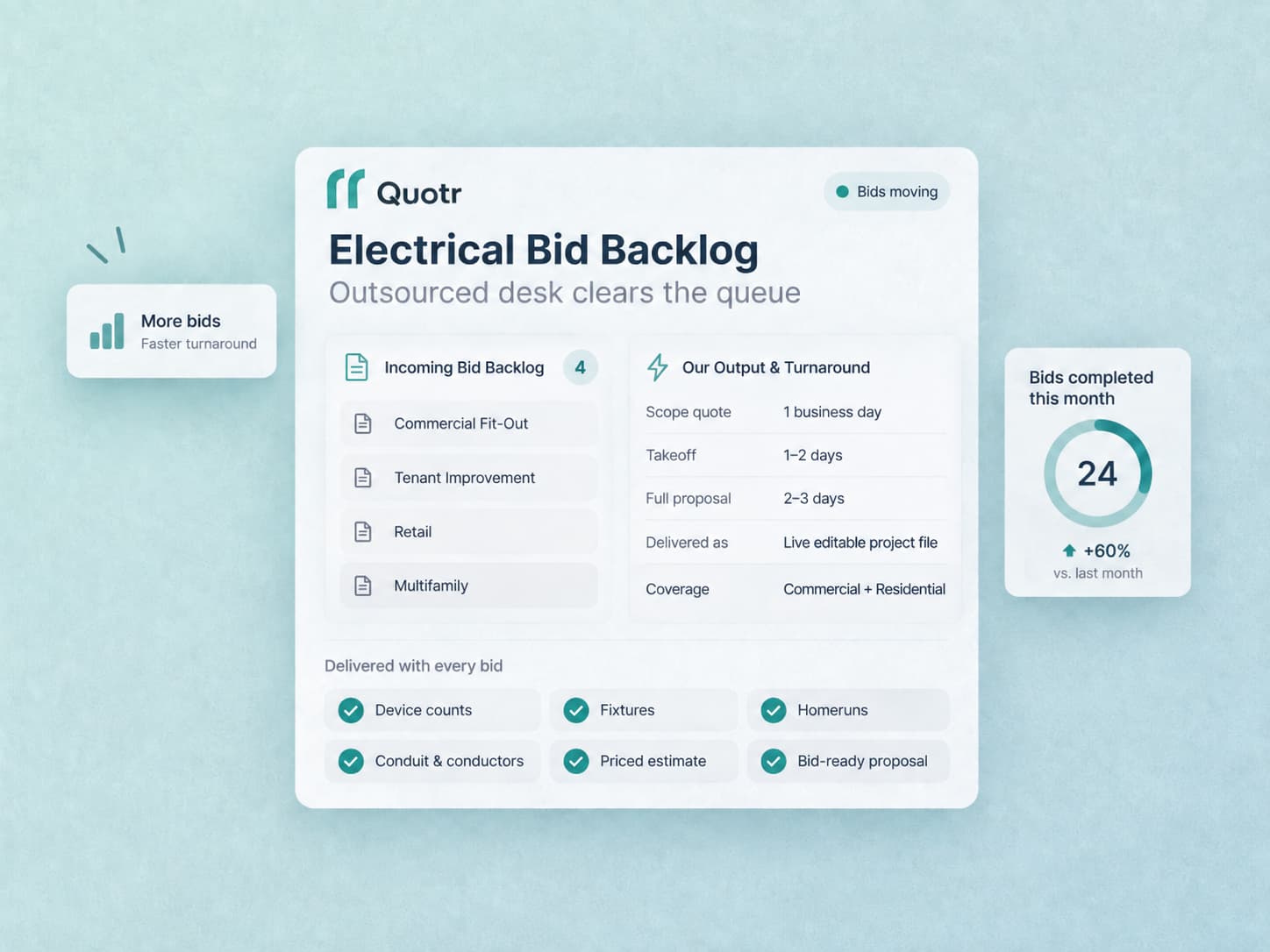
Two things follow. First, you get the takeoff back fast — typically 3–4 business days, per project — and you can take just the quantities and price them with your own rates, or have Quotr.ai carry it through to a priced estimate. Second, because the engine is Quotr.ai’s own, it’s also available as self-serve Quotr.ai Software if you’d rather run takeoffs in-house, and the quantities can flow downstream into factory-direct construction procurement at buyout. It’s multi-trade by design and built for any trade.
Send us a set and see the quantities on your own drawings — scope a project or talk to our team. For the wider picture, start with construction estimating services or the outsource-vs-hire breakdown.
Frequently Asked Questions
How much do quantity takeoff services cost? Quantity takeoff services typically run from about $150 for a minor single-trade residential review to $5,000+ for a large multi-division commercial set, with single-trade takeoffs commonly starting near $250 and full commercial in the $1,200–$2,500 range. Rush 24–48-hour jobs add roughly 20–50%. Quotr.ai prices per square foot — $0.25/sq ft under 50,000 sq ft and $0.10 above — scoped before work begins.
What’s the difference between a quantity takeoff and an estimate? A quantity takeoff is the measuring — counts, lengths, areas, and volumes pulled from the drawings. An estimate is the takeoff plus pricing: unit costs, labor, and markup applied to those quantities. Many contractors outsource only the takeoff so they can keep their own pricing and assemblies in-house while offloading the time-consuming measurement.
Should I outsource quantity takeoff? Outsource the takeoff when it’s the bottleneck between you and more bids, when you want to protect your pricing while offloading the measuring, or when your volume doesn’t justify a full-time takeoff hire. If your real problem is pricing accuracy or scope review rather than measuring, choose a fuller estimating service instead.
How fast can a quantity takeoff be delivered? Turnaround ranges from 24–48 hours (usually at a premium) to several business days, depending on scope and provider. Quotr.ai Service typically delivers in 3–4 business days once the plan set and scope are confirmed, because an AI engine does the measuring pass and an in-house estimator reviews the flagged items before delivery.
Is an outsourced takeoff accurate enough to bid from? It can be, when quantities are traceable and reviewed. Quotr.ai’s AI takeoff runs at 95–99% accuracy on clean vector PDFs (internal benchmarking), attaches a confidence score to each item, and ties every quantity back to the sheet — so you can see exactly what to trust and what to check before the number goes into your bid.
Related Reading
- Construction Estimating Services: What They Do and When to Use One
- Construction Cost Estimating Services: Your AI-Powered Outsourced Cost Estimator
- Should You Outsource Construction Estimating? Costs, Pros & Cons (2026)
- How to Do a Construction Takeoff From a PDF Blueprint
About Quotr.ai
Quotr.ai is an AI construction platform with three parts: Quotr.ai Software (AI takeoff, estimating, and bidding — including the AI agent that reads your plans), Quotr.ai Service (done-for-you cost estimates and pro formas), and Quotr.ai Procurement (factory-direct materials delivered door-to-door). Built for subcontractors, general contractors, and developers, and based in San Francisco.
Published on the Quotr.ai blog. Quotr.ai is an AI-powered construction estimation, takeoff, and procurement platform based in San Francisco.