How to Reduce Construction Material Costs in 2026 | Procurement
Material prices in 2026 are not behaving the way most estimators budgeted for. The Producer Price Index for construction inputs hit an all-time high in early 2026, and by spring, inputs to new nonresidential construction were running roughly 8.4% higher year over year — the steepest annual jump since the pandemic. Steel, aluminum, and copper are carrying 50% tariffs. Copper wire and cable alone climbed more than 24% in twelve months. If your buyout strategy still assumes a stable market, your margin is quietly bleeding out.
Short answer: The fastest way to reduce construction material costs in 2026 is to attack both quantity and price — order less by improving takeoff accuracy, then pay less per unit through early procurement, value engineering, tariff-aware substitution, bulk consolidation, and cutting out distributor markup with factory-direct sourcing.
This guide walks through seven concrete levers, in the order that usually delivers the biggest wins. The first five apply no matter what tools you use. The last two are where a platform starts to earn its keep.
Why material costs are climbing in 2026
Before the levers, it helps to understand what you are fighting. Three forces are stacked on top of each other:
- Tariffs. As of 2026, steel, aluminum, and copper products carry a 50% tariff, derivatives of those metals sit at 25%, and softwood lumber carries 10%. Nonresidential construction input prices surged at a 12.6% annualized rate in the first two months of 2026.
- Demand shocks. AI data center construction is absorbing copper and electrical components faster than supply can respond. Copper and brass mill shapes rose roughly 27% year over year by mid-2026.
- Lead-time pressure. Structural steel fabrication runs 14–20 weeks in most U.S. markets, and custom work can stretch past 20 weeks. Long lead times mean you commit to prices earlier — and get exposed to escalation longer. You cannot control tariffs or global demand. You can control how accurately you order, when you buy, what you specify, and who you buy from. That is where the savings live.
Lever 1: Get the takeoff right so you stop over-ordering
Waste is the cheapest cost to eliminate because it never had to exist. Industry research finds that up to 30% of materials delivered to jobsites end up as waste, and a major driver is over-ordering during the takeoff and procurement stage. When a contractor budgets for 5% waste but actually runs 15%, every project starts underwater before the first delivery arrives.
An inaccurate takeoff hurts twice. You buy material you never install, and you eat the disposal and restocking cost on the back end. Tightening quantities is pure margin recovery.
Practical moves:
- Count from the drawings, not from memory or ratios. Rule-of-thumb multipliers are where phantom quantities creep in.
- Standardize your waste factors per material instead of applying a blanket 10% to everything. Sheet goods, trim, and tile all waste differently.
- Reconcile as-ordered against as-installed after each job so your next takeoff learns from the last. For a deeper look at where quantities go wrong, see our guide to common construction estimating mistakes to avoid.
Lever 2: Procure early and lock prices before they move
In a rising, tariff-driven market, timing is a lever in its own right. When a material has volatile pricing, limited suppliers, or a long fabrication lead time, buying early can lock both the price and the fabrication slot before escalation catches you.
Tactics that work in 2026:
- Owner-direct or early purchase on high-volatility scopes — structural steel, electrical gear, glazing — once design and quantities are confirmed.
- Price-protected supply agreements negotiated months ahead of need, so a tariff change mid-project does not reset your budget.
- Buy-now, deliver-later releases that reserve today’s price while scheduling delivery to when the job actually needs the material, avoiding storage and handling costs. The catch: early procurement only works if your quantities are trustworthy. Locking the price on the wrong quantity just locks in the wrong number. Levers 1 and 2 reinforce each other.
Lever 3: Value-engineer specs before you buy, not after
Value engineering is not cutting corners — it is choosing the assembly that hits the performance requirement at the lowest total cost. The discipline is doing it during design and preconstruction, when substitutions are cheap, rather than during a change order, when they are expensive.
- Challenge over-specified finishes and assemblies that exceed what the project actually requires.
- Compare equivalent products using current supplier quotes rather than assumptions about what “should” be cheaper this year.
- Evaluate offsite or modular components for repetitive scopes, where controlled production reduces both waste and onsite labor exposure.
Lever 4: Time and substitute around tariffs
Because tariffs land unevenly across materials, the same building can be over-exposed in one scope and untouched in another. Track your tariff-sensitive materials — steel, aluminum, copper — separately, since they move on different cycles.
- Substitute where engineering allows. Properly engineered AA-8000-series aluminum conductors, for example, can replace copper on larger feeders and services, and aluminum is generally the cheaper conductor per amp — though larger conductor sizes are required, so verify with your electrical engineer.
- Sequence purchases around announced tariff changes when you have visibility into them.
- Build escalation language into bids so you are not absorbing a duty change you never priced. For a full treatment of pricing tariffs into every bid, read tariff-aware estimating: building material escalation into every bid and our breakdown of the 2026 tariff impact on steel, aluminum, and copper costs.
Lever 5: Buy in bulk and consolidate orders
Fragmented purchasing leaves money on the table. Every separate order carries its own freight, handling, and minimum-order overhead, and small buyers rarely command volume pricing.
- Consolidate purchases across jobs and trades to hit volume tiers and reduce per-order freight.
- Standardize products across projects so you are buying more of fewer SKUs — the single biggest driver of volume leverage.
- Coordinate delivery schedules to cut redundant final-mile charges and the storage cost of material sitting on site too early.
Lever 6: Cut change orders before they cut you
Change orders are among the most expensive material costs because they arrive at the worst possible time — mid-build, at spot prices, with rush freight and no negotiating leverage. Most trace back to incomplete scope, coordination gaps, or takeoff errors that surface after buyout.
- Resolve scope and coordination conflicts in preconstruction, not in the field.
- Confirm quantities and long-lead items before release so you are not re-ordering at a premium.
- Keep a clean audit trail from takeoff through buyout so disputed quantities can be settled against the source, not against memory. Our guide to moving from takeoff to buyout on a single estimating and procurement platform covers how to keep that chain intact.
The first six levers are process discipline — you can start on them Monday with the team and vendors you already have. The last stretch is about tooling: how accurate takeoff software and a factory-direct procurement layer compress the two biggest cost drivers, quantity and per-unit price. If your interest is specifically in the software category, our companion piece on construction procurement software for cutting material costs in 2026 goes deep on that.
How Quotr helps: accurate takeoff plus factory-direct procurement
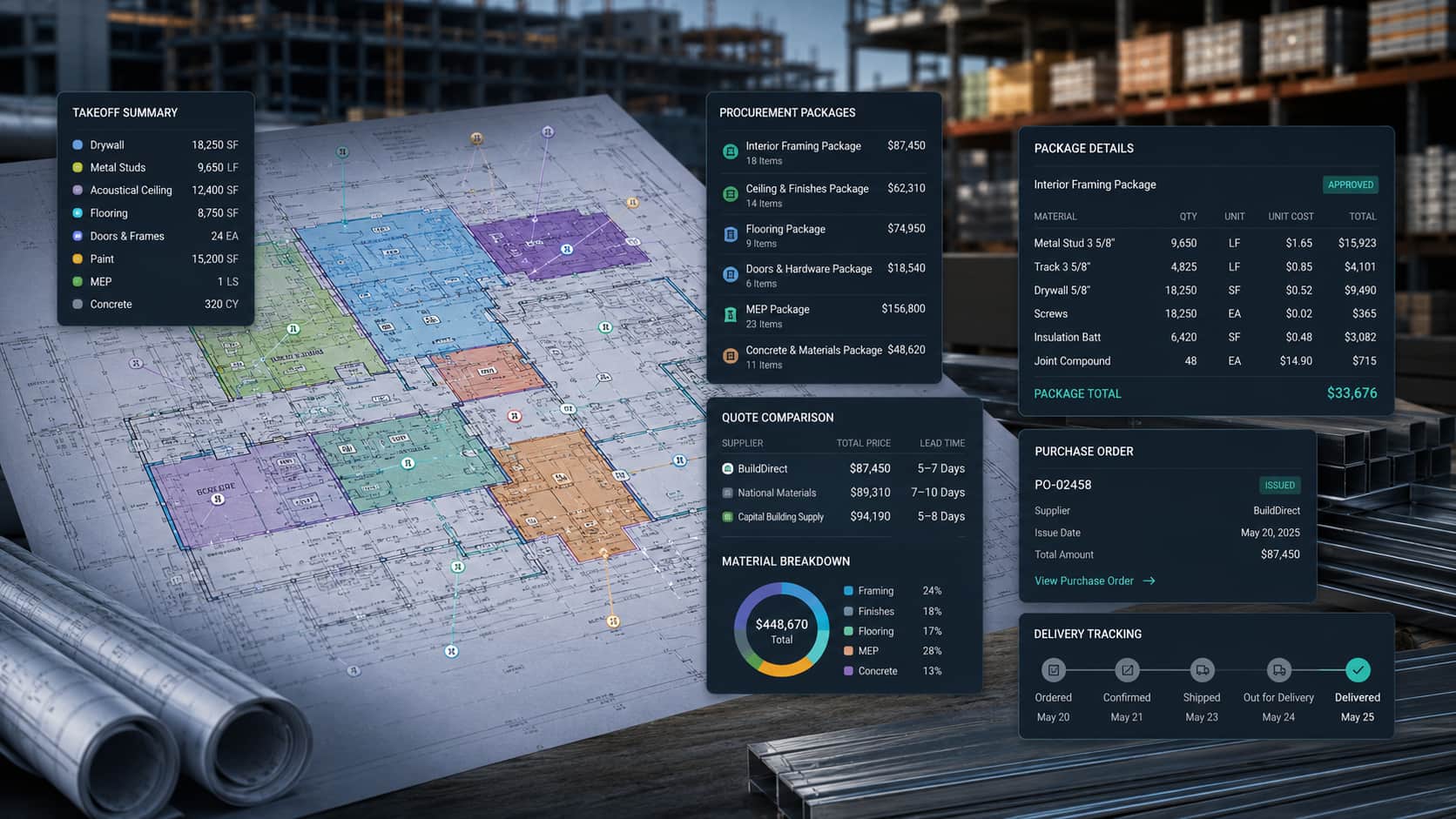
Quotr.ai is an AI-powered construction estimation, takeoff, and procurement platform built for subcontractors, general contractors, and developers. It attacks the two levers that move the most money — quantity and price — in one place.
Accurate AI takeoff to shrink over-ordering
Quotr’s AI takeoff performs automatic counting with per-item confidence scoring through a feature called Smart Matching, so you can see where the model is certain and where a human should verify. Every quantity carries a full audit trail. On clean vector PDFs, Quotr reaches 95–99% accuracy (Quotr internal benchmarking), with a human-in-the-loop workflow so estimators stay in control.
The point is not speed for its own sake. Tighter, defensible quantities mean you order what you install — directly attacking the over-ordering waste from Lever 1 and giving you numbers trustworthy enough to lock prices early under Lever 2. To understand the category, see what AI construction estimating software actually is.
Factory-direct procurement to strip out markup
This is where Lever 5 gets a real engine. Each stop in a traditional supply chain — distributor, regional warehouse, retail showroom — adds a margin, and by the time a product reaches your project you can be paying 30% to 50% more than factory cost.
The Quotr procurement layer removes those stops. It acts as a dedicated sourcing partner delivering factory-direct materials door-to-door on a DDP basis — one number that covers factory cost, export packing, ocean freight, US customs and duties, final-mile delivery, and certification documents (NFRC, CARB, cUPC). No surprise freight or duty invoices arriving after the fact.
Covered categories include:
- Windows and doors
- Garage doors
- Cabinetry and millwork
- Flooring (LVP, hardwood, tile)
- Bath and plumbing fixtures On average, projects sourcing through Quotr save 40–55% per project versus Bay Area dealers, sidestepping the 30–60% showroom and distributor markup. The sourcing network spans 50+ verified factories across Foshan and Guangdong, China, supplying US-certified materials.
Good to know: Quotr’s procurement layer is Bay Area–focused for sourcing relationships but delivers to any US port or jobsite. A typical quote turnaround is about 3–5 business days, and you can reach the team at procurement@quotr.ai.
Pricing
Quotr’s contractor plans are Solo at $299.90/mo, Team (2–6 seats) at $499.90/mo, and Enterprise (7+ seats) as custom pricing, with a 7-day trial. See full details for contractors.
Quotr is backed by Llama Ventures and headquartered in San Francisco.
Ready to see what factory-direct pricing and accurate takeoff do to your next buyout? Contact the Quotr team or email procurement@quotr.ai for a quote.
Frequently asked questions
Why are construction materials so expensive in 2026?
Construction materials are expensive in 2026 primarily because of tariffs and demand shocks. Steel, aluminum, and copper carry 50% tariffs, and copper is being absorbed by booming AI data center construction. Nonresidential input prices rose about 8.4% year over year by spring 2026, the steepest annual jump since the pandemic.
How can I reduce construction material costs?
To reduce construction material costs, attack both quantity and price. Improve takeoff accuracy to stop over-ordering, procure early to lock prices, value-engineer specs, substitute around tariffs, buy in bulk, cut change orders, and buy factory-direct to remove distributor markup. Accurate quantities make every other lever work.
How much do distributors mark up building materials?
Distributor and showroom markups on building materials commonly run 30% to 50% over factory cost, because each stop in the chain — distributor, warehouse, retail showroom — adds a margin. Buying factory-direct removes those layers; Quotr’s procurement layer averages 40–55% savings per project versus Bay Area dealers.
How much material ends up as waste on a jobsite?
Up to 30% of materials delivered to jobsites end up as waste, and over-ordering during takeoff and procurement is a leading cause. Contractors often budget 5% waste but run closer to 15%. Improving takeoff accuracy is the cheapest way to cut this, since avoided waste is pure margin recovery.
Should I buy construction materials early to lock in prices?
Yes — early procurement is one of the strongest levers in a rising market. Locking prices and reserving fabrication slots protects against tariff-driven escalation, especially on volatile, long-lead scopes like steel and glazing. Structural steel already runs 14–20 weeks, so early commitment reduces both price and schedule risk.
What is DDP in construction material procurement?
DDP (Delivered Duty Paid) means a single price covers factory cost, export packing, ocean freight, US customs and duties, final-mile delivery, and certification documents. It eliminates surprise freight and duty invoices. Quotr’s procurement layer delivers factory-direct materials door-to-door on a DDP basis, so your landed cost is one predictable number.
Can substituting materials lower construction costs?
Yes, engineered substitution can lower costs when it meets the same performance requirement. For example, AA-8000-series aluminum conductors can replace copper on larger feeders at a lower cost per amp, though larger sizes are required. Always confirm substitutions with your engineer and price them against current supplier quotes.
Related reading
- Construction procurement software: cutting material costs in 2026
- Tariff-aware estimating: building material escalation into every bid
- Tariff impact on 2026 construction costs: steel, aluminum, and copper
- From takeoff to buyout on one estimating and procurement platform
- Construction estimating mistakes to avoid
- What is AI construction estimating software?
References
- Associated General Contractors of America — Double-digit increases in aluminum, steel and copper costs drive up producer price indexes for construction materials
- Construction Dive — Construction prices spiked at ‘staggering’ rate to begin 2026
- ConstructionOwners.com — 50% steel, aluminum, copper tariffs raise construction costs in 2026
- ConstructionOwners.com — Construction material prices jump 12.6% in early 2026
- BigRentz — Construction waste statistics
- Terrapin Construction Group — Commercial construction material lead times 2026
- Monmouth Millwork — The architect’s guide to sourcing premium windows at manufacturer-direct prices
- Solutions GC — Construction material prices in 2026: cost-saving alternatives and procurement
Published on the Quotr.ai blog. Quotr.ai is an AI-powered construction estimation, takeoff, and procurement platform based in San Francisco.