Quotr.ai vs PlanSwift: Why Estimators Are Leaving Desktop Takeoff for AI + Procurement (2026)
Quotr.ai and PlanSwift are not the same kind of product, even though both are sold to construction estimators.
PlanSwift is a Windows desktop takeoff and estimating application, first released in 2005 and owned by ConstructConnect. It digitizes the point-and-click measurement of materials, areas, and lengths from PDF plans, then exports those quantities to Excel for pricing. The 2025 shift from perpetual licenses to a subscription model (roughly $1,749–$2,000/year as of mid-2026 — confirm current pricing on the vendor site), combined with persistent stability complaints on large plan sets, triggered a wave of estimators looking for modern alternatives.
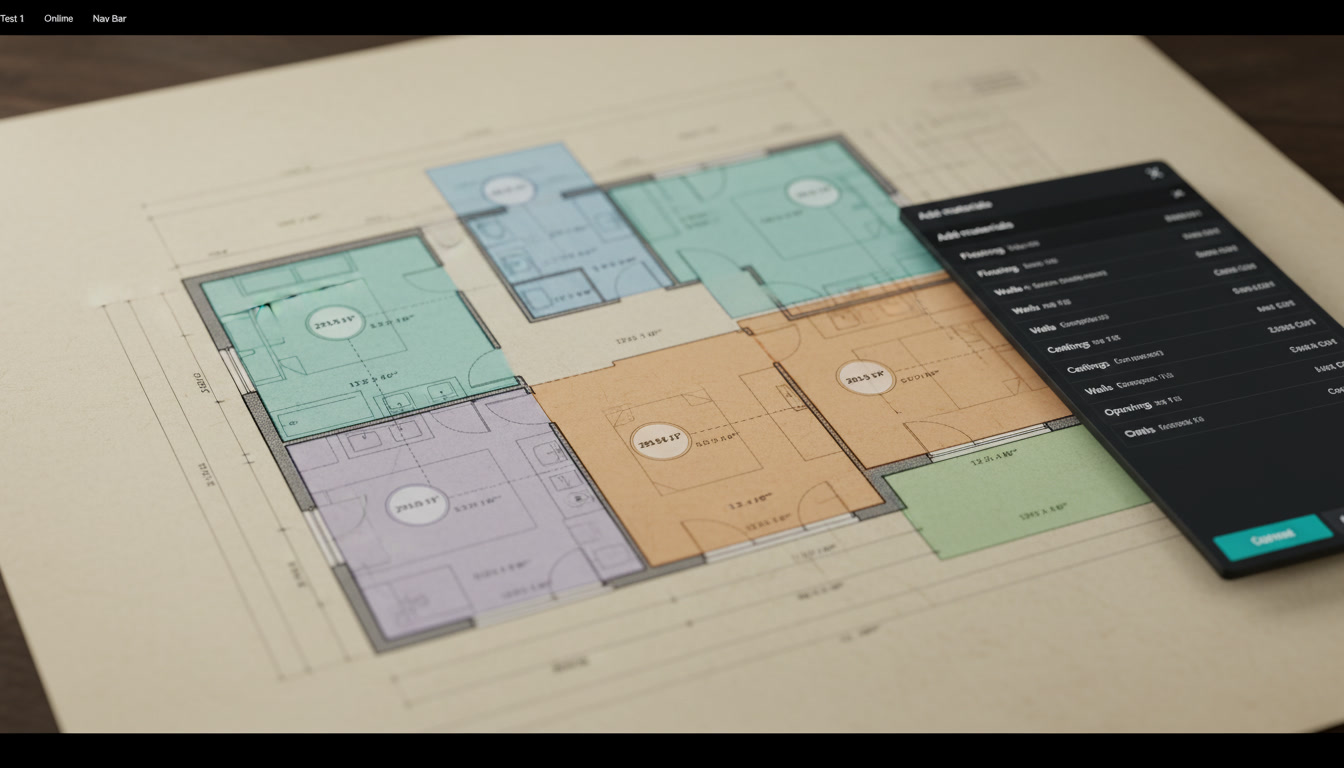
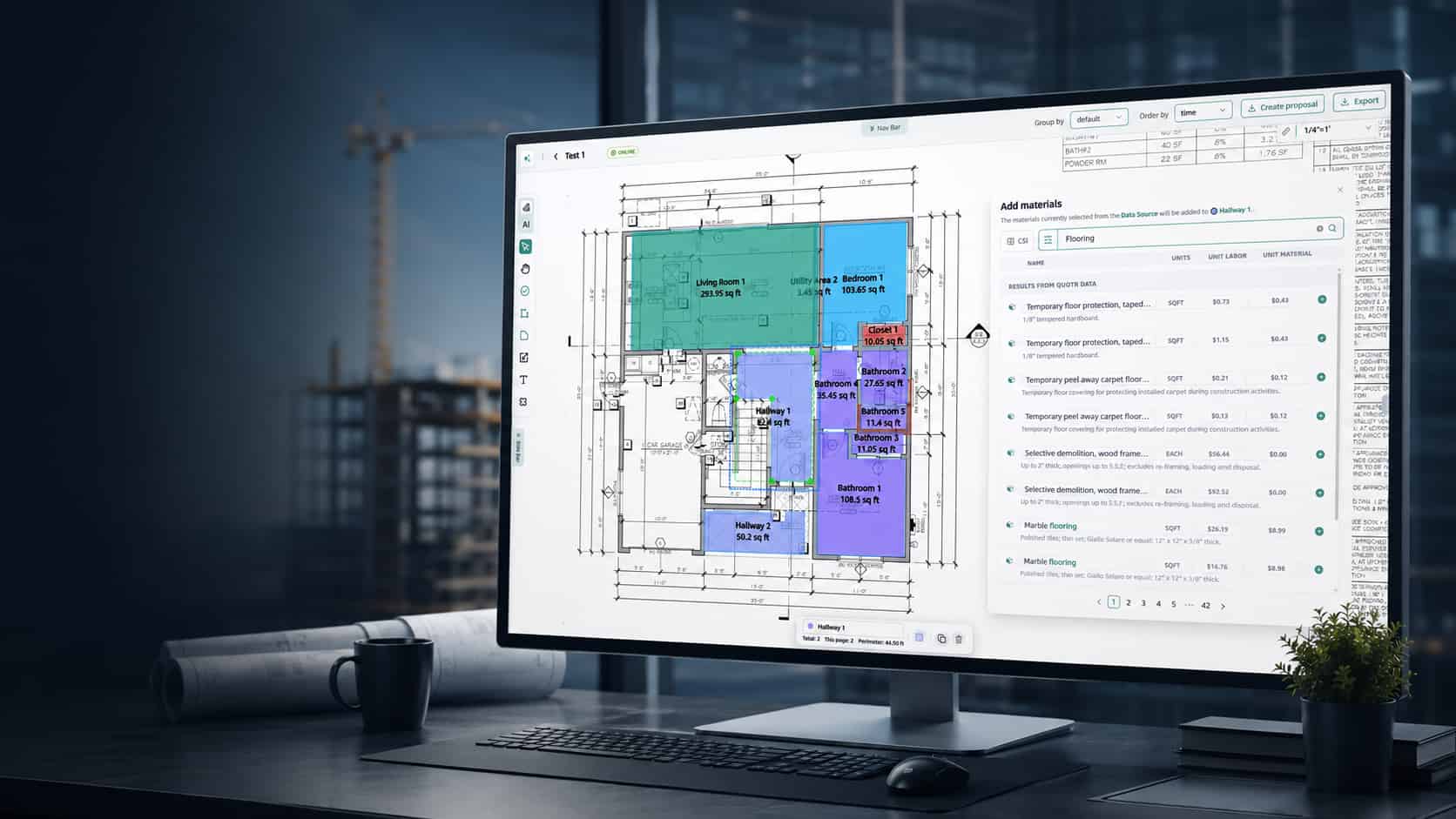
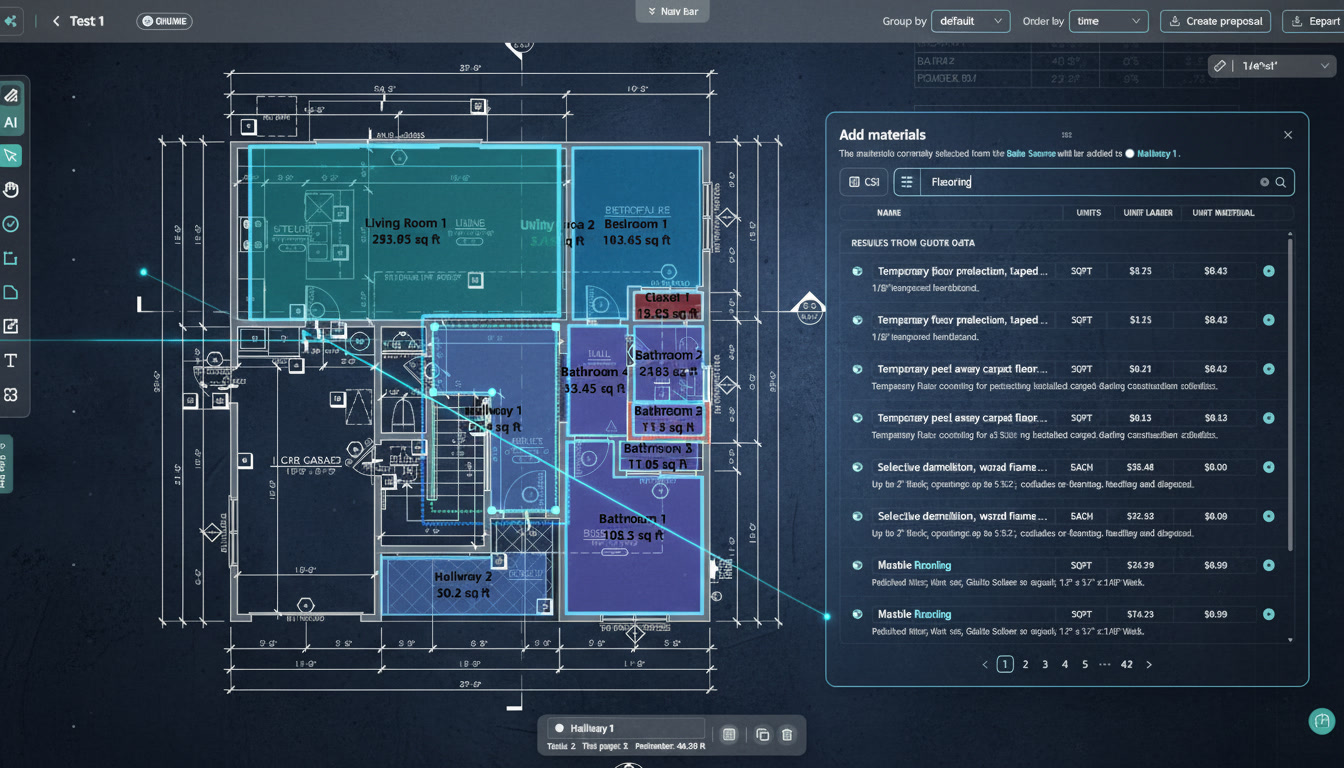
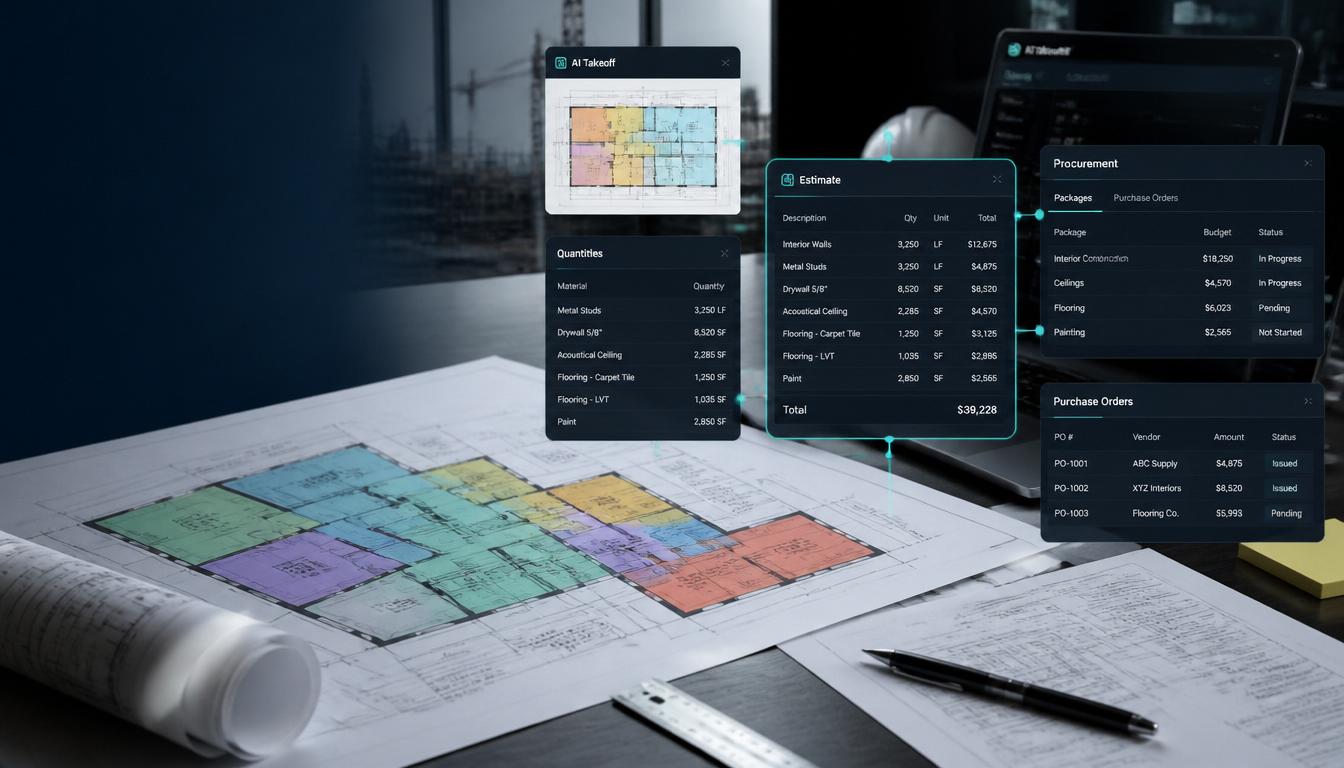
Quotr.ai is an AI-native, cloud-based platform that reads PDF blueprints, generates quantity takeoffs automatically, builds priced estimates, and connects directly to factory-direct procurement in the same session. Quotr comes in three parts: Quotr Software (AI takeoff, estimating, and bidding — including the AI agent that reads your plans), Quotr Service (done-for-you estimates and pro formas for developers and busy teams), and Quotr Procurement (factory-direct materials, delivered door-to-door).
The simple difference:
PlanSwift helps an estimator click faster on a Windows desktop.
Quotr.ai turns a PDF blueprint into a priced estimate and a procurement decision — without the click.
For contractors comparing these two in 2026, the question is not which one has a better point-and-click interface. It is whether you want a tool that automates the measurement, or a platform that closes the Takeoff-to-Transaction Gap between quantities and locked-in material pricing.
Quotr.ai vs PlanSwift at a Glance
| Category | Quotr.ai | PlanSwift |
|---|---|---|
| Best for | AI-driven takeoff → priced estimate → procurement | Manual digital takeoff on Windows desktop |
| Launched | 2024 | 2005 |
| Architecture | Cloud-native, browser-based, multi-device | Windows desktop application |
| AI takeoff | Native — AI reads plans and auto-identifies items | Takeoff Boost™ AI add-on (2024), layered on the desktop app |
| Engagement model | Self-serve software or done-for-you per-project service | Self-run software only |
| Pricing | Published tiers from $299.90/mo (see pricing) | ~$1,749–$2,000/yr; quote-based (confirm on vendor site) |
| Real-time collaboration | Yes — multi-user, browser-based | Typically shared drives / third-party tooling |
| Mac / iPad / mobile | Yes — any device with a browser | No — Windows desktop only |
| Stability on large plan sets | Cloud rendering, no local memory ceiling | Users report freezes/crashes/data loss on very large sets |
| Procurement | Core differentiator — factory-direct (door-to-door, DDP) in-session | Not in scope |
| Material price locking | In-session | Not in scope — relies on Excel exports |
| Revision handling | AI detects plan changes; review the deltas | Manual re-measurement |
| Free trial | 7 days, no credit card | 14 days (confirm on vendor site) |
New to construction takeoff? Read the foundational What Is a Construction Takeoff? guide first — it explains the workflow this comparison is built on.
What Is PlanSwift?
PlanSwift is one of the original digital takeoff tools for construction. Launched in 2005 and acquired by ConstructConnect, it replaced paper plans and measuring wheels with a Windows desktop application that lets an estimator draw lines, areas, and counts directly onto a PDF or image of a blueprint. It has a large installed base and is known inside the industry as the “old reliable” of takeoff software.
The product is built around a point-and-click model. Estimators import a PDF, calibrate the scale, then click linears, areas, counts, and volumes on the digitized plan. Drag-and-drop assemblies — pre-built combinations of materials, labor, and waste factors — price specific takeoff items. Quantities export to Microsoft Excel for downstream estimating.
In 2024, PlanSwift added an AI module called Takeoff Boost™ — Auto Takeoff (a full page of results in as little as 30 seconds), Auto Count, Auto Scale, and Auto Bookmark. It is a real AI feature set, but it is bolted onto the existing desktop product rather than rebuilt around it. That distinction — AI added to a desktop tool vs an AI-native platform — is the heart of this comparison.
Where PlanSwift still works well: estimators who know it inside-out and have built custom assembly libraries over years; shops with stable Windows infrastructure; small-volume bidders where speed isn’t the bottleneck; users on an existing perpetual license.
Where PlanSwift struggles: it is Windows-only (no Mac, iPad, or browser); the learning curve is steep (reviewers describe it as “huge”); large plan sets can freeze, crash, or lose data (on 32-bit Windows, RAM addressing is also capped); and cloud collaboration isn’t native.
What Is Quotr.ai?
Quotr.ai is an AI-native construction estimating platform that combines blueprint takeoff, priced estimates, bid preparation, and factory-direct procurement into a single cloud-based workflow.
Where PlanSwift gives you a digital ruler, Quotr.ai gives you an AI assistant. Upload a set of plans and Quotr’s model reads them, identifies common elements (walls, doors, windows, fixtures, symbols, linear runs), and produces a first-pass takeoff automatically. The estimator reviews, adjusts, and finalizes — editing a draft instead of starting from a blank page. On clean vector PDFs, Quotr’s AI takeoff runs at 95–99% accuracy on counts and areas (Quotr internal benchmarking), with per-item confidence scoring that flags where to review, and it stays human-in-the-loop.
The platform was built around a different premise: the takeoff is not the final deliverable. It is the first step in a chain that ends with materials purchased and a margin protected. With aluminum prices up 30.5%, steel 17%, and copper 11.8% in 2025 — and accelerating into 2026 — the time between measuring a quantity and locking in supplier pricing is now a financial risk, not a workflow inconvenience.
For a deeper view, see How AI Construction Estimating Works and How AI Construction Takeoff Works in 2026.
Two Ways to Work With Quotr.ai: Software or Done-for-You Service
This is a category PlanSwift doesn’t compete in at all. PlanSwift is software you install, learn, and run yourself. Full stop. Quotr.ai gives you two paths:
- Quotr Software (self-serve). Your team runs the platform like any SaaS tool — AI takeoff, priced estimates, bidding, and bid comparison in the browser, on any device.
- Quotr Service (done-for-you). Don’t want to run the software on a given bid? Quotr’s estimating desk processes your plans and delivers a finished estimate, priced at $0.25/sq ft under 50,000 sq ft and $0.10/sq ft over 50,000 sq ft. No software learning required. For contractors who bid constantly, the software subscription is the core tool. For those who only occasionally take on a large project, the per-project Service replaces the need to hire an outside estimating firm or add headcount — a single 40,000 sq ft project runs about $10,000, a fraction of a typical outsourced estimating engagement. Most legacy takeoff tools offer nothing like this.
Why Estimators Are Leaving PlanSwift in 2026
The PlanSwift exodus is documented in user reviews, peer comparisons, and analyst reports — and it accelerated after the 2025 licensing change.
1. The 2025 Perpetual License Reversal
For years PlanSwift’s selling point was a one-time license. In 2025 that changed, moving long-time users to an annual subscription (reported around $1,749/year) and triggering backlash. One verified Capterra review: “I paid thousands of dollars back in 2017 to buy perpetual licenses… in 2025, they told me they no longer support perpetual licenses and that we would have to pay an annual subscription fee to ‘support’ our license.” When a user is asked to repurchase software they already own, the switching math changes.
2. Stability on Large Plan Sets
Users report freezes, crashes, and data loss on large plan sets. A senior estimator review: “Constantly running out of memory, hour-long loading of zipped PS files, and loss of data” before switching to a cloud-based tool. For a GC on a 400-page set, that’s a deadline-night failure mode that costs bids.
3. No Native Cloud, Mobile, or Remote Access
PlanSwift is a Windows desktop application — no native Mac, iPad, or browser version. It offers cloud storage for files (up to 30 days), but cloud storage isn’t cloud computing: team collaboration depends on shared drives or third-party tooling, not native multi-user workflows.
4. Takeoff Without Procurement Is Half the Workflow
This is the deepest difference. PlanSwift does quantity takeoff and basic estimating; it does not do procurement, sourcing, or material-price locking. For a contractor bidding where aluminum is up 33% and steel 20.7% year-over-year as of January 2026, the absence of an integrated procurement workflow isn’t a missing feature — it’s the entire margin-protection problem.
The 2026 Material Pricing Context (Why This Comparison Matters Now)
PlanSwift was designed for a market where material pricing was relatively stable. That market doesn’t exist in 2026. Per the Associated General Contractors of America’s producer price index analysis:
- Aluminum mill shapes rose 30.5% from December 2024 to last December — the largest year-over-year increase since early 2022.
- Steel mill products, subject to a 50% tariff, jumped 17% in 2025.
- Copper and brass mill shapes climbed 11.8% last year. By February 2026, aluminum and steel indexes had risen 33.0% and 20.7% year-over-year. AGC Chief Economist Ken Simonson: “It is clear that the steep tariffs on imported metals and products are enabling U.S. sellers to push up costs… Construction costs are sure to rise further in 2026 as long as the current tariffs remain in place.”
The implication for the PlanSwift workflow: an estimator finishes a takeoff Monday → quantities export to Excel → supplier pricing is pulled from a sheet updated three weeks ago → the bid goes out Friday → the number is already stale. That stretch is the Takeoff-to-Transaction Gap. In a flat market it’s an inefficiency; in 2026’s tariff-driven environment it’s a structural margin risk. Quotr’s factory-direct procurement closes that gap in the same session. PlanSwift cannot, by design.
For deeper analysis, see Construction Cost Trends 2026 and Construction Costs Surged 12.6% in 2026.
Head-to-Head by Category
| Workflow Stage | Quotr.ai | PlanSwift |
|---|---|---|
| Upload PDF plans | Browser upload, no install | Local file open, desktop install |
| AI quantity recognition | Native, first-pass in minutes | Takeoff Boost™ add-on |
| Manual click takeoff | Available when needed | Core workflow |
| Priced estimate | Native, in-session | Manual via Excel |
| Bid prep & comparison | Native | Manual + external tools |
| Factory-direct procurement | Native (door-to-door, DDP) | Not supported |
| Material price locking | In-session | Not supported |
| Revisions/addenda | AI flags the deltas | Manual re-measurement |
| Collaboration | Real-time, multi-user | Shared drives only |
| Devices | Mac, Windows, iPad, browser | Windows desktop only |
| Accuracy | 95–99% on clean vector PDFs (internal benchmarking) + confidence scoring | As accurate as the estimator; drifts with fatigue on long sets |
| Learning curve | Hours | Weeks |
Pricing Comparison: The True Cost of Each Platform
Sticker price is the wrong lens. The right lens is total workflow cost — the software plus everything you still need around it.
| Quotr.ai | PlanSwift | |
|---|---|---|
| Entry (solo) | $299.90/month (annual billing lowers the effective rate) | ~$1,749–$2,000/yr; quote-based |
| Team (2–6 users) | $499.90/month | Per-user, quote-based |
| Enterprise (7+) | Custom | Quote-based |
| Per-project service | Yes — $0.10–$0.25 per sq ft | No |
| Price transparency | Published on the website | Redirects to sales |
| Free trial | 7 days, no credit card | 14 days (confirm on vendor site) |
| Included | Takeoff, priced estimates, bidding manager, bid comparison, assemblies | Takeoff only |
The PlanSwift sticker price isn’t the whole cost — it’s the license plus Excel for estimating, plus separate tools for procurement and sourcing, plus the time cost of moving data between systems, plus the margin risk of stale pricing. Quotr’s subscription bundles takeoff, estimating, bidding, and procurement into one price, and the per-project Service lets you scale with demand without a permanent commitment. See Quotr.ai pricing for current tiers.
Who Should Pick Which
Stay with PlanSwift if:
- You already own a perpetual license and aren’t being forced onto a subscription
- You have a small, stable team of Windows-based estimators who know it deeply
- Your bid volume is low enough that speed isn’t the bottleneck
- You’ve built a rich custom assembly library and migration cost is high Switch to Quotr.ai if:
- You bid more than a handful of projects a month and speed matters
- Anyone on your team uses a Mac or iPad, or works across locations
- You’re tired of re-keying takeoff quantities into a separate estimating tool
- You bid in trades exposed to steel, aluminum, copper, or lumber volatility and want pricing locked during the takeoff
- You want AI to do the repetitive counting so estimators focus on strategy
- You occasionally need to outsource a big bid and prefer a predictable per-sq-ft price
- You’re an architect, developer, or contractor who wants validated pricing without becoming a procurement specialist Evaluate both if:
- You’re a mid-sized GC or sub doing 5–20 bids a month with a mix of experienced and new estimators. Start Quotr’s 7-day free trial and run one live bid through each tool — compare hours spent and the accuracy of the final numbers.
Make the switch to Quotr.ai. Start free — no card, bring your hardest plan set and run a real takeoff → estimate → procurement in one session. Make the switch to Quotr.ai → · talk to our team
For an applied view, see How RL Electric Cut Estimating Time with AI-Powered Takeoffs and Blueprint to Priced Estimate Workflow.
Frequently Asked Questions
Is PlanSwift better than Quotr.ai?
For a narrow profile — a solo estimator who already owns a perpetual PlanSwift license, only uses Windows, and bids at low volume — PlanSwift can still be the right choice. For most contractors in 2026, Quotr.ai is faster, works on any device, and covers more of the bid workflow, including procurement.
Does PlanSwift have AI?
Yes — PlanSwift added an AI module called Takeoff Boost™ in 2024 (Auto Takeoff, Auto Count, Auto Scale), with Auto Takeoff producing a full page of results in as little as 30 seconds. The difference is architectural: PlanSwift’s AI is an add-on to a desktop product, while Quotr.ai is AI-native — the AI is the foundation, not a feature.
How much does Quotr.ai cost compared to PlanSwift?
Quotr’s solo plan is $299.90/month; Team (2–6 users) is $499.90/month; Enterprise (7+) is custom, all with a 7-day free trial. PlanSwift’s pricing isn’t published but historically starts around $1,749–$2,000/year, plus a separate estimating tool. On an all-in basis — takeoff plus estimating plus bidding plus procurement — Quotr is generally more cost-effective for teams currently running multiple tools.
Can Quotr.ai replace both PlanSwift and my estimating software?
Yes. Quotr covers takeoff, estimates, bidding management, and bid comparison in one platform — typically two or three separate tools in a legacy workflow — and adds factory-direct procurement on top.
Can I have Quotr.ai do the takeoff for me instead of running the software?
Yes. Quotr Service processes your plans and delivers a finished estimate, priced at $0.25/sq ft under 50,000 sq ft and $0.10/sq ft over 50,000 sq ft. PlanSwift offers no comparable done-for-you service.
Can PlanSwift run on Mac?
No. PlanSwift is Windows-only, with no native Mac or mobile version. Quotr.ai runs in any modern browser on any operating system.
Does PlanSwift connect to procurement?
No. PlanSwift exports quantities to Excel and stops there; procurement and material-price locking aren’t part of the product. Quotr’s factory-direct procurement is built into the same session as the takeoff.
How accurate is Quotr.ai’s AI compared to a human using PlanSwift?
Manual takeoff is only as accurate as the estimator, and accuracy drifts with fatigue on long sets. Quotr’s AI runs at 95–99% accuracy on counts and areas on clean vector PDFs (Quotr internal benchmarking), with per-item confidence scores and human-in-the-loop review on edge cases. See Is AI Takeoff Actually Accurate Yet?.
What is the Takeoff-to-Transaction Gap?
It’s the time between completing a takeoff and locking in actual material pricing. In stable markets it’s an inefficiency; in 2026’s tariff-driven environment — with aluminum up 30.5% year-over-year — it’s a margin risk. Quotr closes it in-session; PlanSwift can’t, by design. Read The Takeoff-to-Transaction Gap.
How long does it take to switch from PlanSwift to Quotr.ai?
Days, not weeks — nothing to install. Rebuild assemblies quickly or start fresh and let the AI populate quantities from day one. Onboarding is designed to get an estimator to a first AI takeoff the same day.
Can I try Quotr.ai before switching?
Yes — a 7-day free trial on every software plan, no credit card required. Start at quotr.ai.
The Bottom Line
PlanSwift is a competent desktop takeoff tool that added an AI add-on and moved to a subscription. For a single-estimator Windows shop on small plan sets, it still works.
Quotr.ai is built for 2026’s market: AI-native takeoff, priced estimates, bidding, and factory-direct procurement in one browser-based platform — plus a done-for-you Service for the bids you’d rather hand off. When steel is up 17% year-over-year, tariffs reshape every bid, and your team needs Mac and mobile, the gap between PlanSwift’s architecture and your business’s reality keeps widening.
If you’re not locked in by an existing license, start with Quotr’s 7-day free trial — no credit card, so the downside is zero.
Make the switch to Quotr.ai → · see it on your own plans
Published on the Quotr.ai blog. Quotr.ai is an AI-powered construction estimation, takeoff, and procurement platform based in San Francisco.