The State of AI in Preconstruction 2026: Adoption, ROI, and What Top GCs Are Learning
AI in preconstruction has moved past the “interesting demo” phase.
In 2026, the question for contractors is no longer whether AI can read drawings, summarize specs, or accelerate takeoffs. The real question is whether AI can help preconstruction teams bid faster, protect margins, reduce rework, and make better decisions before work ever reaches the field.
That shift matters because preconstruction is where project risk becomes financial reality.
A missed scope item, outdated drawing, bad assumption, incomplete subcontractor quote, or slow estimate review can turn into margin erosion months later.
For general contractors, specialty contractors, developers, and preconstruction teams, AI is becoming most useful when it sits inside the actual workflow:
- Drawing review
- Quantity takeoff
- Scope comparison
- Estimating
- Pricing
- Procurement
- Proposal generation
- Bid management
That is where platforms like Quotr.ai are positioned: not as generic AI chatbots, but as construction-specific software that helps teams move from drawings to priced estimates with less manual friction.
Why AI in Preconstruction Is Accelerating in 2026
The broader construction market is under pressure from labor constraints, cost volatility, data center demand, housing demand, tariff exposure, and compressed schedules.
Deloitte’s 2026 engineering and construction outlook highlights how AI, cloud demand, and data center growth are reshaping capital projects, especially as infrastructure needs expand around power and advanced facilities. (deloitte.com)
At the same time, ENR’s contractor rankings show how large contractors are scaling in an environment where speed and coordination matter. ENR’s 2025 Top 400 preview listed Turner, Bechtel, and Kiewit as the top three contractors by 2024 revenue, while 2026 reporting based on ENR data showed Turner, Bechtel, STO Building Group, Kiewit, Whiting-Turner, MasTec, DPR, HITT, Fluor, and Mortenson among the top commercial contractors by 2025 revenue. (enr.com) (constructiondive.com)
The lesson is simple: the largest contractors are not adopting AI because it sounds futuristic.
They are adopting AI because the volume, complexity, and speed of modern preconstruction work are outgrowing manual workflows.
Preconstruction teams are being asked to answer questions like:
- How fast can we turn a new drawing set into a reliable quantity takeoff?
- Which scope gaps could become change orders later?
- Which materials are exposed to pricing volatility?
- Which assumptions are buried inside the estimate?
- Can we compare drawing revisions without starting over?
- Can we move from takeoff to proposal faster without losing estimator control?
- Can our estimate connect to procurement before buyout risk appears?
AI becomes valuable when it helps answer those questions earlier.
The 2026 Adoption Pattern: From AI Experiments to Workflow AI
In 2023 and 2024, many construction companies tested AI through pilots: internal chatbots, document summarization, safety assistants, or basic automation.
By 2026, adoption is becoming more practical.
Contractors are learning that AI produces value when it is tied to a specific workflow, not when it is treated as a general productivity toy.
That is especially true in preconstruction.
Generic AI can summarize text. Construction AI needs to understand plans, assemblies, specs, bid packages, alternates, exclusions, units, quantities, labor assumptions, vendor quotes, and pricing logic.
This is why AI adoption in preconstruction is separating into three categories.
1. Document Intelligence
AI helps teams search, summarize, and compare specifications, addenda, RFIs, bid documents, exclusions, and proposal requirements.
This matters because a preconstruction team is rarely working from one clean file. They are working across drawings, specifications, revisions, addenda, subcontractor quotes, supplier updates, and owner requirements.
2. Drawing Intelligence
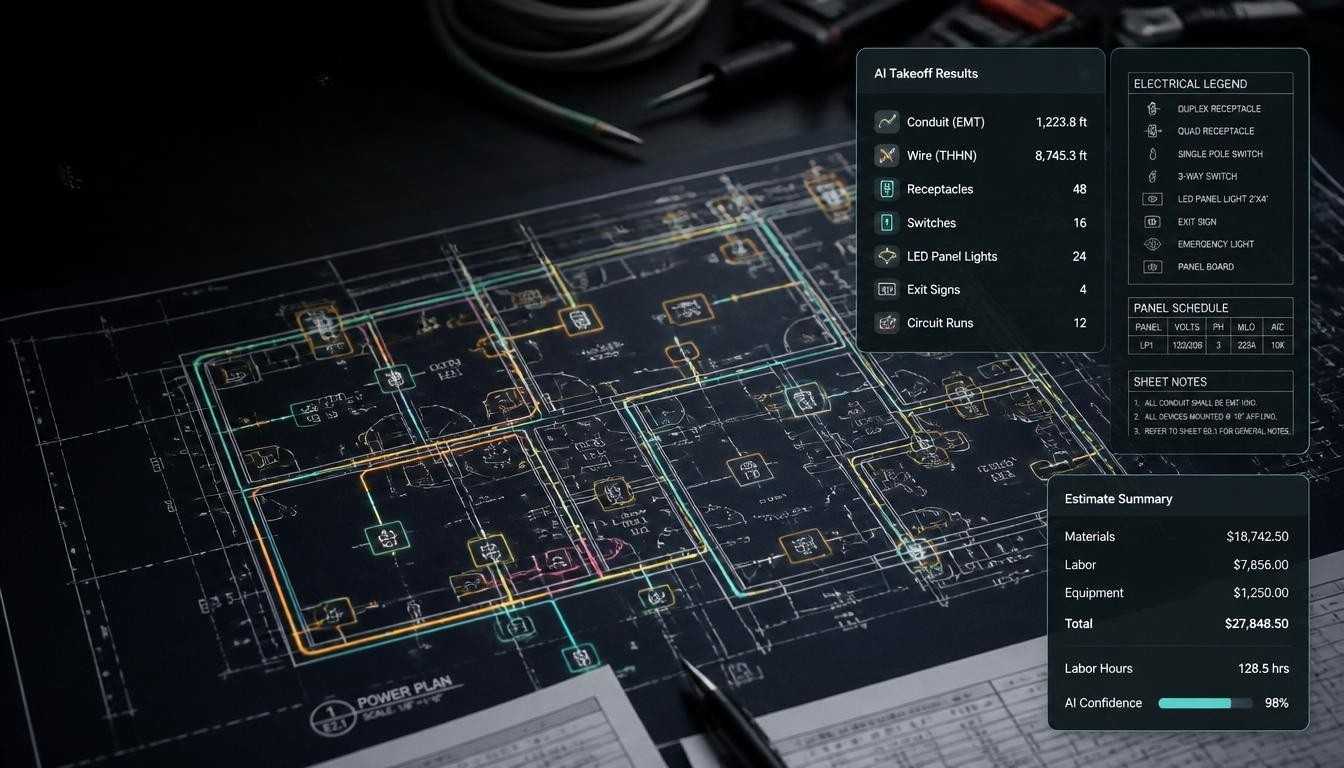
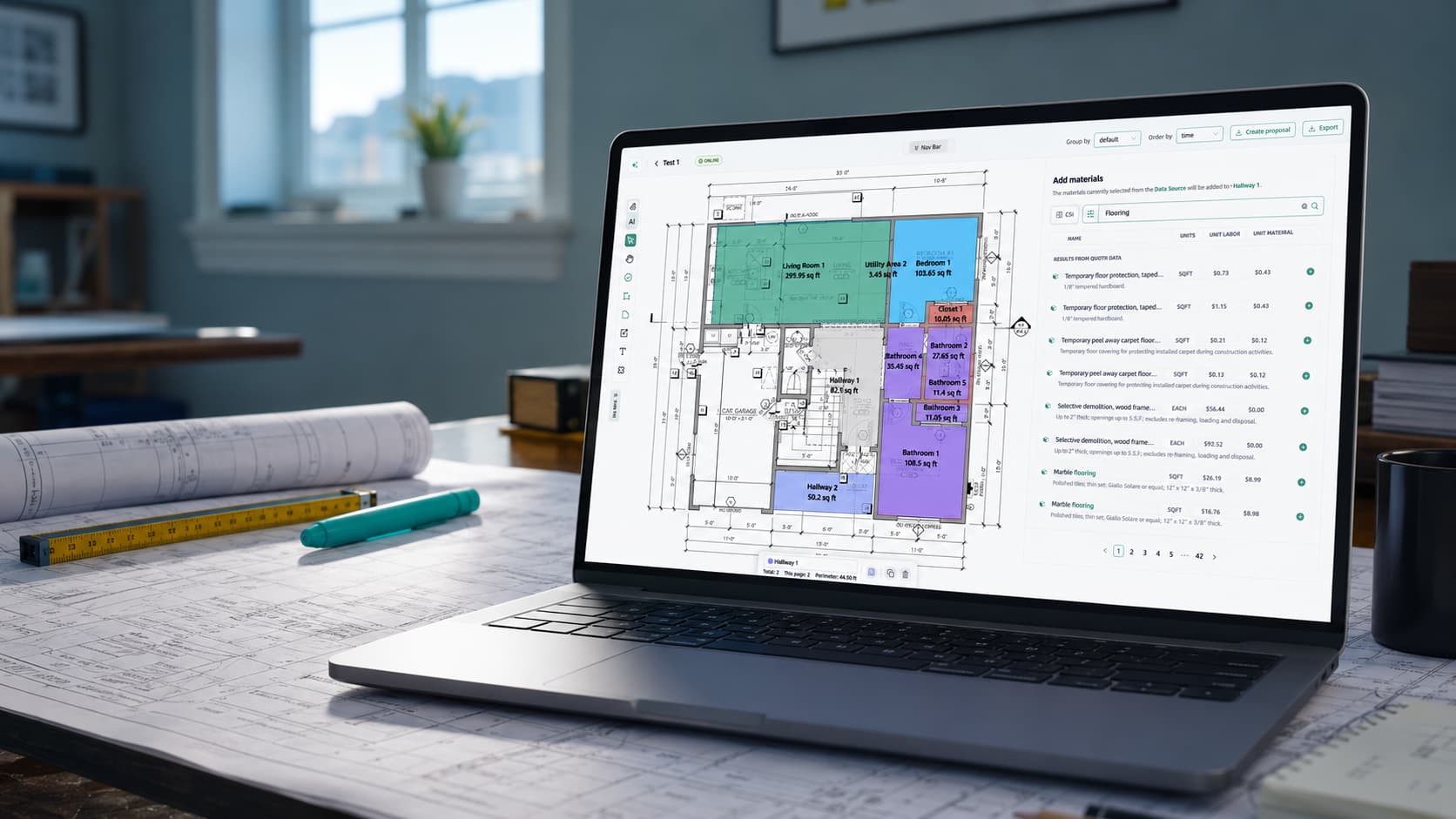
AI assists with plan reading, measurement, object recognition, quantity extraction, drawing revision review, and plan-based Q&A.
This is the area most people think of first when they ask about AI construction takeoff.
For example, a contractor may ask:
- Can AI count fixtures?
- Can AI measure areas?
- Can AI identify symbols?
- Can AI compare drawing versions?
- Can AI help me ask questions about a blueprint?
Quotr.ai already addresses this workflow in guides like how AI construction takeoff works in 2026 and AI that reads construction drawings.
3. Estimate Intelligence
AI helps connect quantities to pricing, labor, assemblies, proposal language, procurement, and risk review.
This is where the highest ROI begins.
A contractor does not just need an AI tool that “reads a blueprint.” They need a workflow that helps them understand what changed, what needs to be counted, what needs to be priced, what needs to be excluded, and what needs to be purchased.
That is why the future of AI in preconstruction is not just AI takeoff.
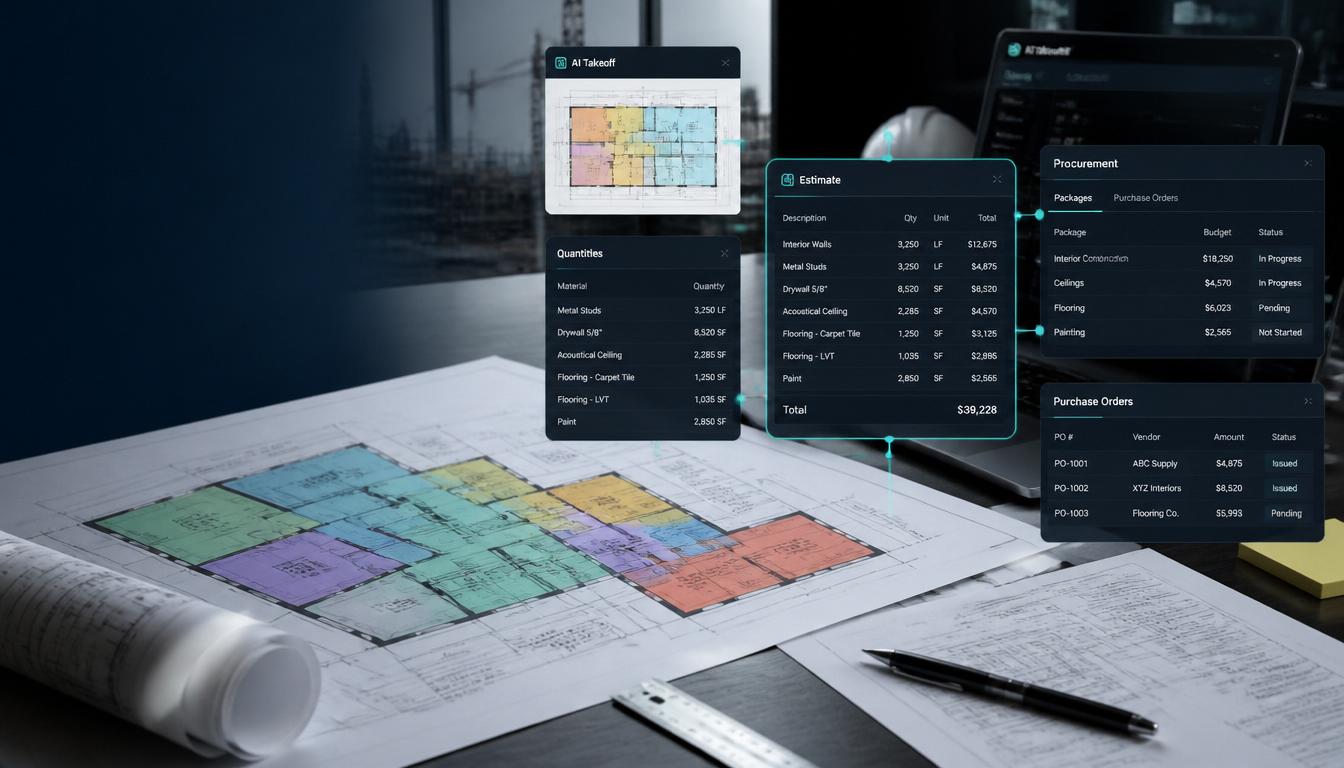
It is AI-assisted estimating connected to procurement.
Where AI Creates ROI in Preconstruction
AI ROI in preconstruction is not only about saving time.
Time savings matter, but the bigger value is decision quality.
A faster takeoff is useful. A faster takeoff that still needs to be manually checked from scratch is less useful. A faster takeoff that helps estimators validate assumptions, compare scope, generate cleaner proposals, and connect material quantities to procurement is much more valuable.
In 2026, the ROI case for AI in preconstruction usually falls into five buckets.
1. Faster Quantity Takeoff
Manual takeoff is still one of the most time-consuming steps in preconstruction.
Estimators spend hours measuring linear footage, counting devices, calculating areas, reviewing sheets, and checking whether drawings align with the scope.
AI-assisted takeoff can reduce repetitive measurement work and help teams move faster from plans to quantities.
This does not mean estimators disappear.
It means estimators spend less time clicking every object and more time reviewing whether the quantity, scope, and assumptions make sense.
For specialty contractors, this can be especially powerful. Electrical, mechanical, plumbing, drywall, concrete, roofing, framing, and other trades all depend on fast, accurate quantity extraction.
For a deeper workflow breakdown, see Quotr.ai’s guide on construction takeoff and AI construction estimating software.
2. Better Estimate Review
The most expensive mistakes in preconstruction are often not obvious measurement errors.
They are missing assumptions.
An estimator might count devices correctly but miss an addendum. A team might price conduit but overlook access constraints. A bid may include the base scope but fail to flag an alternate, exclusion, allowance, or long-lead material risk.
AI can help by reviewing documents against the estimate and surfacing gaps for human review.
The point is not to let AI approve the estimate.
The point is to create another layer of review before the bid goes out.
This is where construction-specific AI matters. A generic chatbot may summarize a spec section. A preconstruction AI workflow should help connect that spec section to the bid package, estimate structure, and proposal.
3. Drawing Revision Comparison
Preconstruction teams often receive multiple drawing versions before bid day.
Every revision creates risk.
What changed? Which sheets were updated? Did the change affect quantities? Did it affect pricing? Did the team already account for it? Is the subcontractor pricing based on the latest drawings?
AI can help compare versions and identify what deserves review.
This is one of the biggest hidden ROI areas because revision tracking consumes estimator time and creates downstream risk.
If a drawing change is missed, the cost may not show up until construction is underway.
4. Faster Proposal Generation
Many contractors still separate estimating from proposal writing.
The estimator builds the estimate, then someone else turns it into a client-facing proposal with scope, exclusions, alternates, clarifications, pricing, and schedule notes.
That handoff creates delay and inconsistency.
AI can help convert structured estimate data into proposal language faster. Quotr.ai already addresses this workflow in AI construction proposals: from takeoff to proposal.
The future is not a black-box proposal writer.
The future is a workflow where the estimate, assumptions, exclusions, and proposal are connected.
5. Procurement and Pricing Intelligence
Preconstruction is increasingly connected to procurement.
A quantity takeoff is not the end of the workflow.
It is the beginning of pricing, sourcing, quote comparison, vendor management, material planning, and risk management.
This is why Quotr.ai’s positioning around the “takeoff-to-transaction gap” matters. Contractors do not only need quantities. They need a path from quantities to pricing decisions. See Quotr’s article on the takeoff-to-transaction gap.
In 2026, AI ROI will increasingly come from connecting preconstruction data to procurement actions.
That is one of Quotr.ai’s strongest wedges: helping teams move from plans to estimates to purchasing decisions faster.
What 5 ENR Top 400 GCs Are Learning
The most important lesson from major contractors is that AI adoption is not one-size-fits-all.
Each company applies AI through its own operating model, project mix, risk tolerance, delivery methods, technology stack, and preconstruction process.
Below are five patterns visible from public signals across ENR Top 400-level contractors.
1. Turner Construction: Scale Requires Standardized Intelligence
Turner remains one of the largest contractors in the United States. ENR’s 2025 preview ranked Turner No. 1, and 2026 reporting based on ENR data again showed Turner at the top with $28.3 billion in 2025 revenue. (enr.com) (constructiondive.com)
The lesson for preconstruction teams is that scale creates a data problem.
Large contractors operate across regions, project types, teams, owners, delivery methods, and subcontractor networks. At that scale, AI is not just about making one estimator faster. It is about standardizing how teams review information, capture assumptions, and reduce variability.
For preconstruction, this means AI tools need to support repeatable workflows:
- Standard takeoff procedures
- Consistent estimate review
- Structured scope comparison
- Repeatable proposal language
- Better knowledge transfer across teams
- More reliable bid-day decision-making
For smaller contractors, the lesson is still relevant.
Even if your company is not operating at Turner’s scale, your estimating process still needs consistency.
A one-person estimating shop has a scale problem too: the owner, estimator, and proposal writer are often the same person.
2. Bechtel: Complex Projects Need Better Risk Visibility
Bechtel ranked No. 2 in ENR’s 2025 Top 400 preview and was also listed No. 2 in 2026 commercial contractor reporting based on ENR data. (enr.com) (constructiondive.com)
Bechtel’s project environment is highly complex: infrastructure, energy, industrial, and large capital projects.
In that context, AI’s value is not just speed.
It is risk visibility.
For preconstruction, this matters because complex projects often involve:
- Large document sets
- Multiple disciplines
- Long procurement timelines
- Interdependent scopes
- High consequences for missing assumptions
- Heavy coordination between engineering, estimating, procurement, and construction teams
AI can help teams identify inconsistencies, summarize large document sets, and review scope more systematically.
But the estimator and project team still need to control judgment.
The practical lesson: AI should reduce blind spots, not replace accountability.
3. Kiewit: AI Must Fit Engineering-Heavy Workflows
Kiewit was listed as one of the top contractors in ENR’s 2025 preview and remained in the top five in 2026 reporting based on ENR data. (enr.com) (constructiondive.com)
For engineering-heavy builders, AI has to work inside technical workflows.
It cannot be limited to generic summaries or simple chat interfaces.
Preconstruction teams working on infrastructure, power, transportation, industrial, or heavy civil projects need tools that respect how estimates are built:
- Units
- Assemblies
- Crews
- Production rates
- Equipment
- Sequencing
- Constructability
- Risk assumptions
The lesson for Quotr.ai’s audience is clear: AI should not flatten construction knowledge.
It should enhance it.
A strong AI estimating workflow should let the estimator keep control while using automation to accelerate repetitive work.
4. DPR Construction: Technical Projects Reward Integrated Preconstruction
DPR was listed in ENR-related reporting as a top contractor, and public DPR materials emphasize complex technical projects, advanced technology, data centers, supply chain coordination, prefabrication, and early planning.
DPR’s Q1 2026 market conditions report specifically discusses speed to market, data center demand, market volatility, and the importance of supply chain performance. (chubb.com) (dpr.com)
This is one of the clearest signals for preconstruction.
On complex technical projects, early decisions matter more.
The cost of slow coordination is high. The cost of poor quantity visibility is high. The cost of late procurement is high.
AI becomes valuable when it connects:
- Drawing review
- Quantity takeoff
- Scope validation
- Procurement planning
- Schedule risk
- Proposal clarity
For contractors working in data centers, life sciences, manufacturing, healthcare, multifamily, or advanced facilities, AI should not be treated as a standalone estimating feature.
It should support integrated preconstruction.
5. Skanska: AI Adoption Works Best When It Starts with Practical Use Cases
Skanska has publicly discussed AI through practical construction use cases, including internal AI tools, safety knowledge access, reality capture, drones, photogrammetry, LiDAR, and AI-enabled field intelligence.
Skanska has also emphasized pragmatic implementation of AI to improve productivity, reduce costs, and improve access to knowledge. (usa.skanska.com) (usa.skanska.com)
The lesson is important: successful AI adoption often starts with a narrow, useful workflow.
For preconstruction teams, that might mean:
- Automating fixture counts
- Summarizing drawing notes
- Reviewing spec sections
- Comparing drawing revisions
- Generating proposal drafts
- Checking scope gaps
- Flagging missing assumptions
AI adoption does not need to start with a company-wide transformation.
It can start with one workflow where the pain is obvious and the ROI is measurable.
What This Means for Mid-Market Contractors
The ENR Top 400 contractors have large teams, large data sets, and major technology budgets.
But their lessons apply to smaller and mid-market contractors too.
In fact, mid-market contractors may benefit even faster because their teams often have fewer estimators, less admin support, and tighter bid deadlines.
For a smaller contractor, AI in preconstruction can mean:
- Bidding more jobs without hiring more estimators
- Reducing late nights before bid day
- Reviewing drawings faster
- Producing cleaner proposals
- Reducing missed scope
- Improving client confidence
- Turning estimates around faster than competitors
- Connecting takeoff quantities to pricing and procurement earlier
This is where Quotr.ai’s value becomes practical.
A contractor does not need an enterprise innovation lab to use AI in preconstruction.
They need a workflow that helps them move from plan review to takeoff to estimate to proposal.
Start with Quotr.ai’s AI software demo or explore how Quotr.ai Software helps the estimating workflow.
The Biggest Mistake: Treating AI as a Replacement for Estimators
The wrong way to think about AI is:
“Can AI replace my estimator?”
The better question is:
“Can AI help my estimator produce better work faster?”
Estimators are not just measurement operators.
They understand risk, constructability, labor conditions, vendor behavior, project history, market pricing, and client expectations.
AI can help with the repetitive and review-heavy parts of the workflow:
- Counting
- Measuring
- Searching
- Summarizing
- Comparing
- Drafting
- Flagging
- Organizing
But humans still need to decide:
- Whether the quantity makes sense
- Whether the scope is complete
- Whether the labor assumption is realistic
- Whether the bid is too risky
- Whether the proposal protects the contractor
- Whether the price can win without destroying margin
The winning model is estimator-led AI.
How to Evaluate AI Preconstruction Software in 2026
When comparing AI estimating or takeoff tools, contractors should avoid being distracted by generic AI language.
The best question is not:
“Does it use AI?”
The better question is:
“Where does it improve the workflow?”
Use this checklist.
1. Can it read the kinds of drawings you actually bid?
A tool that works on clean demo drawings may struggle with real project documents.
Test it with your own PDFs, addenda, plan sets, and messy drawing packages.
2. Does it support estimator review?
AI output should be easy to inspect, correct, and validate.
If the estimator cannot trust or verify the output, the workflow breaks.
3. Does it connect takeoff to pricing?
Quantities are useful, but priced estimates are what win work.
Look for workflows that help connect quantities to cost items, assemblies, labor, and proposal outputs.
4. Does it reduce rework when drawings change?
Revision comparison is one of the biggest sources of preconstruction friction.
AI should help identify what changed and what needs review.
5. Does it help produce client-ready outputs?
The best preconstruction AI does not stop at measurement.
It helps teams create estimates, proposals, clarifications, and bid packages faster.
6. Does it connect estimating to procurement?
This is where many estimating tools stop too early.
A modern AI preconstruction platform should help contractors move from quantity extraction to material pricing, quote comparison, and procurement decisions.
That is the gap Quotr.ai is built to close.
For more detail, see Quotr.ai’s AI construction estimating software buyer’s guide and Quotr vs. traditional estimating.
The 2026 Preconstruction AI Maturity Model
Contractors are moving through four levels of AI maturity.
Level 1: Manual Workflow
The team uses PDFs, spreadsheets, legacy takeoff tools, email, and manual proposal writing.
Work gets done, but speed and consistency depend heavily on individual estimator bandwidth.
Level 2: Point Automation
The team uses AI for isolated tasks: a drawing count here, a document summary there, a proposal draft somewhere else.
This saves time but does not fully connect the workflow.
Level 3: Connected Preconstruction Workflow
Takeoff, estimating, proposal creation, and bid management begin to connect.
AI supports the estimator across the full workflow instead of acting as a separate tool.
Level 4: Preconstruction Intelligence Layer
The company builds a structured system where historical estimates, drawing data, pricing, procurement, proposals, and project outcomes inform future bids.
Most contractors in 2026 are somewhere between Level 1 and Level 3.
The opportunity is to move from disconnected automation to connected workflow intelligence.
Why Quotr.ai Fits the 2026 AI Preconstruction Shift
Quotr.ai is built around a practical preconstruction problem: contractors need to move from drawings to estimates and proposals faster.
That is different from generic AI.
A generic AI assistant can answer questions. Quotr.ai is designed for construction workflows where the output needs to become part of a bid, estimate, proposal, or procurement decision.
Quotr.ai’s content library already covers the core workflow:
- How AI construction estimating works
- How AI construction takeoff works in 2026
- AI that reads construction drawings
- Blueprint to priced estimate workflow
- How to manage bids in Quotr AI
- How to export a proposal in Quotr AI
That internal link structure matters for both readers and AI search.
It shows that Quotr.ai is not writing about AI construction in the abstract.
It is building an ecosystem around the actual preconstruction workflow.
Final Takeaway
The state of AI in preconstruction in 2026 is not hype-free, but it is becoming more practical.
The biggest contractors are learning that AI only works when it is tied to specific workflows, trusted data, estimator review, and measurable ROI.
The same lesson applies to every contractor.
AI will not replace preconstruction judgment.
It will make strong preconstruction teams faster, more consistent, and better prepared.
The contractors that win will not be the ones that use AI for the sake of using AI.
They will be the ones that use AI to improve the path from drawings to decisions.
For teams ready to modernize that workflow, Quotr.ai helps contractors turn construction drawings into faster takeoffs, clearer estimates, stronger proposals, and better procurement decisions.